0
0

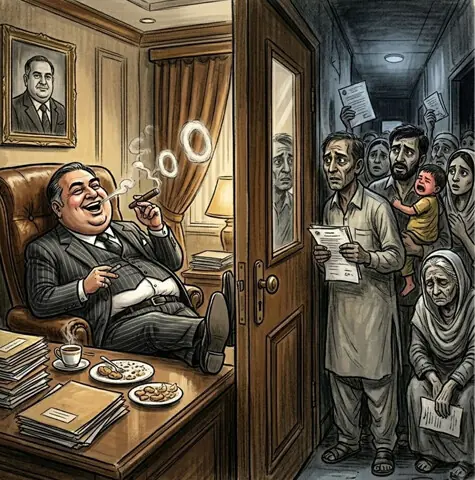
THE Great Britain had not entered the subcontinent to serve its people or to introduce democracy through persuasion, as is sometimes claimed. Its primary objective was economic and political control. The administrative machinery it built was, therefore, not designed to serve citizens, but to govern them. Civil servants were trained as authority figures — officers who expected compliance — rather than as facilitators of public welfare.
Although Britain left the subcontinent nearly eight decades ago, elements of that administrative culture continue to shape governance in Pakistan and India. In many instances, the relationship between the state and the citizen still appears inverted: instead of public officials serving the people, citizens often feel compelled to navigate rigid systems that demand patience, persistence and deference. Indeed, there are decent officials as well, but they are considered misfit in the system, they are denied promotions and sometimes even face demotions.
To understand what a people-centred system can look like, one may consider the example of the Netherlands. Despite its relatively small population of around 18 million, it is widely regarded as one of the world’s strongest welfare states. What stands out is not just policy, but attitude. In Dutch public offices, whether in person or over the phone, officials tend to engage with applicants not as distant authorities, but as service providers. Rather than relying on delays or procedural barriers, they often aim at resolving issues promptly.
At the end of an interaction, it is common for an officer to ask, Heeft u nog een vraag? (Do you have another question?) This simple gesture signals something deeper: a commitment to ensuring that the citizen leaves satisfied and informed. The interaction typically concludes with a courteous farewell. This is what public service, in its true sense, looks like — not merely the execution of rules, but the delivery of assistance with respect and efficiency. The contrast highlights an important distinction. A public servant is someone whose authority exists to assist, guide and serve the citizen. A system becomes oppressive when authority is exercised without responsiveness, creating unnecessary obstacles rather than solutions. If post-colonial societies wish to move beyond inherited administrative cultures, the transformation must go beyond structural reforms. It requires a shift in mindset — from control to service, from hierarchy to accountability, and from procedure to purpose.
The question, then, is not simply about history, but about choices: will public institutions continue to reflect the logic of the past, or evolve towards a model where the citizen is truly at the centre?
Abdul Quayyum Raja
Amsterdam, Netherlands
Published in Dawn, May 14th, 2026