IMF funds arrive as govt opens pre-budget talks

• Aurangzeb, mission discusses revenue targets, tax measures, reforms, fiscal strategy
• Lender stresses need for fiscal discipline
• Minister heads to China for Panda bond launch
ISLAMABAD / KARACHI: Pakistan has received fresh inflows of $1.3 billion from the International Monetary Fund (IMF), which has pushed the State Bank of Pakistan’s (SBP) foreign exchange reserves above $17bn and closer to the central bank’s target of $18bn.
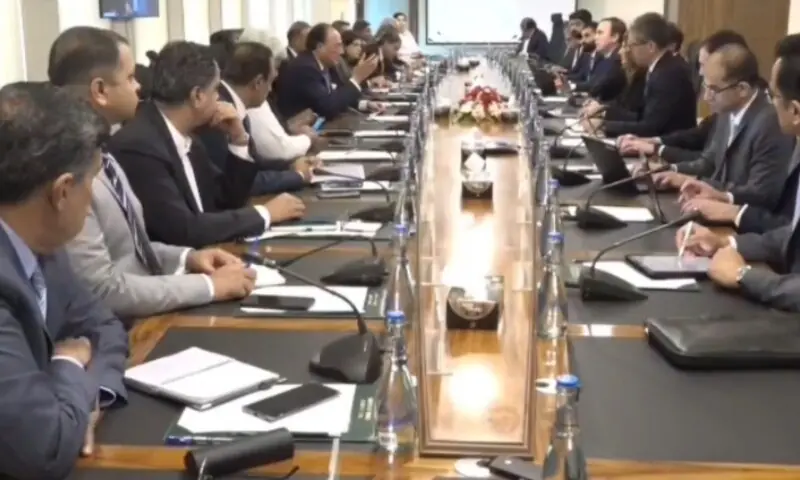
Meanwhile, a visiting IMF mission on Wednesday began a pre-budget review of Pakistan’s economy, focusing on revenue collection targets, proposed tax measures, reforms and the fiscal strategy for 2026-27.
The Fund approved special drawing rights (SDR) worth 760 million for Pakistan under the Extended Fund Facility (EFF) and SDR 154 million under the Resilience and Sustainability Facility (RSF).
“The SBP has received SDR 914m (equivalent to about $1.3bn) under the EFF and RSF in value dated May 12, 2026, from the IMF,” the central bank said on Wednesday.
The SBP’s foreign exchange reserves have become highly critical for the economy as they help build confidence among importers and exporters, meet the trade deficit, stabilise the exchange rate and support debt servicing payments.
In its recent half-yearly report, the SBP revealed it had been buying dollars from the inter-bank market to improve reserves. During the last three years, the central bank purchased about $27bn from the currency market.
The SBP’s foreign exchange reserves stood at $15.85bn on April 30. With the inflow of $1.3bn from the IMF, reserves have risen to about $17.15bn. The SBP’s target for FY26 is $18bn, which could now be achieved with purchases of less than $1bn from the currency market.
Pakistan, however, has struggled to attract foreign investment, which has been declining for years. Foreign direct investment fell 27 per cent during July-March FY26.
According to the SBP, global FDI flows increased 14pc to $1.6 trillion in 2025, primarily driven by the European Union, while developing economies witnessed disinvestment.
Moreover, the secondary income account recorded a higher surplus, largely reflecting robust workers’ remittances that helped finance a major part of the combined deficit in trade in goods and services and the primary income account.
Pre-budget review
The review began in Islamabad, during which detailed technical discussions is expected on the budget framework and government proposals before subsequent approval under the programme.
The IMF team, led by Mission Chief Iva Petrova, is expected to remain in Pakistan for about six working days, likely until May 20.
According to an official statement, Finance Minister Muhammad Aurangzeb briefed the IMF delegation on Pakistan’s macroeconomic outlook, fiscal strategy, reform priorities and the government’s efforts to ensure sustainable economic stability and long-term growth.
The discussions focused on macroeconomic stabilisation efforts, preparations for the upcoming federal budget and reforms aimed at strengthening fiscal and external sustainability while supporting economic growth.
Both sides exchanged views on maintaining reform momentum, preserving macroeconomic stability and advancing structural reforms to promote investment, productivity and export-led growth.
Aurangzeb highlighted positive trends in remittances and exports, reflecting growing resilience in the economy and gradually strengthening macroeconomic fundamentals.
He said the government remained mindful of structural economic challenges, particularly external liabilities and the need to accelerate sustainable, export-led growth.
The minister reiterated the government’s commitment to reforms aimed at strengthening macroeconomic stability without compromising long-term growth prospects.
He also briefed the IMF mission on Pakistan’s continued engagement with international development partners, including ongoing economic cooperation initiatives with China and efforts to mobilise long-term investment aligned with the country’s strategic priorities.
Petrova acknowledged Pakistan’s progress in maintaining macroeconomic stability despite a challenging global and regional environment. The IMF mission appreciated the government’s continued commitment to prudent economic management and reform implementation.
The IMF team emphasised the importance of sustaining reform momentum, maintaining fiscal discipline and advancing structural reforms to support durable and inclusive economic growth.
The mission reaffirmed its commitment to continued engagement and constructive cooperation with the government of Pakistan in support of the country’s economic reform programme and long-term resilience.
Meeting with US official
Aurangzeb also met S. Paul Kapur, the US assistant secretary at the Bureau of South and Central Asian Affairs. Mr Kapur was accompanied by US Chargé d’Affaires Natalie A. Baker.
The meeting, held at the Finance Division, focused on Pakistan-US economic cooperation, investment opportunities, trade relations and the government’s reform agenda aimed at strengthening macroeconomic stability and improving the business environment.
According to an official statement, both sides exchanged views on enhancing bilateral economic engagement and expanding cooperation in areas of mutual interest.
The finance minister briefed the US official on Pakistan’s economic performance during the current fiscal year and emphasised the government’s focus on attracting long-term investment, particularly in energy, mining, infrastructure, technology and digital finance.
Panda bond launch
Later on Wednesday night, Aurangzeb left for China to participate in the issuance ceremony of Pakistan’s inaugural Panda bond in Beijing.
According to a finance ministry statement, the overall Panda bond programme has been set at $1bn, while the inaugural issuance will amount to the equivalent of $250m.
The issuance is supported by the Asian Development Bank and the Asian Infrastructure Investment Bank.
During his visit to China, the finance minister is also expected to hold meetings with investors, financial institutions and senior Chinese officials to discuss bilateral cooperation and investment.
Published in Dawn, May 14th, 2026