Indian arrogance shot down alongside planes during last year's military conflict, Tarar says
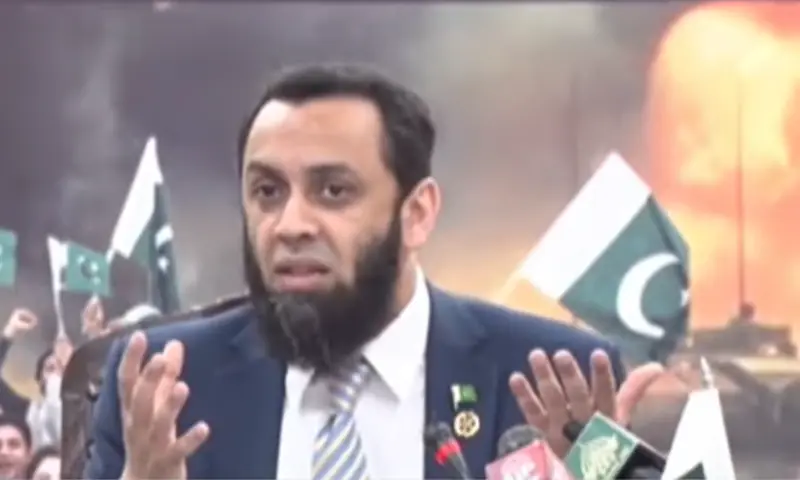


Information Minister Attaullah Tarar said on Wednesday that the Indian aircraft shot down during the brief military conflict in May last year “brought down Indian arrogance with them”.
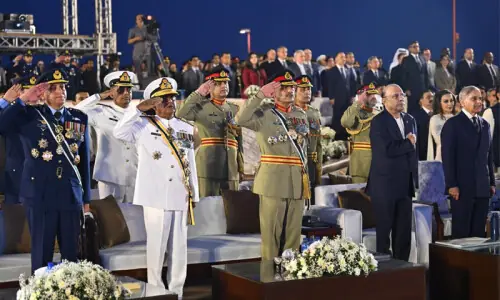
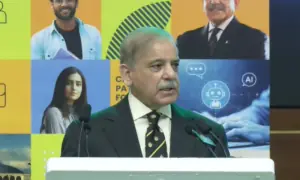
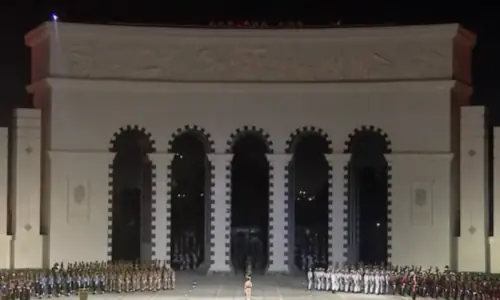
He made these remarks while addressing a ceremony held in relevance to Marka-i-Haq at Islamabad’s Institute of Strategic Studies.
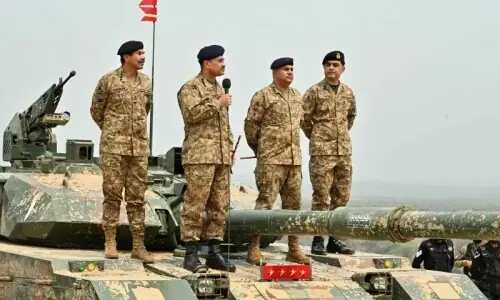
The conflict with India — starting from the April 22 Pahalgam attack to the end of Operation Bunyanum Marsoos with a ceasefire between the two countries on May 10 — has been called “Marka-i-Haq” (Battle of Truth) by the state.
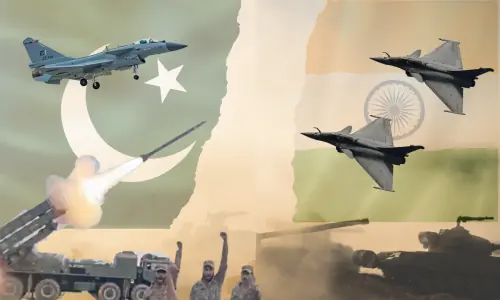
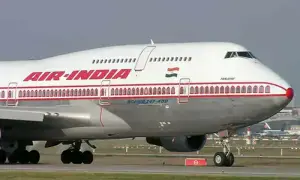
During the conflict, New Delhi launched deadly air strikes in Punjab and Azad Kashmir on May 7. Pakistan retaliated by downing several Indian planes in air-to-air combat. The initial tally of the downed jets was announced as five and later raised to eight.
In his fresh remarks on the matter, Tarar said: “When those eight planes went down — and a lot of them were Rafale planes, which are a source of pride for India — those planes brought down with them the Indian arrogance; and proved to the world, once again, our dominance in aerial battle; and how Pakistan’s indigenous technology helped it achieve victory.”
He also said the Pakistan Navy was “alert and ready” to respond to any aggression.
“So this Marka-i-Haq belongs to the entire nation. We saw the entire nation stand tall, stand united. We set aside our political differences, we set aside our differences of opinion, and the whole nation came together as a united force,” he added.
Earlier in his address, Tarar noted that a first information report of the Pahalgam attack in India-occupied Kashmir was registered “within 10 minutes of the incident, without any inquiry, without anyone going to that spot, without any detailed investigation”.
He recalled that Indian was then quick to blame Pakistan, further stating that Islamabad’s narrative during the May conflict “gained strength” right from the beginning because “we expressed the truth at the right forum at the right time”.
“When it comes down to narrative, it’s all about saying the right thing at the right time at the right forum … There has to be a specific, detailed campaign with regard to what your strategic narrative is,” he explained.
The minister said Pakistan’s narrative was boosted when Prime Minister Shehbaz Sharif made the offer of a fair, independent and transparent investigation into the Pahalgam incident in April 2025.
“A year has passed, and there has been no response to the prime minister’s offer. And there could not be any response because we knew that it was a false flag operation.
“Pakistan proved that our hands are clean, and it was India that shied away from an investigation,” he said.
Tarar went on to say that on the pretext of that false flag operation, India resorted to attacking civilians in Pakistan. “It further damaged India’s stance, especially at the global stage,” he added.
The minister said Pakistan was well within its rights under the UN Charter to respond to Indian attacks in a firm and decisive manner in May last year.
He further stated that Pakistan had been “a frontline state against terrorism, or a shield or a wall between the terrorists and the rest of the world”.
“When one Pakistani lays down his or her life, it is for the motherland. But then, laying down that life [also] makes the world a safer place. No other country has to its credit 90,000 lives laid down …
So how can a country which is countering terrorism be blamed for terrorism?” he said.
“And who is pinning this blame on Pakistan?” he further questioned, as he went on to recount allegations of transnational assassinations associated with India.
In connection with this, he also mentioned Kulbhushan Sudhir Jadhav, an Indian spy who was arrested in Pakistan in 2016. Tarar said Jadhav had been involved in terrorist activities, adding: “When an Indian spy is captured red-handed within the territory of Pakistan … and it is proven at the international level that he has been involved in these activities, then which country is promoting terrorism?”
Coming back to Marka-i-Haq, he said where Pakistan told the truth to the world in an effective manner, the Indian media and government made “absolutely absurd” claims.
He also acknowledged the role of the Pakistani media, intelligentsia, journalists, academia and analysts, who he said “made us look very good at the global stage”.
The Pakistani media was giving out information that was “100 per cent authentic, verified and that could not be contradicted at any level”, he said, adding that it was so because there was “complete unanimity and smooth, uninterrupted flow of information between the state institutions and the private sector media”.
Tarar also commended the youth, mentioning the “meme war” that was witnessed during Marka-i-Haq.
“We were at the top of our game. When it came down to the narrative game, when it came down to the conventional war, when it came down to diplomatic efforts … because we had a lot of truth to tell the world and we told it the right way, we were at the top of our game,” he said.
On the other hand, Tarar continued, “the enemy kept on making mistake after mistake. The entire world saw how their nefarious designs were exposed”.
“The entire world saw that starting from the false flag operation of Pahalgam and the baseless allegations made against Pakistan, Pakistan played all its cards right,” he added.
Tarar said a year after Marka-i-Haq, Pakistan’s relevance, significance and status had elevated at the international level.
“On the other hand, you have your eastern neighbour that spent hundreds of billions of dollars through lobbying and PR firms to come up with a ‘shining’ slogan. But, from shining to isolation, this is a one-year journey.
“When you base your entire premise and narrative on false information and propaganda, and you externalise your internal issues and internalise your external issues, and you try to create a hegemony within the region, and you assume the role of the bully of South Asia, that can never go well for you,” he said.
Tarar ended his speech, saying that “we have all witnessed how Pakistan has transformed after Marka-i-Haq” and “it is a moment to be proud”.