• Conference concludes with focus on climate resilience
• Senate chairman links climate security with regional peace
• KP CM highlights Billion Tree Initiative, forest expansion efforts
• Marriyum reveals Punjab’s plans for climate observatory
ISLAMABAD: Stringent implementation of policies and laws is the need of the hour to mitigate the adverse impact of climate change, speakers said during the second and concluding session of the Breathe Pakistan International Climate Change Conference organised by DawnMedia on Thursday.
Speakers were of the view that all necessary climate-related laws and policies already existed in the country but lacked effective implementation.
The conference discussed climate resilience, adaptation, energy transition, water security, urban planning, agriculture, climate finance and equitable policymaking.
The event brought together policymakers, parliamentarians, international organisations, climate experts, corporate leaders, academics, development partners and civil society representatives to examine Pakistan’s climate vulnerabilities and the reforms needed to strengthen climate resilience.
On both days, speakers stressed that climate change was no longer solely an environmental issue but a broader economic and development challenge requiring coordinated implementation, regional cooperation and long-term planning.
The second day of the conference focused on Global South cooperation, climate-smart cities, clean energy transition, private-sector climate leadership, climate equity and provincial climate initiatives.
The conference concluded with renewed calls for implementation-focused climate action and stronger institutional coordination.
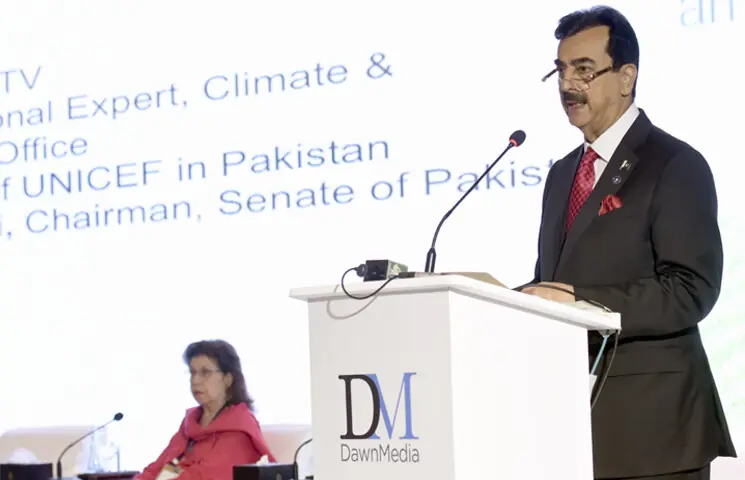
Senate Chairman Yousaf Raza Gilani said Pakistan was confronting climate challenges with “resilience and resolve”, stressing that climate, food and economic security depended on internal stability, regional peace and global cooperation.
Mr Gilani reaffirmed the Senate’s commitment to climate legislation and said climate resilience efforts must directly benefit farmers, families and vulnerable communities. During a session titled “On the Frontlines of Climate Change: Khyber Pakhtunkhwa”, speakers discussed the province’s climate initiatives and afforestation efforts.
In a video message, Khyber Pakhtunkhwa Chief Minister Sohail Afridi praised DawnMedia for organising the conference and highlighted climate initiatives launched under former prime minister Imran Khan’s government. He described the Billion Tree Initiative as a major achievement, saying forests now cover around 27 per cent of the province’s total area.
According to Mr Afridi, the province had invested over Rs650 billion in forest conservation and expansion since 2017 and could potentially generate significant revenue through carbon credits. He stressed that climate change was a collective national challenge requiring cooperation between federal and provincial governments.
Special Assistant to the Chief Minister on Information Shafiullah Jan said forest cover in KP had increased from 19.5pc to 26.5pc under the PTI government. He warned that glacial melt and the conversion of agricultural land into housing developments posed growing risks for the province. He also called for climate-related allocations in the National Finance Commission Award.
In the closing session, Punjab Senior Minister Marriyum Aurangzeb outlined the Punjab government’s efforts to build climate resilience through a multisectoral “ecosystem approach”.
She highlighted public transport expansion, smog mitigation measures and the creation of an environment protection force, claiming Punjab had reduced PM2.5 levels by around 35pc over the past year and a half.
She also announced plans for a climate observatory with satellite offices across Punjab, stressing the importance of data and spatial planning.
Aban Marker Kabraji, senior regional expert for climate and environment at the UNEP Asia Regional Office, reflected on climate finance as one of the conference’s recurring themes, describing it fundamentally as “development finance”.
Speaking on behalf of the United Nations in Pakistan, Pernille Ironside of Unicef Pakistan said many solutions had already been identified and now required implementation and financing.
Anupa Rimal Lamichhane of the International Fund for Agricultural Development (IFAD) said Pakistan was on the frontline of climate change due to the vulnerability of its agriculture sector, which contributes 23pc to GDP.
She highlighted that while farmers were central to climate solutions, only 0.8pc of global climate finance reached them.
Mohamed Yahya, UN resident and humanitarian coordinator in Pakistan, said Pakistan’s experience of floods, droughts and glacial melt reflected a broader South Asian reality and underscored the need for regional cooperation.
Water law and policy expert Dr Erum Sattar discussed Pakistan’s transboundary water challenges involving India and Afghanistan, saying the country was uniquely positioned to experiment with solutions while exercising “ethical leverage” in global climate discussions.
Renato Redentor Constantino, adviser to the Climate Vulnerable Forum, argued that climate change should be viewed as a development crisis rather than solely an environmental issue.
Romina Khurshid Alam, coordinator to the prime minister on climate change, described climate change as a “state of war” for vulnerable countries and criticised the lack of progress on the Loss and Damage Fund. She said developing countries sought partnership and trade, not charity.
Others who spoke on the occasion included Seema A. Khan of the Seed Advisory Group, Nepal’s Ambassador to Pakistan Rita Dhital and Maldives High Commissioner Mohamed Thoha.
Published in Dawn, May 8th, 2026