Karachi mass transit: a pipe dream

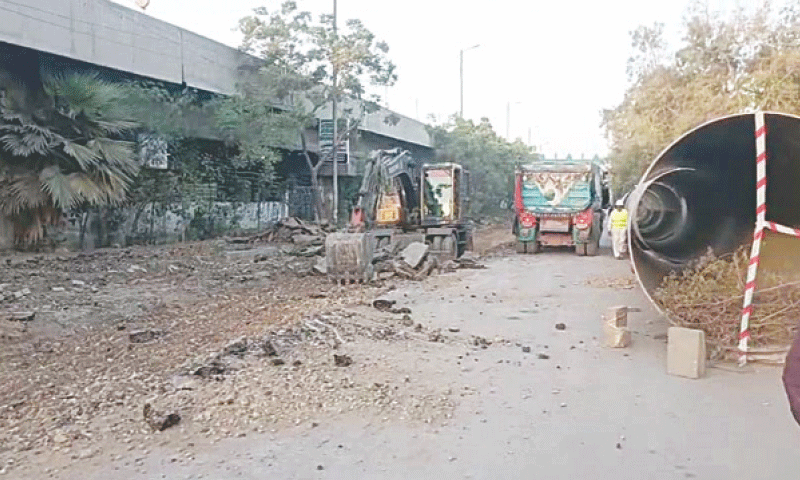
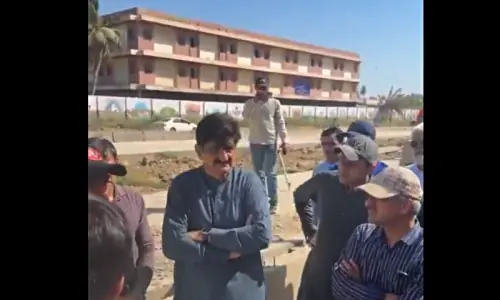
THE Frontier Works Organisation has taken over construction of University Road, which is part of Karachi’s chronically sick Red Line project, on an ‘emergency’ footing to meet a 90-day deadline — offering some hope to long-suffering Karachiites. However, a broader perspective reveals a more complex picture of Karachi’s transport issues. The idea of the Bus Rapid Transit was first introduced in Pakistan during the Karachi Mass Transit Study (KMTS) in 1987-1990 — nearly 25 years before Punjab implemented the Lahore Metrobus, the country’s first BRT, in 2013.
KMTS, undertaken by the Karachi Development Authority through local and international experts, and assisted by the World Bank and UNDP, identified six high-demand corridors with a total length of 87 kilometres of BRTs and Light Rail Transits (LRTs). In 1990, a priority corridor from Sohrab Goth to Tower was selected as the pilot project. It was never implemented.
Another attempt by the Japan International Cooperation Agency in 2010 gave the city the meticulously prepared Karachi Transportation Improvement Project 2012-2030 (KTIP). Finalised in 2012, it proposed an 18-year plan including six BRT lines (91.5 km), two LRT lines (41 km) and the revival of the Karachi Circular Railway (KCR — 43 km) for a total network of 175.5 km to be completed by 2030.
KTIP remained dormant until 2015, when the federal government — despite urban transport being a provincial subject — initiated and completed 20 km of the Green Line BRT in two years. However, delays in bus procurement by the Sindh government left the facility unutilised till 2021, when the federal government stepped in to procure buses. The remaining 2 km (Numaish to Saeed Manzil) have been a bone of contention between the two governments for several years now.
Karachi currently has fewer than 700 private buses plying on its roads against an estimated requirement of 8,000-10,000.
The Sindh government has completed only one BRT — the Orange Line (3.9 km) — during the past 14 years of KTIP (2012-2026). During this period, the Punjab government has implemented three BRT lines of around 68 km (in Lahore, Rawalpindi and Multan), mostly completed within a two-year time frame. In addition, the 27-km Orange Line Metro Train became operational in 2020. Further projects in Faisalabad, Gujranwala and Lahore totalling some 78 km are under approval or construction.
The combined length of Punjab’s completed, planned and under construction BRT/LRT projects approaches 170 km — comparable to 175.5 km envisaged under KTIP — of which nearly 150 km remain unimplemented, with only 3.9 km completed by the Sindh government and 20 km by the federal government.
The Sindh government also initiated work on the Red and Yellow BRT Lines of around 43.4 km, which have been under construction since 2019. Both projects are funded through loans from the Asian Development Bank and the World Bank. Delays in execution have led the Sindh government to request extensions in financing timelines. There appears to be no progress on the remaining 105km of the KTIP, including the Blue Line (Sohrab Goth to Tower), which has remained a priority corridor since 1990. Had these projects been undertaken in time (2012 or thereabout), the remaining 105 km (43 km of the KCR and 62 km of LRTs/ BRTs) could have cost an estimated Rs440bn. While the provincial government often cites resource constraints, the reality is that Karachi has been denied a sum of Rs3,360bn in development funds since the 2010 NFC award. The required sum of Rs440bn was only 13pc of Karachi’s rightful share.
The KP government completed the Peshawar BRT (27 km) between 2017 and 2020. The federal government funded and completed 60 km of Islamabad’s Orange, Blue and Green Lines (apart from 10 km of the Islamabad-Rawalpindi BRT and 20 km of Karachi’s Green Line).
In terms of expense, BRT projects have been costliest in Sindh: Lahore and Multan BRTs — Rs1.2-1.6 billion per kilometre; Peshawar BRT — Rs2.5bn per kilometre; Karachi’s Green Line by the federal government — Rs1.7bn per kilometre; Karachi’s Red Line by the Sindh government — Rs3.8bn per kilometre (revised); Karachi’s Yellow Line by the Sindh government — Rs8.5bn per kilometre (estimated); the Gujranwala BRT initiated last December — Rs2bn per kilometre.
Karachi currently has fewer than 700 private buses plying on its roads against an estimated requirement of 8,000-10,000 as identified by various studies. Under KTIP, the proposed new BRT/ LRT routes are to be linked with the KCR and various localities of the city through 78 feeder routes with approximately 3,100 small and large buses, which, when added to around 800-1,000 buses on BRT corridors, require the induction of around 4,000 new buses. However, the Sindh government procured only around 379 buses against KTIP’s planned 4,000 over the past 14 years — an average of roughly 27 buses per year. At this rate, the procurement of 4,000 buses would take around 148 years to complete.
Since 2012, the federal government completed approximately 90 km of BRT length, Punjab around 95 km (with additional projects of 78 km underway), KP 27 km, while Sindh has completed only 3.9 km in the past 14 years. Hence the rate of implementation of the KTIP since 2012 by the Sindh government has been 0.28 km per year. At this rate, it will take around 535 years to complete the remaining 150 km of KTIP, which was to be completed in 2030.
According to the World Bank’s Transforming Karachi into a Liveable and Competitive Megacity, 2017, “The city’s liveability and competitiveness will continue to deteriorate, limiting its ability to drive Pakistan’s growth.” Our aspirations for sustained economic growth will remain unfulfilled unless Karachi is revived as a liveable and efficient city.
The writer was formerly a federal secretary and caretaker provincial minister. He is currently the chairman of the Policy Research and Advisory Council.
Published in Dawn, May 8th, 2026