0
0
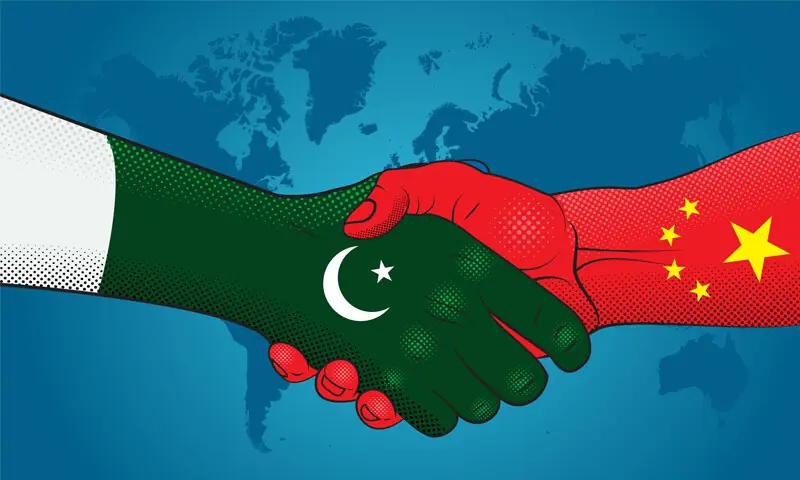

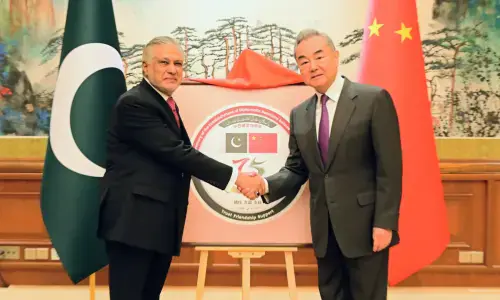
President Asif Zardari’s week-long visit to China is widely interpreted as a fresh push by Pakistan to recalibrate its “all-weather” partnership around hard economic priorities, with investment, industrial cooperation, and technology transfer taking centre stage.
Beyond that, the visit signals the start of a new phase in bilateral ties, with provinces stepping forward to serve as key engines of trade, investment and technology transfer.
With Pakistan seeking investments, joint ventures, and technology partnerships with China to stabilise its fragile economy, the presidential trip was aimed at attracting Chinese investment, expanding trade, and accelerating industrial cooperation.
He is said to have focused beyond infrastructure on industrial zones, agriculture modernisation, and technological collaboration under the China-Pakistan Economic Corridor (CPEC) 2.0. Further, the visit carried a defence dimension.
‘There appears to be a deliberate shift towards sub-national diplomacy, where provinces act as engines of trade, investment and technology transfer’
In the port city of Sanya, President Zardari attended the commissioning ceremony of the first of eight Chinese-built Hangor-class submarines for the Pakistan Navy. He described the development as a “historic milestone,” reaffirming Pakistan’s commitment to maritime security and continued defence collaboration with Beijing.
The visit underlines a change in Islamabad’s approach towards economic ties with Beijing. Moving beyond headline infrastructure, both sides seem to be looking to deepen the next phase of CPEC, the flagship project of the Beijing-led multinational Belt and Road Initiative, through collaboration in manufacturing, clean energy, agriculture and emerging sectors such as electric vehicles and artificial intelligence. The countries share a longstanding strategic cooperative partnership, and Beijing has invested an estimated $25.9 billion in large transport and energy projects under the CPEC initiative.
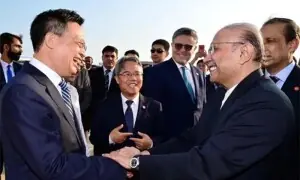
President Zardari’s quiet diplomatic engagement with China was unusual in the sense that he began his visit in Changsha, the capital of Hunan province, before proceeding to Sanya in Hainan Province on the second and last leg of his trip, unlike past high-profile visits by Pakistani leaders that mostly begin and end in Beijing or Shanghai, the centres of political and economic diplomacy. Nor did he have scheduled meetings with any senior Chinese leader.
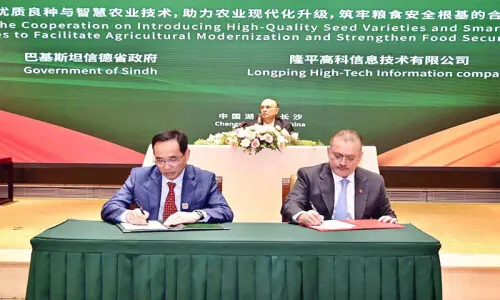
Rather, he met with provincial leadership, industrial stakeholders, and defence officials in what a commentator described as hubs of provincial economic power and emerging industrial cooperation. Several memorandums of understanding (MoU) were signed, deepening cooperation across three key sectors — agriculture technology, water desalination, and tea production — with a particular focus on provincial-level collaboration.
This choice, a China watcher wrote, “signals a deliberate shift towards sub-national diplomacy, where provinces act as engines of trade, investment and technology transfer.”
According to media reports, Prime Minister Shehbaz Sharif is expected to visit China later this month to build on the momentum generated by the presidential trip, with a focus on expanding investment, advancing CPEC projects and unlocking new avenues of cooperation. Some observers believe that the ongoing engagement with Beijing underscores a shift in Pakistan’s economic diplomacy from reliance on large-scale infrastructure financing towards a diversified, investment-driven partnership as the two countries celebrate 75 years of diplomatic ties this year.
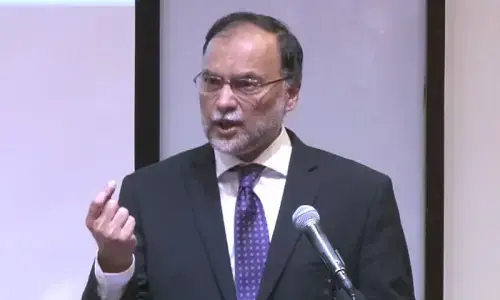
Ambassador Mansoor Ahmad Khan, Director of the Beaconhouse Centre for Policy Research and head of the Initiative on Pakistan’s Place in the World, argues that Pakistan’s renewed engagement with China carries both economic and geopolitical significance.
He notes that bilateral coordination has intensified in response to shifting regional dynamics, particularly the ongoing Middle East conflict. “Both countries are aligning their engagement in light of geopolitics, especially the conflict in the Middle East,” he said.
“China is significantly affected, as a large share of its oil imports either originates from Iran or transits through the Strait of Hormuz.” Islamabad, he added, has kept Beijing closely informed of its diplomatic efforts to secure a ceasefire between the US and Iran. During Dar’s visit to Beijing in March, the two sides consulted closely and proposed a five-point framework for de-escalation.
At the same time, Khan observed that both sides are leveraging high-level geopolitical consultations as opportunities to advance economic cooperation on a project-by-project basis.
He pointed to President Zardari’s visit to China, during which several MoUs were signed between the Sindh government, Chinese investors, and provincial authorities.
“In essence, the primary driver of engagement right now is the evolving geopolitical situation in the region”, he said, “but within that framework, both sides are actively pursuing avenues for bilateral economic cooperation.” He predicted that bilateral engagement between Pakistan and China is likely to increase in the coming months as they continue to work more closely on these fronts.
“On the one hand, the conditions in Afghanistan are not conducive for CPEC expansion towards Central Asia and on the other, Pakistan did not develop any mechanism to move forward on the Corridor. Then there was the issue related to the security of Chinese nationals working on CPEC, as several were killed in terrorist attacks,” he said.
Whether this evolving, investment-led approach ultimately translates into a full-scale revival of CPEC remains uncertain. While the shift towards targeted partnerships, provincial engagement and sector-specific cooperation may inject fresh momentum into bilateral ties, challenges continue to weigh on progress. Security concerns, regional instability — particularly in Afghanistan — and Pakistan’s own institutional and policy constraints will need to be addressed to restore investor confidence.
Published in Dawn, The Business and Finance Weekly, May 4th, 2026