• Justice Kayani transferred to Lahore, Justice Sattar to Peshawar, Justice Saman Imtiaz to Sindh High Court
• Transferred judges to lose their seniority
• IHC CJ Dogar withdraws proposed transfers of Justices Tahir, Soomro
• No new hirings expected, vacant seats will also be filled via transfers
• JCP members, PTI call it ‘unfortunate day’ in judicial history
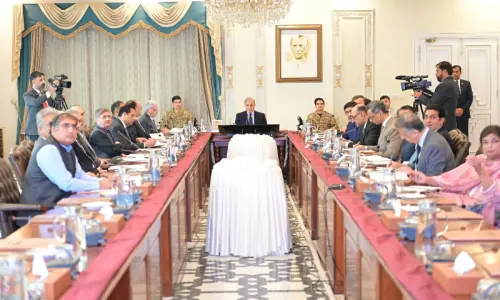
ISLAMABAD: In an unprecedented move, the Judicial Commission of Pakistan (JCP) on Tuesday transferred three judges of the Islamabad High Court (IHC) to three separate provinces without their consent, a move that JCP members and the opposition PTI described as an “unfortunate day” in Pakistan’s judicial history.
Presided over by Chief Justice of Pakistan Yahya Afridi, the commission commenced its proceedings at the Supreme Court building, with different compositions, to consider proposals regarding the transfer of IHC judges to other high courts under Article 200 of the Constitution.
Initially, five judges were recommended for the transfer by IHC Chief Justice Sarfraz Dogar, but CJ Dogar withdrew the proposed transfers of two judges, Justice Arbab M Tahir to the Balochistan High Court and Justice Khadim Hussain Soomro to the Sindh High Court (SHC).
The commission approved the transfer of Justice Mohsin Akhtar Kayani from the IHC to the Lahore High Court and Justice Saman Rafat Imtiaz to the SHC by a majority of 11 to four, whereas the transfer of Justice Babar Sattar to the Peshawar High Court (PHC) was approved by a majority of 10 to five.
These three were among the judges who, in 2024, wrote letters to the Supreme Judicial Council (SJC) to register complaints against alleged meddling by intelligence agencies in judicial affairs. They had also demanded a judicial probe against the agencies and had petitioned the Supreme Court questioning the transfer of three judges to the IHC.
Their transfer was opposed by CJP Afridi, Justice Munib Akhtar, PTI leaders Barrister Gohar Ali Khan and Syed Ali Zafar. However, besides these four, Justice Sattar’s transfer was also opposed by PHC CJ Attique Shah.
This is the first time such transfers have been made after the 27th Amendment. Article 200 of the Constitution empowers the JCP to recommend transfers without the consent of the judges concerned; something that was mandatory before the 27th Amendment. The amended provision later vested this authority in the JCP, where decisions are taken by a majority vote.
The meetings were convened by the JCP secretary in exercise of powers conferred under Article 175A (22) of the Constitution, as the JCP chairman — CJP Afridi — had declined to convene the meeting on requisition by one-third of the total members.
The commission also decided, by a majority of its total membership, that any vacancy arising as a result of the transfer of judges from the IHC will be filled through transfer only, and such slots will not be treated as vacancies for initial appointment.
Judges lose seniority
Following his transfer, Justice Mohsin Akhtar Kiani — who was IHC’s senior puisne judge — will lose his seniority and be relegated to 12th in the LHC seniority list. Justice Babar Sattar, who was number three in the IHC, will become the sixth in the PHC.
Justice Saman Rafat Imtiaz, from her sixth spot in the IHC, has been relegated to 16th position in the SHC.
Justice Arbar M Tahir and Justice Khadim Hussain Soomro, whose transfer was withdrawn, however, have risen in the seniority ranks following the transfer of their colleagues.
The JCP spent almost four hours deliberating the merits of the transfer, with the majority of the time consumed in discussing the letter written by the CJP, who had opposed the idea of transferring judges from IHC to different high courts, and a three-page letter by Justice Babar Sattar wherein the judge had requested a personal hearing before any decision regarding the transfer. Meanwhile, Barrister Gohar Ali Khan and Syed Ali Zafar, while speaking to reporters, described the transfer as the “second fatal blow” to the judiciary after the 27th Amendment. As a result, the entire edifice of Pakistan’s judiciary has been crumbled and razed to the ground, Barrister Gohar claimed.
The PTI leaders also emphasised framing appropriate rules and developing terms and conditions before such transfers. If anyone has a complaint against the conduct of a particular judge, then the Supreme Judicial Council under Article 209 was the only forum for the removal of a superior judge, the PTI leader said.
Likewise, Barrister Zafar emphasised that the judge should be transferred only if another high court wanted to take advantage of the judge’s expertise in a particular field. But these transfers fall under the category of “strange” and “unusual” since the judges were transferred without being given a chance for a personal hearing.
“The Constitution did not allow to employ Article 200 to transfer a judge as a tool of punishment,” he said, adding that such transfers should not become a precedent.
Earlier this month, the CJP had refused to convene the JCP meeting, saying that such transfers would reduce appointments of judges to merely a temporary and reversible administrative arrangement. He had feared that the request for transfers was not accompanied by any articulated reasons or apparent institutional necessity.
Published in Dawn, April 29th, 2026