Compressing Dia al-Azzawi’s expansive oeuvre in a Mayfair gallery is no easy feat, considering his decades-long practice, informed by his training in archaeology and ethnography, with visuals that range from his interest in Pan-Arab identity and his more indigenous Iraqi identity. An acclaimed Iraqi modernist, this is Azzawi’s second exhibition in London, the city he calls home.
Works in this latest exhibition, ‘Dia al- Azzawi: Excursions Across Time’, some produced over more than half-a-century ago and some as recently as 2025, are rife with political statements. Azzawi’s practice has a rawness and urgency to it, one that confronts the viewer with how little has changed in the region he hails from in terms of struggle and how much has changed in terms of control and power.
The display at London’s Richard Saltoun Gallery is curated in three sections. The first presents his interest in Iraqi identity, the second his long-standing appreciation of and inspiration from Arab literature, and the third presents his engagement with Arab identity.
The works included are large and medium in scale — bold abstract paintings, sculptures in the form of a relief and obelisk, and small intimate monochrome drawings, one of which, a piece from 1966 titled Amulets: Ya Shafi Ya Kafi Ya Allah, is reminiscent of Sadequain’s style, albeit much smaller in scale.
Dia al-Azzawi’s works continue to prove why he is regarded as a pioneer of modern Arab art and why his works continue to resonate so deeply today
The room presenting the artist’s interest in Arab literature has an artist diary or daftar entitled Excursions Across Time, from which the exhibition takes its name. This piece, composed of hand-coloured lithographs, including text and drawings in Azzawi’s signature style with bold colours, motifs and marks, is based on a poem by the Lebanese author Talal Haider.
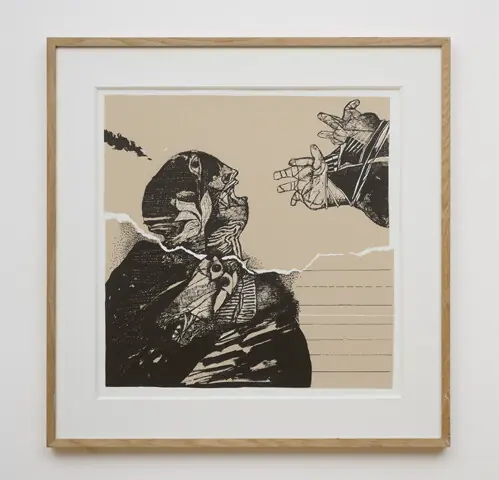
Also included in the exhibition is a silkscreen piece from 1979 titled Tell al-Zaatar, based on a poem by the Palestinian poet Mahmoud Darwish. The poem was written as a response to the Tal al-Zaatar massacre, which resulted in the killing of around 1,500 Palestinian and Lebanese Muslims in 1976.
The achromatic piece depicts a masked and hooded figure taking up most of the left side of the sheet. On the figure are sets of eyes positioned at different places, including the top of the head and just below the face. The latter could possibly belong to another figure, perhaps a child clinging to the main figure or maybe a beast.
On the top right of the image is a pair of hands, tied at the wrists, with contorted fingers. In the middle of the image is what looks like a thin organic rip, cutting through the figure, separating the top of the work from the bottom, reminiscent of borders in cartographic drawings. Similarly, on the bottom right of the piece are straight horizontal lines, some solid, others broken or dotted. Azzawi’s representation seems to be in line with the gist of Darwish’s poem, which focuses on themes of exile, resilience and identity, and alludes to the Palestinian struggle that continues with faceless victims who serve as mere statistics.
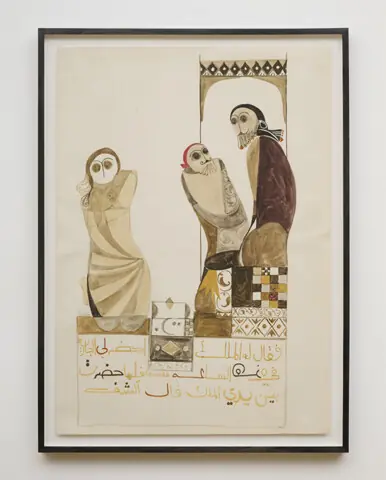
Alongside this evocative piece are three drawings inspired by Alf Laylah wa-Laylah, popularly known as One Thousand and One Nights in English. One of the works from this series, One Thousand and One Nights: And the King Said to Him.., depicts three characters, two males with stylised curling beards and a female, all of them with large black eyes. They seem to be standing by an architectural space with an arched passageway and beneath them are tiles with traditional motifs from folklore and Arab textiles. Right at the bottom, under these blocks with diverse designs, is a section of Arabic text, meant to kindle feelings of nostalgia and childhood storytelling, particularly for an Arabic-reading audience.
One of the most interesting and underrated pieces in the exhibition is a medium-sized bronze relief titled Misfired Target: Iraqi Cylinder Seal, styled after a section of an Assyrian relief in the British Museum, known as the The Dying Lioness (which itself is part of The Royal Lion Hunt of Ashurbanipal), that depicts a wounded lioness with arrows puncturing its form. Although attacked and injured, it is thought to be putting up a fight against its hunt and demise. This, to the artist, is emblematic of his country of origin, Iraq.
Displayed alongside the relief is a cylinder seal of the relief. Historically, cylinder seals were small, made of stone and carved with a design in intaglio, so that when they were rolled out on clay, they left a continuous and repeating design. The adoption and display of this historic Mesopotamian technique alongside the relief it would produce symbolises Azzawi’s own heritage and his experience in archaeology and ethnography.
‘Dia al-Azzawi: Excursions Across Time’ is on display at the Richard Saltoun Gallery in London from March 10-May 9, 2026
The reviewer is a freelance writer and has written for various organisations including Dawn, ArtNow and The Karachi Collective
Published in Dawn, EOS, April 26th, 2026