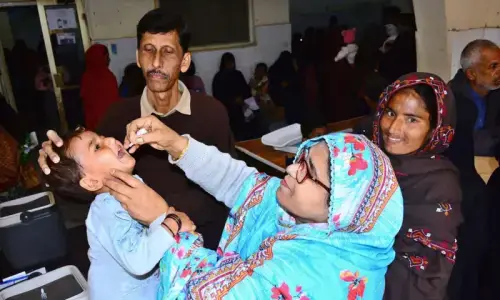
VACCINES rarely make the headlines unless there is an outbreak. This World Immunisation Week, it is a moment to reflect on how one of Pakistan’s quietest public-health successes remains one of its most consequential.
Since the Expanded Programme on Immunisation began in 1978, vaccines have helped avert 2.6m child deaths, protected millions of mothers and children, and contributed to a 99.8pc reduction in paralytic polio since 1994. WHO estimates routine immunisation averts up to 17pc of childhood mortality in Pakistan.
Few health interventions achieve so much for so little. But this year’s theme — ‘For every generation, vaccines work’ — should not invite complacency. It should prompt a harder question: can the state ensure they reach every child?
There are worrying signs that make this question so pressing. Pakistan reported over 16,000 measles cases in 2025, with more than half among unvaccinated children. A preventable disease is resurging because too many children are missing routine doses, with deadly consequences for those already weakened by malnutrition.
While that is dangerous in itself, it is also a warning that immunity gaps are widening. Children may miss doses because of weak outreach, disrupted delivery, poor follow-up or misinformation. Some, however, receive no routine vaccines at all. These ‘zero-dose’ children are missed because health services do not reach them — a sign of structural failure, not parental neglect.
Pakistan’s Big Catch-Up campaign, which reached 2.8m children who had missed routine doses, showed progress. It also exposed the scale of gaps in routine immunisation. This is why immunisation cannot be treated as a series of emergency drives mounted when risk spikes. It must be understood as a routine public service, sustained through functioning primary healthcare, reliable cold chains, disease surveillance and last-mile delivery.
The polio campaign offers lessons. Its vast infrastructure shows what political focus can achieve. Yet polio’s persistence in pockets of the country shows that the final barriers remain less about the vaccine than about reaching every child. The same lesson applies more broadly. Vaccine hesitancy is blamed on ignorance, but misinformation, distrust and unreliable services also play a role.
Meanwhile, climate shocks, displacement and urban growth are making immunisation harder, especially for children in informal settlements and disaster-hit communities. Every missed vaccine also carries economic costs, pushing preventable illness onto families and an already strained health system.
The next frontier is not simply more campaigns, but closing immunity gaps through stronger routine systems. That requires budgets to protect immunisation financing, support front-line workers and strengthen local delivery. Immunisation is not an issue to be revisited each April, but a test of whether the state can reliably reach every child, every time.
Published in Dawn, April 26th, 2026