Pakistan pushes for reform, investment
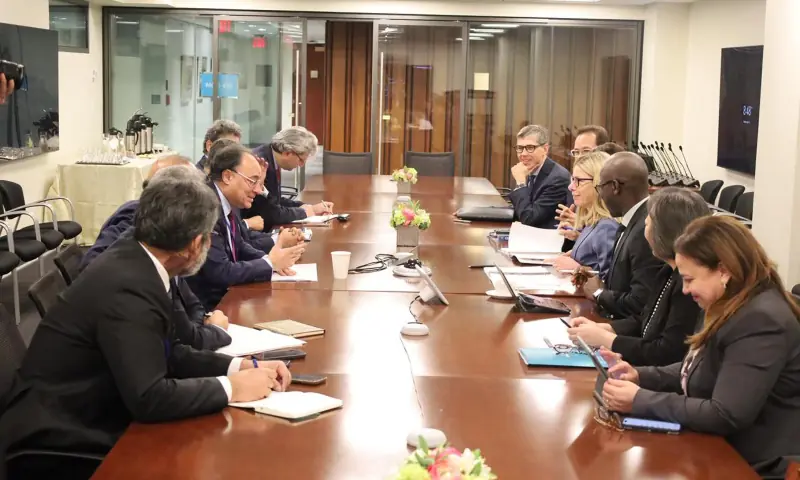

WASHINGTON: A severe global energy shock triggered by the US-Iran war has dominated discussions at the World Bank-IMF Spring meetings, where Finance Minister Muhammad Aurangzeb held a series of high-level engagements on Monday focused on stabilising Pakistan’s economy amid tightening external conditions.
The International Monetary Fund (IMF), the World Bank Group and the International Energy Agency (IEA) have warned that the conflict has caused one of the most severe disruptions to global energy markets in modern history. Oil prices have surged by around 50 per cent, shipping through the Strait of Hormuz has been significantly disrupted, and global supply chains for gas and fertiliser have been severely strained.
Developing countries — particularly energy importers with high debt burdens and limited fiscal buffers — are expected to bear the brunt of the shock. The IMF estimates that $20-$50bn in emergency support may be needed in the near term.
Against this backdrop, Mr Aurangzeb’s meetings centred on reform continuity, debt sustainability, social protection and private-sector-led growth.
Aurangzeb joins IMF-WB talks as Iran war shakes global economy
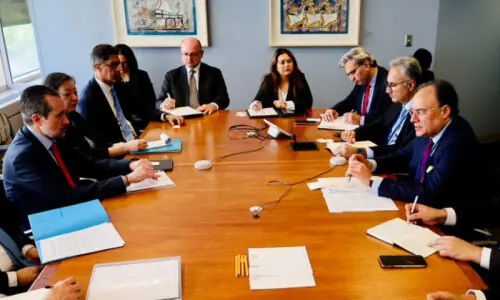
In his meeting with Ms Anna Bjerde, Managing Director (Operations) at the World Bank Group, the finance minister reviewed Pakistan’s economic outlook and the impact of external shocks stemming from the Middle East conflict. Both sides emphasised strengthening targeted social protection systems to shield vulnerable segments of society from rising energy and food costs. They also reviewed progress under Pakistan’s Country Partnership Framework, agreeing on the need for sustained reforms and implementation discipline.
He also called for a coordinated federal and provincial approach to address Pakistan’s demographic challenges and requested World Bank assistance in developing a comprehensive national master plan.
In a separate meeting with Jorge Familiar Calderón, Vice President of the World Bank Group, discussions focused on debt management, capital market development and financial innovation.
The minister outlined Pakistan’s diversified financing strategy, including sukuk issuances, ESG-linked instruments and efforts to deepen domestic bond markets. He stressed the need for technical assistance, advanced analytical tools and capacity building for Pakistan’s Debt Management Office to strengthen long-term financial resilience.
The finance minister also met Makhtar Diop, Managing Director of the International Finance Corporation (IFC), focusing on private investment and capital mobilisation.
He highlighted the economic impact of the global energy shock and reaffirmed Pakistan’s commitment to maintaining macroeconomic stability. He sought IFC support for capital market development and expanded private investment, particularly in agriculture, which is under pressure from rising input and fertiliser costs.
Mr Aurangzeb also participated in a panel discussion at Harvard University on Pakistan’s Economic Agenda: Stability, Reform and What Comes Next, held as part of the Pakistan Conference 2026.
The session was moderated by former SBP governor Dr Reza Baqir and featured distinguished panellists, including Professor Atif Mian of Princeton University and Nobel Laureate Professor Daron Acemoglu of the Massachusetts Institute of Technology, said a finance ministry press release.
Speaking at the discussion, Pakistan’s Ambassador Rizwan Saeed Sheikh underlined the importance of strengthening Pakistan-US economic ties.
As global institutions warn of prolonged disruption and structural shifts in the world economy, Mr Aurangzeb’s engagements in Washington underscore efforts to reposition its economic strategy for a more volatile, energy-constrained, and uncertain global environment.
Published in Dawn, April 14th, 2026