Echoes of History — Unheeded in Pakistan
By Asim Imdad
ILQA Publications
ISBN: 978-969-640-338-8
303pp.
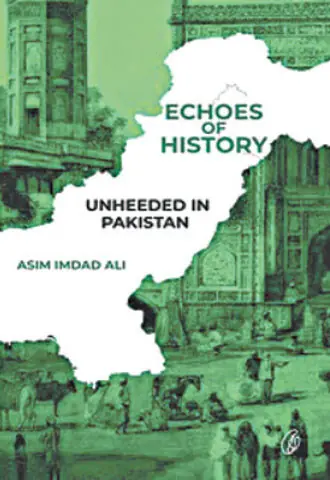
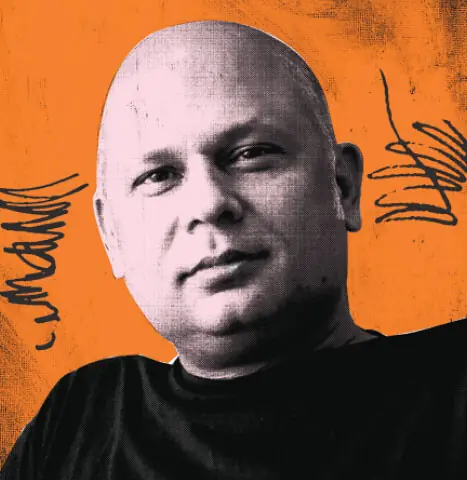
Asim Imdad Ali, the author, explaining the reason for writing Echoes of History — Unheeded in Pakistan, says that some readers of his earlier works, Circular History of Pakistan and Blind Spots in Pakistan’s History, posed “insightful” questions. “How long [has it] been like this, walking around in circles? The short answer: it has been like this for a while now… Are we the only ones trapped in such a political predicament? The short answer is, astonishingly, no.”
He seems to imply that, in Pakistan, instead of gaining objective lessons from history, we tend to beat around the bush and hide behind fables, while repeating our mistakes again and again.
Ali pursued postgraduate education at the School of Law at King’s College London, completed a master’s degree in Public Administration at the Harvard Kennedy School and served in the Pakistan Administrative Service.
The first thing that grabs the reader’s attention in Echoes of History is its outstanding English. In fact, while the highbrow, rich vocabulary and the substantial use of unique, uncommon diction make the book remarkable in the literary sense, on occasion it distracts the reader from the chain of the narrative, the flow of thought and the continuity of the case being made by the author, like a stream which disappears under the soil only to re-emerge on its subsequent course. To comprehend the articulation of arguments in this book requires effort, if not struggle, to connect the dots.
A recent book attempts to decode the patterns of power and politics in Pakistan by connecting these dynamics with examples from ancient and modern world history
Similarly, the proliferation of hundreds of impressive quotations — from William Shakespeare, Aristotle, Sigmund Freud, Niccolo Machiavelli, Rudyard Kipling, Sun Yat-sen, George Orwell, Victor Hugo, Karl Marx and innumerable others — is another challenge a reader has to confront to place the arguments in perspective vis-à-vis the book’s subject.
Notwithstanding the above remarks, Ali offers an uncommon perspective on history and mythology to describe the reverberations of history that have been disregarded in Pakistan, albeit in a hyperbolic manner. Although he often paraphrases what we mostly know in Pakistan and read all the time about the political culture and turmoil, he takes the trouble to connect these dynamics with patterns and examples from ancient and modern world history.
For instance, in a section titled ‘Cultology’, he discusses the fate of cult figures such as Adolf Hitler, who committed suicide along with his mistress, and Benito Mussolini, who was executed by Italian partisans and his body, along with that of his mistress, was hung upside down publicly at a petrol station in Milan.
It transpires, according to the author, that historically there is only one model of control: the ancient, classic one of ruling through the force of might, money and the authority of the state. The names and titles have been changing, but the general infrastructure remains an oligarchy of families, syndicates (mafias) and elitism.
“The generals and commanders in their uniforms (potentates), the politicians with their electoral badges, business barons with deep pockets and even deeper connections (princes), judges in their black robes and the media moguls wielding digitally empowered usernames (prelates), all serve as modern masks for age-old archetypes,” he writes.
Ali discerns that, despite evolving law, judiciary and justice in a state to replace violent revenge, states still resort to the old culture of violence. Man never changes his passions and desires. That is why he doesn’t learn from history, because he is not guided by knowledge and intellect but by his heart.
“Like many states, Pakistan is governed by an oligarchy of one percent (or even less),” he asserts. “Power remains lucratively locked in the hands of potentates, princes and prelates. The totem pole is clear: the men on horseback still hectoringly call the shots. This has been our core model of governance for centuries. We perform rituals of horizontal power shifts — new faces, same hierarchy.
“Some other groups have attempted veritable vertical redistribution to at least get a second chance (however fleeting) in the race of life. Not us. Our 99 percent is excluded from every critical decision. That is the root of public angst. If the meek have but a slim chance of inheriting the earth elsewhere, what hope do they really have in Pakistan? Perhaps even less — and should their turn come, it will likely arrive later than anywhere else.”
He describes well-known realities such as military rule behind elected governments, dynastic politics and the emergence of the business/industrial class as rulers, as well as the role of the judiciary as their collaborator. But in more flowery language and complicated diction.
In the chapter ‘No Revolution in Subcontinent’, Ali analyses why the Indian Subcontinent has never experienced a true revolution. He argues that there has never been a popular uprising that led to fundamental vertical change in societal structure and power dynamics. He differentiates a ‘revolution’ from revolts, rebellions, the toppling of monarchs and invasions. A revolution brings vertical changes, while the rest of the upheavals are basically horizontal shifts of power.
He believes three factors stand as the reason for the absence of a revolutionary “groundswell” in the history of the Indian Subcontinent. One, a lack of urban density due to the dominant, widely spread-out and loosely linked villages. Two, a superficial “transfer of power” at the time of decolonisation. And, three, a deeply held belief in predestination among the populace.
Referring to the French Revolution of 1789, he writes: “The distinction between revolts and revolutions may not carry the same weight that it once did for the king who lost his head over confusing the two [mistaking the revolution for a revolt], but it is crucial when evaluating underlying motives, manifestos and machinations of those who seek our consent, contribution and cash for their grand plans, proposals and policies.”
Echoes of History — Unheeded in Pakistan can be an effective academic textbook for higher studies in the history of power tussles. However, it may not be as handy for a general readership.
The reviewer is a freelance writer and translator.
He can be reached at mehwer@yahoo.com
Published in Dawn, Books & Authors, April 12th, 2026