Iranian tomatoes fail to ease prices


 0
0
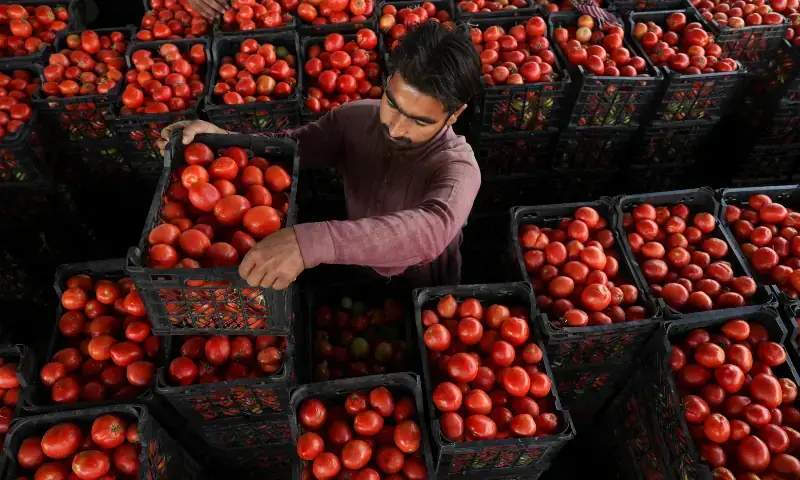

KARACHI: The arrival of Iranian tomatoes has failed to bring any respite to consumers, as prices have swelled to Rs450-500 per kg.
Interestingly, retailers are also forcing consumers to pay the same prices for tomatoes from Balochistan crops.
A number of traders are seen charging Rs450-500 per kg or Rs110-125 per 250 grams for Iranian and Quetta tomatoes, while others keep the rate at Rs400 per kg for small-size and unripe fruit.
They said that most traders appear reluctant to sell Iranian tomatoes, as they lose their hardness much faster than Pakistani fruit. Besides, a vast difference in taste between Pakistani and Iranian tomatoes also exists.
Consumers are also seen tightening their purchases as they get hardly two to three small-sized tomatoes for Rs50-60, traders said.
Consumers paying Rs450-500 per kg
Tomatoes were available at over Rs300 per kg earlier this month as compared to Rs120-160 in the third week of June and Rs80-100 per kg in April.
Younus Soomro, a tomato grower and former vice-president of the Karachi Chamber of Commerce and Industry (KCCI), said Iranian tomatoes were arriving in very small quantities, on average 10 containers per day.
Secondly, when Iranian tomatoes reach Karachi, they are about 30pc damaged, and they are not up to the standard of Sindh or Balochistan tomatoes in respect of taste, he said. Currently, only the Balochistan crop is feeding, which is insufficient to cover the huge demand in the country.
In Sindh, planting is starting now, and crops may be harvested by mid-September. The tomato crop had ended in April, while crops from Khyber Pakhtunkhwa and Punjab usually arrived in May-June, which remained confined in these two provinces to meet demand.
As per data of Pakistan Bureau of Statistics (PBS), total vegetable exports in FY26 drastically fell to 594,104 tonnes ($163m) from 1.448m tonnes ($367m) in FY25.
Mr Soomro said that vegetables were exported in very small quantities by air, while potatoes and onions were not exported due to the lack of vessels for Dubai because of the Gulf War. Exports to Afghanistan and CIS countries had already been suspended due to the closure of the Afghan border.
The weight of onions and potatoes in total vegetable exports is much higher, which caused a steep fall in total vegetable exports’ earnings.
Published in Dawn, July 22nd, 2026