When Shah Abbas I ascended the throne of the Safavid Empire in 1588, the political geography of Western and South Asia was undergoing a profound transformation. Sixteenth-century colonial expansionism was one of several realignments in the region, and maritime trade through the Arabian Sea was fast gaining new importance.
For more than a century, the Portuguese Empire exercised formidable control over this coastline. In 1515, they captured Hormuz from Shah Ismail I, and their hold stretched all the way to their colonial capital at Goa, which they had seized in 1510.
Through Vasco da Gama’s voyage at the close of the 15th century, the Portuguese had reached the Indian Ocean via the Cape of Good Hope. By the 1600s, however, this dominance was beginning to weaken. New European rivals, such as the East India Company (EIC), were entering Asian waters, determined to claim a share of the lucrative trade.
The turning point came in 1612, when English ships defeated a Portuguese fleet in the Battle of Swally, fought off the coast of Gujarat. The Mughal emperor Jahangir, impressed by this naval victory, soon granted the EIC permission to establish a trading factory at Surat in 1613. Later, a British-Safavid operation regained control of Hormuz in 1622. These encounters significantly altered the balance of power in the region.
In 1613, the East India Company established its first major trading base in the Arabian Sea at Surat in Indian Gujarat. Another contender was Gwadar…
Decades prior, the Portuguese had already lost favour across the Makran coast with Baloch groups. In Asia Portuguesa, the Portuguese historian Manuel de Faria e Sousa writes that Gwadar was destroyed in 1581, along with Pasni.
Almost coincidental then, that our protagonist, Robert Sherley, was born that same year.
The Brothers Sherley
Born in Sussex, Sherley belonged to a family of English gentry whose fortunes had declined. At the end of the 16th century, he travelled east with his elder brother Anthony, arriving at the court of Shah Abbas in Isfahan.
Their arrival in Persia would prove transformative. The Sherley brothers presented themselves as useful intermediaries between the Safavids and Europe, and Shah Abbas found their services valuable. Robert was kept by the Shah to take part in the Safavid-Ottoman Wars and later became an envoy of the Shah.
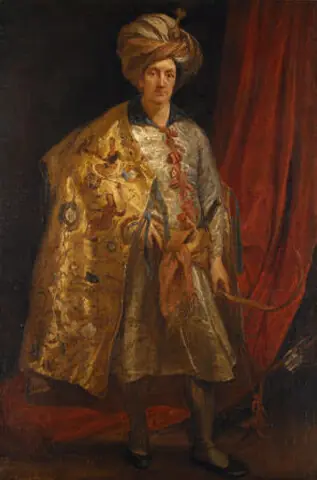
Over the following years, the younger Sherley travelled widely across Europe, representing Safavid interests before various courts. Dressed in Persian robes and presenting himself as the Shah’s ambassador, he became a fascinating diplomatic figure of the age. An Englishman stood serving a Persian monarch while negotiating with European rulers.
The Expedition
It was during one of his journeys to Persia that Robert found himself aboard the English ship, Expedition, in 1613. The vessel sailed under the command of Christopher Newport, bound for the Indian Ocean.
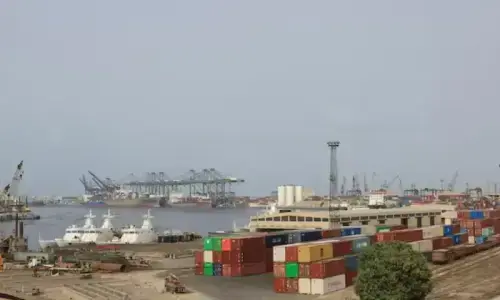
The ship reached the Makran coast and anchored off Gwadar on September 17, 1613. After its destruction, the port was on the margins of both the Mughals who had conquered Sindh, and the Safavids. Nazerbeg, a Persian accompanying Sherley, went on land and brought back a message that, while Makran was not formally under the authority of Shah Abbas, he would be welcomed and provided with safe passage inland.
The offer was appealing. Preparations began for the overland journey towards Isfahan. Sherley’s baggage and gifts were sent ashore, while arrangements were made for the caravan that would escort him. According to Walter Payton, as reproduced in Purchas’ Pilgrims — a nearly fantastical 17th century travel collection by Englishmen and others, which merit the need to vet multiple sources — things did not go exactly as planned.
By chance, a sailor aboard the Expedition overheard a conversation, in which Payton writes “…they had consulted and concluded upon the Massacre of us all.” Instead of escorting Sherley safely across Makran, they intended to lure members of the ship ashore, kill them and seize their property.
The discovery forced a rapid change of plans. Several locals who had boarded the ship were detained as hostages until Sherley’s goods were returned. Only after his possessions had been safely recovered did the Expedition raise anchor and depart Gwadar, now sailing towards Sindh.
Sherley’s reaction to the encounter, however, was somewhat unexpected.
A Factory that Never Was
Despite a narrow escape, Robert lay convinced that Gwadar possessed considerable commercial potential. According to British anthropologist Brian Spooner, Sherley wrote to the EIC, suggesting that the port could serve as a base for English trade with Persia.
Its location offered several advantages, wrote Sherley. It provided autonomy, close passage to the Safavids and “the richest traffic in the world.” From such a base, Sherley argued, English merchants could develop profitable commerce in Persian silk and other goods.
According to US-based historian Daniel Razzari, it was partly at his insistence that the British helped the Safavid’s recapture Hormuz. Therefore, instead of Surat as the site of the first English factory, it could have very nearly been at Gwadar. However, Persia was seen as a trading backwater and an Ottoman-Safavid truce reduced the need for maritime trade. The EIC’s attention was also already fixed on the opportunities presented by Mughal India.
Moreover, Sherley himself had become a somewhat ambiguous figure for the EIC. England had become Protestant, yet Robert cultivated close relationships with Catholic Europe during his diplomatic missions, promising them access to Persia if the British refused. Company officials, such as Thomas Roe, were wary of allowing an independent adventurer to shape their commercial strategy, particularly since the EIC held exclusive shipping rights for the English court in the Indian Ocean.
The proposal faded from consideration.
Gwadar Onwards
Gwadar’s later history followed a more regional path. The port remained a modest settlement along the Makran coast for much of the early modern period. In the late 18th century, it briefly assumed greater importance when the Khan of Kalat, Mir Nasir Khan I Ahmedzai, gave refuge to Sultan bin Ahmad Al Busaidi, who had fled a power struggle in Oman.
Mir Nasir Khan’s initial intentions were to help Sultan take over Oman, but then later offered him refuge at Gwadar, to rule as a fiefdom. Sultan then used the port as a base to regain his throne in Muscat, linking Gwadar to the political fortunes of the Omani dynasty. He kept Gwadar and, under Omani patronage, Gwadar and Chahbahar outstripped similar ports such as Jiwani and Pasni.
Meanwhile, Sultan was in no hurry to return it to the Khan of Kalat, who by now had to resist insurrections from feudatory states, later on spurred by the British Raj. Omani hold over the Makran developed further.
In the long narrative of imperial expansion in the Indian Ocean, the episode of Robert Sherley’s visit to Gwadar might appear little more than a historical curiosity, yet it offers a small reminder of how contingent such histories can be. The establishment of the EIC at Surat in 1613 can be seen as an inevitable development. Sherley’s brief encounter with Gwadar suggests otherwise. The possibility remains an intriguing footnote to the early encounters between Europe and the shores of the Arabian Sea.
From being the very first territories that could have fallen into British hands, Balochistan ended up amongst the very last, under Robert Sandeman and the creation of the Balochistan Agency in 1877. When Prince Karim Aga Khan IV funded the purchase of Gwadar in 1958, it also became amongst the last territories to be brought into Pakistan.
Correction: The print version of this article incorrectly stated that the creation of the Balochistan Agency took place in 1871. It occurred in 1877. The error is regretted.
The writer is Managing Editor, Folio Books
Published in Dawn, EOS, March 29th, 2026