Federal Constitutional Court asserts it is not bound by Supreme Court rulings
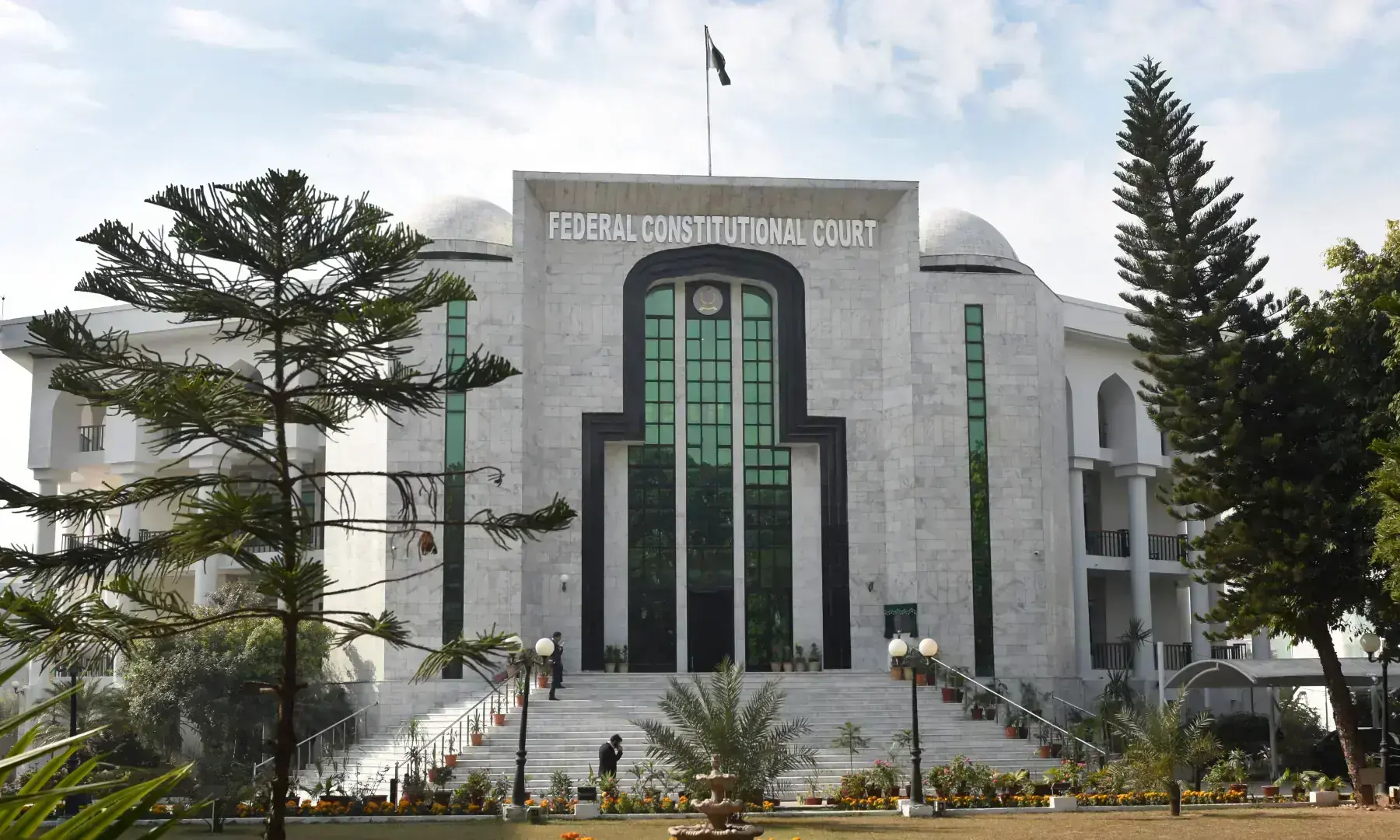
• Justice Rizvi says ‘precedential hierarchy’ stands restructured after 27th Amendment
• Court will follow earlier jurisprudence if not incompatible with evolved constitutional values
ISLAMABAD: The Federal Constitutional Court (FCC) has dispelled the impression that it was unconditionally bound by Supreme Court pronouncements, a position that was not necessarily required under the constitutional framework.
Justice Syed Hasan Azhar Rizvi explained that frequent references to Supreme Court judgements in FCC decisions might otherwise create a mistaken belief that the FCC was irrevocably bound by such rulings.
The judge had made these observations in a judgement upholding the validity of a marriage between a Christian woman and a Muslim man, while dismissing a habeas corpus petition filed by her father seeking the recovery of his daughter.
The judgement explained that Article 189 of the Constitution, which formerly accorded binding force to the judgements of the Supreme Court upon all courts, must now be read in light of the altered constitutional architecture ( 27th Amendment).
Upon the establishment of the FCC and the conferment upon it of final and binding authority in all matters, particularly constitutional matters, the precedential hierarchy stands constitutionally restructured, it added.
Accordingly, the binding force contemplated under Article 189 must be understood as operating subject to the overriding authority of the FCC.
The supremacy of constitutional adjudication now vests in the FCC, and all courts, including the Supreme Court, are bound by its pronouncements.
The judgement also clarified that the binding force of judicial precedent was not derived from institutional seniority but from the constitutional hierarchy itself. Where the Constitution expressly vests final interpretative authority in a particular court, its pronouncements necessarily prevail over all others, including those of courts which formerly exercised such jurisdiction. Consequently, judgements of the Supreme Court rendered prior to the establishment of FCC do not operate as binding precedents upon FCC, the judgement emphasised.
They nonetheless continue to command great persuasive value, particularly when grounded in sound reasoning, reflect a consistent line of authority and are in harmony with the text, structure, and underlying values of the Constitution, the judgement said.
Needless to mention, the doctrine of stare decisis has not been abrogated; rather, it has been recalibrated to accord primacy to constitutional supremacy.
The judicial discipline demands that precedent be reconsidered, not ignored and disregarded in silence and that continuity be preserved except where departure becomes a constitutional necessity, the FCC emphasised.
Thus the FCC would ordinarily respect and follow our earlier constitutional jurisprudence evolved by the Supreme Court, unless it is established that the same is manifestly erroneous, inconsistent with the constitutional text or scheme, or incompatible with fundamental rights and contemporary constitutional values, the judgement said.
Any departure from earlier Supreme Court precedent would be reasoned, express, and principled. The ultimate touchstone, however, remains the Constitution itself, whose meaning the FCC is duty-bound to expound with finality, the judgement said.
To sum it up, the departure from earlier Supreme Court precedent may be justified only where the FCC finds that such precedent is manifestly inconsistent with the text or structure of the Constitution; undermines or dilutes fundamental rights; reflects judicial overreach into legislative or executive domains; or has become incompatible with evolved constitutional values and democratic norms, it said. Or if there’s any other compelling reason which tends to advance the cause of justice, the judgement added.
Published in Dawn, March 27th, 2026