Freak storms to hit war-ravaged Middle East
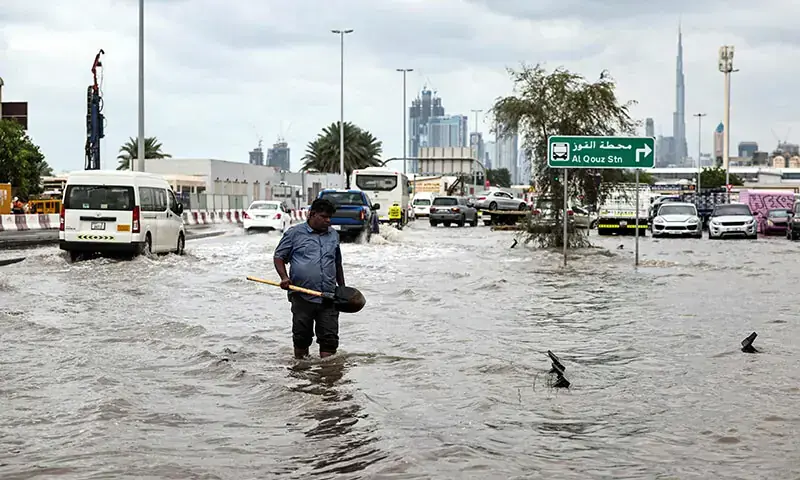


A TORNADO Alley-style storm system is about to hit the Middle East — a virtually unheard of atmospheric setup for the region, the Washington Post reported, as areas in the Gulf region received heavy rains.
Parts of the Arabian Peninsula and Persian Gulf could be slammed by strong to severe thunderstorms tomorrow (Thursday), bringing the po-tential for damaging winds, destructive hail and a few tornadoes, The Post said.
Large expanses of the desert may flood, with up to a year’s worth of rain falling in three days. At least one model shows storm effects stretching from parts of Iran toward Dubai and Abu Dhabi on Thursday afternoon.
The storm system could feature a few rotating thunderstorms, and there’s the exceptionally unusual risk of tornado activity in the desert.
Weather system developing over Mediterranean may be ‘supercharged’ by jet stream, causing winds up to 60mph
Major highways and airports could be inundated, adding complications to an already challenging geopolitical crisis affecting the Middle East, as the US and Israel war with Iran continues.
This is not a part of a world that often sees this kind of severe weather. Although that may be shifting.
Dubai, which averages 4 inches of rain annually, could see 3 to 6 inches by the end of the week, WaPo said.
The Labour Ministry in Qatar issued an alert regarding the adverse weather on Tuesday.
On Tuesday, a developing upper-level low — or pocket of cold air, low pressure and spin aloft — was present over the Mediterranean. To the south, the jet stream — a river of swiftly moving winds in the upper atmosphere — is squeezed.
Simultaneously, a surface low-pressure system will strengthen near Baghdad on Wednesday.
By midday today (Wednesday), the approaching jet stream dip is expected to swing more dramatically southeast over Egypt and the Red Sea, before pivoting over Saudi Arabia early on Thursday.
Any thunderstorms that are ongoing over the Persian Gulf or Gulf of Oman will feel those fierce jet stream winds aloft. Changing winds with height, meanwhile, could encourage storms to rotate. That means that rotating supercells — long-lived thunderstorms characterised by a deep, persistently rotating updraft known as a mesocyclone — can’t be ruled out.
Any supercell thunderstorms could produce large, damaging hail up to the size of eggs, damaging straight-line winds near 60mph and torrential rainfall, as well as the outside chance of an isolated tornado or two. Waterspouts could accompany any offshore thunderstorms, posing a hazard to maritime commerce.
Meanwhile, there are indications of additional strong storms and heavy rainfall into early April, WaPo reported.
Published in Dawn, March 25th, 2026