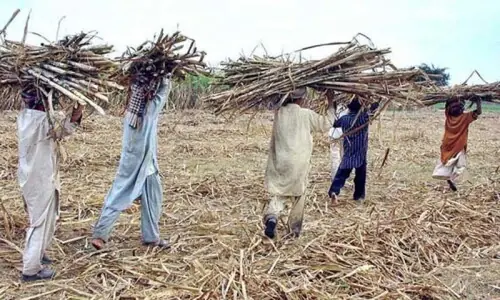
LAHORE: In a dramatic reversal of Pakistan’s agricultural landscape, Rahim Yar Khan district - once the country’s largest cotton producer - has witnessed a historic collapse in cotton output and quality due to an unchecked expansion of sugarcane cultivation, even as reports emerge of yet another sugar mill being planned in the area.
Cotton Ginners Forum Chairman Ihsanul Haq warn that the shift from cotton to sugarcane has severely undermined the country’s textile backbone. He notes that until around 15 years ago, Rahim Yar Khan consistently led national cotton production, contributing 11-13 per cent of the country’s total output. The district’s premium “Khan Cotton,” renowned for its superior quality due to unique sunlight conditions, once enjoyed strong demand in European markets and was used by leading global apparel brands.
At its peak, Pakistan produced 14.8 million bales of cotton in 2011-12, with Rahim Yar Khan alone contributing around 1.5 to 1.8m bales. Earlier, in 2004-05, the district recorded a historic high of 1.84m bales out of the national total of 14.3m bales. However, the situation began to deteriorate after 2012 due to the politically-driven establishment of new sugar mills and expansion of existing ones, leading farmers to switch to sugarcane cultivation.
Cotton acreage plummets; Sindh overtakes Punjab in output; six sugar mills operative, another being set up
As a result, cotton cultivation in Rahim Yar Khan has shrunk from around 800,000 acres to less than 300,000 acres, with a continuing downward trend. The district currently hosts six sugar mills with a combined crushing capacity equivalent to eight mills, while additional mills near the Sindh-Punjab border are also sourcing sugarcane from the area.
Reports of another sugar mill near Zahir Pir and one more along the border have raised further concerns about the future of cotton in the region.
The impact is now visible at the provincial level. Historically, Punjab outperformed Sindh in cotton production by as much as 352pc. In 2011-12, Punjab produced 12.1m bales compared to Sindh’s 2.68m. However, due to the rapid expansion of sugarcane farming in Punjab, the trend has reversed.
For the first time in history, Sindh surpassed Punjab in 2024-25, producing 2.807m bales against Punjab’s 2.718m. The gap widened further in 2025-26, with Sindh producing 2.915m bales compared to Punjab’s 2.693m, and projections suggest Sindh may maintain its lead in the coming years.
Haq emphasises that cotton grown in regions without sugarcane - such as parts of Sindh, Balochistan, and Cholistan -- still maintains superior quality, higher oil content, and better seed germination, fetching premium prices in the market.
He urges Prime Minister Shehbaz Sharif to ensure strict implementation of crop zoning laws across the country. Strengthening cotton cultivation, he argues, is essential for reducing imports of cotton and edible oil, conserving foreign exchange reserves, and providing much-needed support to Pakistan’s struggling economy.
Published in Dawn, March 25th, 2026