Israeli attack on largest gas field turns Middle East into powder keg


• Tehran threatens, launches retaliatory attacks on energy facilities in the region
• UAE, Qatar slam Tel Aviv attack on South Pars field, which Israel claims was approved by Washington
• Pezeshkian warns of ‘uncontrollable consequences’ as oil stays above $106 per barrel
• World economies scale back, take measures to cope with fallout
PARIS / DUBAI: Oil-rich Middle Eastern states were in a state of panic, after an Israeli attack on the world’s largest gas field triggered threats of severe retaliation from Tehran.
Pars is the Iranian sector of the world’s largest natural gas deposit, which it shares with Qatar across the Gulf.
The strikes hit the South Pars/North Dome mega-field, the largest known gas reserve in the world, supplying around 70 per cent of Iran’s domestic natural gas.
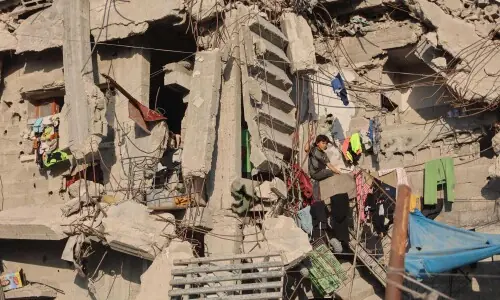
The Fars news agency reported on Wednesday that gas tanks and parts of a refinery had been hit, workers had been evacuated to a safe location and emergency crews were trying to put out a fire.
As a result, Iranian flows to Iraq were halted as it diverted gas domestically, a senior Iraqi official told Reuters. Tehran supplies between a third and 40pc of Iraq’s gas and power needs.
Iranian President Masoud Pezeshkian has condemned attacks on the Islamic republic’s energy infrastructure, writing on X, “Such aggressive acts will yield nothing for the Zionist-American enemy and their supporters.
“This will complicate the situation and could have uncontrollable consequences, the scope of which could engulf the entire world,” he adds.
Israel claimed the attack was carried out with US consent, and in response, Iran’s Revolutionary Guards told Saudi Arabia, the UAE and Qatar to evacuate several energy facilities.
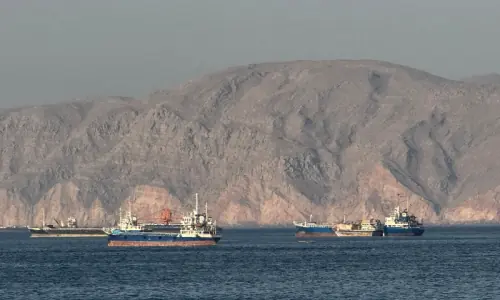
The attacks have raised concerns that Iran could now target infrastructure of global energy majors across the Gulf, and alternative regional export routes such as Saudi Arabia’s Red Sea port of Yanbu.
The warning was directed at Saudi Arabia’s Samref Refinery and Jubail Petrochemical Complex, the UAE’s Al Hosn Gas Field, and Qatar’s Mesaieed Petrochemical Complex, Mesaieed Holding Company and Ras Laffan Refinery.
“These centres have become direct and legitimate targets and will be targeted in the coming hours. Therefore, all citizens, residents, and employees are requested to immediately leave these areas and move to a safe distance without any delay,” Iranian state media cited authorities as saying.
Later, Saudi Arabia said it destroyed five drones headed towards a gas plant and four missiles targeting its capital on Wednesday, while Qatar said it was dealing with multiple Iranian attacks, and a fire in the Ras Laffan area. UAE also said it was responding to fresh missile threats.
Both Doha and Abu Dhabi had earlier condemned Israeli attacks on the South Pars field as “dangerous and irresponsible”.
Qatar has fully shut its liquefied natural gas production because of the war, and any damage to facilities could extend the outage beyond May, threatening to keep a fifth of global LNG supply offline.
As a result, Brent crude prices rose over 6pc at one point to nearly $110 a barrel, before settling back down towards $106.95, a gain of 3.4pc.
The attacks on South Pars make it even more likely the war will continue into May, said Torbjorn Soltvedt, principal Middle East analyst at risk intelligence company Verisk Maplecroft.
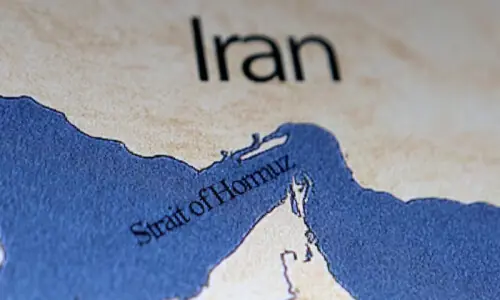
“The biggest concern will be the potential for attacks against Saudi Arabia’s East-West pipeline or export facilities on the Red Sea which alongside Fujairah offer the only significant alternative to the Strait of Hormuz,” Soltvedt added.
Fallout on markets
To help ease energy costs that have surged since US-Israeli strikes on Iran plunged the Middle East into war, President Donald Trump has temporarily waived a century-old shipping law.
Trump’s move to issue a 60-day Jones Act waiver would lift a ban on foreign-flagged vessels transporting cargo between US ports over this period.
It is a step to mitigate “short-term disruptions to the oil market” from the conflict, said White House Press Secretary Karoline Leavitt in a statement.
Iraq, meanwhile, announced it had resumed limited oil exports through the Turkish port of Ceyhan, using a pipeline that avoids the under-fire Strait of Hormuz.
Shipping fuel prices have reached “truly unprecedented” levels, having nearly doubled from the cargo crunch driven by the Middle East war, an industry leader told AFP on Wednesday.
The war is now forcing petrochemical giants in key Asian economies to cut production as the conflict rattles supplies of naphtha, a crucial oil-derived component used to make a range of plastic goods.
German chemicals giant BASF raised prices on some of its industrial products in Europe by 30pc due to rising energy and input prices.
Meanwhile, Sri Lanka has urged electric vehicle owners to stop charging their cars at night, saying the surge in demand is forcing the country to burn more coal and diesel to keep the power grid running.
Published in Dawn, March 19th, 2026