Unable to meet Imran, Aleema denies blocking PTI leaders’ access to him
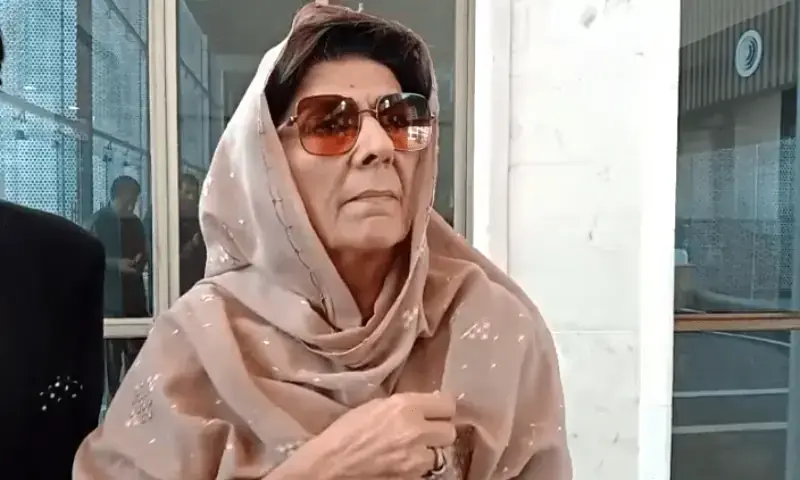

ISLAMABAD/Lahore: Rejecting media reports that she is opposing meetings between Imran Khan and party leaders, Aleema Khan on Tuesday questioned how she could stop such meetings when she herself has been unable to meet her brother.
“People across Pakistan are demanding the release of Imran Khan. The whole world is raising the same demand. Just wait and see — people will come out of their homes and secure his release. Moreover, as the global situation changes, I am hopeful he will be released,” Ms Khan said while talking to media persons outside Adiala jail.
“We are waiting here to find out whether we will be allowed to meet Imran. I believe we will not be granted permission, as they want to hide his health condition and what has been done to him. We had requested the chief justice to allow his medical treatment at Shifa International Hospital. We do not insist on meetings if he is allowed proper medical treatment,” she added.
She said the Chief Justice had forwarded the request for medical treatment to chief commissioner, who comes under Mohsin Naqvi.
Jailed PTI leaders warn economic stability may collapse within weeks if Gulf tensions continue
Replying to a question about attacks from Afghanistan in Khyber Pakhtunkhwa, Ms Khan said she feels pain for every martyr but added that such questions should be directed to the provincial government. She also stressed that there should be no tensions between Muslims.
Open letter
Meanwhile, in an open letter shared by their counsel, Rana Mudassar Umer, PTI leaders Shah Mahmood Qureshi, Yasmin Rashid, Ejaz Chaudhry, Mian Mahmoodur Rasheed, and Omar Sarfraz Cheema warned that the hard-earned macroeconomic stability achieved over the past three years — largely by placing financial strain on ordinary citizens — could dissipate within the next three weeks if the Gulf conflict persists.
Pakistan’s fragile economy has been further exacerbated by a lack of economic restructuring measures and internal disagreements over economic strategy, effectively undermining the chances of reaching a staff-level agreement with the International Monetary Fund (IMF), according to five senior PTI leaders currently incarcerated in Kot Lakhpat Jail.
Titled “From Kot Lakhpat with Love: Protected from Supersonic Missiles, Pakistanis Have Been Hit by Oil and Gas Missiles”, the letter while commenting on the country’s economic situation states that it is becoming increasingly difficult to meet the performance criteria agreed upon during the formulation of the current fiscal year’s budget.
Mr Qureshi and the other leaders emphasised that economic stability is closely tied to political stability, observing that “the current political environment and business as usual is no longer an option.” They urged the government to recognise and accommodate the complexities of federalism.
They highlighted that an increase in diesel prices during wheat harvesting, along with rising gas prices at the start of the Kharif season and higher fertiliser costs, would severely impact farmers.
“The rise in the cost of these two critical agricultural inputs will have a direct and immediate impact on agricultural productivity and the purchasing power of the majority of the rural population,” they added.
Cotton production has fallen significantly short of government estimates, forcing the textile sector to rely on expensive imported cotton lint.
“Our food imports have increased by over 18 per cent, while food exports have declined by more than 34 per cent during the first eight months of the current fiscal year,” the letter noted.
The leaders pointed out that remittances have, in recent years, exceeded export earnings and become a key pillar of Pakistan’s financial stability. “Remittances were expected to reach nearly $42 billion this fiscal year and play a crucial role in financing the trade deficit, servicing external debt, and supporting domestic consumption,” they said.
Highlighting that nearly 55 per cent of remittances originate from approximately 5.5m Pakistanis working in Gulf countries, they warned that prolonged instability in the region could slow investment and tourism, reduce job opportunities for migrant workers, and ultimately impact remittance inflows.
They added that the State Bank of Pakistan had previously brought inflation down to around 7 per cent through monetary policy, but it is now rising again.
“A persistent demand from the business community for a reduction in the policy rate will be difficult to accommodate under current circumstances, further weakening the investment climate and business confidence,” the leaders observed.
Mr Qureshi and his colleagues also stressed that investments from friendly Gulf countries may need to be reassessed.
They urged the government to curb the rising wave of terrorism and counter foreign-sponsored militancy. “Improved governance and law and order are essential to attract meaningful investment into Pakistan,” they emphasised.
The leaders also expressed concern over the shift from annual to monthly rollovers of foreign deposits with the State Bank.
They argued that economic stabilisation under IMF programmes often results in slower growth, as such programmes focus primarily on managing fiscal deficits. “A country with a large youth population, rising unemployment, and widespread poverty cannot afford wasteful government expenditure and misguided development priorities,” they stressed.
The PTI leaders suggested that investment in waterways should have been prioritised over motorways.
They concluded by urging the government to reprioritise expenditures and reassess political attitudes. “If Pakistan is to move forward, political interests must be subordinated to national needs,” they said.
Published in Dawn, March 18th, 2026