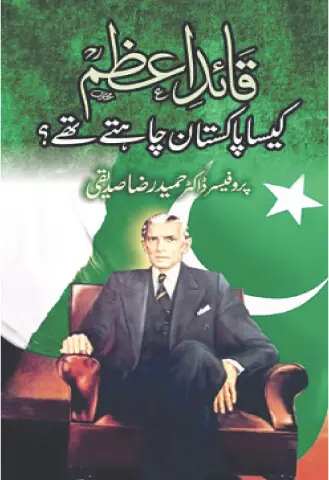
Quaid-i-Azam Kaisa Pakistan Chahtay Thay?
By Prof Dr Hameed Raza Siddiqui
Qalam Foundation
ISBN: 978-9697-460663
136pp.
As Pakistan enters the 150th year of Quaid-i-Azam Mohammad Ali Jinnah’s birth, the urgency to clearly understand his political vision has never been greater.
Every constitutional crisis, every ideological confrontation and every national setback inevitably drag Pakistan back to the same unresolved question: what kind of country did its founder actually want? It is at times like this that it becomes a national necessity, not an academic indulgence or a ceremonial exercise, to revisit Jinnah’s ideas.
It is within this context that Prof Dr Hameed Raza Siddiqui’s book Quaid-i-Azam Kaisa Pakistan Chahtay Thay? [What Kind of Pakistan Did the Quaid-i-Azam Want?] assumes particular significance.
The work arrives not as another addition to the already crowded shelf of Jinnah’s biographies but as a corrective to decades of selective memory, political appropriation and historical distortion. Siddiqui does not present Jinnah as a marble statue to be admired from a distance. Instead, he portrays him as a thinking statesman — firm in principle, flexible in method and deeply concerned with constitutional order, democratic governance and moral responsibility.
Published by the Qalam Foundation, the book’s structure allows readers to engage with Jinnah thematically rather than being confined to a strictly chronological narrative. One of its greatest strengths is its insistence on primary sources. Siddiqui builds his argument through direct references to Jinnah’s speeches, interviews, letters and statements. Rather than filtering Jinnah through later ideological frameworks, he allows the Quaid to speak in his own words. This approach gives the book both authority and clarity, making it difficult to dismiss or reinterpret Jinnah’s positions according to contemporary political convenience.
A meticulously researched book offers a corrective to decades of selective memory, political appropriation and historical distortion about Quaid-i-Azam Mohammad Ali Jinnah’s vision for the country he founded
Furthermore, Quaid-i-Azam Kaisa Pakistan Chahtay Thay avoids anecdotal glorification and emotional storytelling that often dominate popular narratives. Instead, Siddiqui constructs a careful timeline, beginning with Jinnah’s early political engagements in London and moving through the major milestones of his career, culminating in the final months of his life. Every quotation, meeting and political intervention is supported by verifiable references. Nothing is left to hearsay, memory or folklore.
Siddiqui’s background as a seasoned academic is visible throughout the book. Having authored 10 books — many of them dealing with Pakistan’s ideological and intellectual foundations — he approaches Jinnah with the seriousness of a teacher who understands that future generations may rely on this work to grasp the very basis of their state. The writing is deliberately structured and reflects a conscious effort to educate rather than merely impress.
To answer the deceptively simple question at the heart of the book, Siddiqui divides Jinnah’s political thought into 20 interconnected themes, including governance, foreign policy, economic justice, constitutionalism, youth, political ethics and the philosophical rationale behind the demand for Pakistan. This thematic organisation allows readers to engage with Jinnah’s ideas without being overwhelmed by the density of historical detail.
One of the most revealing sections of the book revisits Jinnah’s formative years in London. Siddiqui recounts how the young law student boldly campaigned for Dadabhai Naoroji during the 1892 general elections for the Liberal Party in the Finsbury Central constituency in Britain, even when Prime Minister Lord Salisbury launched a racially charged smear campaign against the Indian candidate. Jinnah’s decision to stand with Naoroji, despite the prevailing racial prejudices of the time, reflected an early display of political courage and moral independence. It was a glimpse of the man who would later refuse to bend before the empire or majority pressure.
The book’s treatment of the Two-Nation Theory is particularly forceful. Siddiqui does not attempt to reinterpret Jinnah’s position through modern ideological lenses, nor does he soften its implications. Instead, he presents Jinnah’s own arguments, drawn from speeches delivered at critical moments.
Through these texts, Siddiqui demonstrates how Jinnah consistently maintained that Muslims and Hindus were not merely followers of different religions, but members of distinct social, cultural and political orders. Without a separate homeland, Jinnah believed, Muslims would remain a permanently disadvantaged minority, excluded from power and economic opportunity.
The book also addresses one of the most frequently cited criticisms against Jinnah: his declaration of Urdu as the national language. Siddiqui revisits Jinnah’s March 21, 1948 speech in Dhaka, placing it in its full historical context. He highlights Jinnah’s clear assurance that provincial languages were a matter of local choice and that Bengali would always remain the language of the province. According to Siddiqui, Jinnah’s insistence on Urdu was not an act of cultural exclusion but an attempt to create a unifying link language for a geographically divided nation.
Furthermore, with regard to the most contested question of all — whether Jinnah envisioned a secular or Islamic state or not — Siddiqui’s conclusion is unambiguous. Jinnah’s Pakistan was to be Islamic in spirit but democratic in terms of its structure. It was to be a welfare state inspired by Islamic principles of justice, equality and compassion, yet firmly opposed to clerical dominance or theocratic rule. Siddiqui reminds readers that Jinnah repeatedly rejected the idea of a theocracy and insisted on constitutional governance, minority rights and the rule of law.
Throughout the book, Siddiqui emphasises Jinnah’s intellectual kinship with Allama Iqbal. One of the most poignant moments comes from Jinnah’s 1940 Iqbal Day speech, where he declared that, if forced to choose between an empire and Iqbal, he would choose the poet-philosopher. The statement underscores how deeply rooted Pakistan’s ideological foundations were in thought and philosophy, not in political opportunism.
The book also gains contemporary relevance when read against current regional realities. In the backdrop of rising atrocities against minorities in India, many of Jinnah’s warnings now appear disturbingly prophetic. Arguments once dismissed as exaggerations or political tactics increasingly resemble sober assessments of the Subcontinent’s future. Jinnah’s fears have not faded with time; they have unfolded.
The final chapter widens the lens by compiling tributes to Jinnah from his contemporaries, including political opponents. Vijay Lakshmi Pandit’s famous remark serves as a fitting conclusion: “Even if the Muslim League had produced a hundred Gandhis, the Congress could never have produced another Jinnah.” Such acknowledgements underline the global stature and moral authority Jinnah commanded.
By the end of Siddiqui’s book, a sobering realisation emerges. The Pakistan Jinnah dreamed of — democratic, principled, tolerant and welfare-oriented — remains largely unrealised. Yet, the book succeeds in reigniting admiration for the Quaid, not as a symbol but as a guide.
In that sense, it is more than a biography or an academic study. It is an invitation — perhaps even a plea — to return to Pakistan’s original blueprint and to honestly measure how far the nation has drifted from the political ethos of its founder.
The reviewer writes on old films and music and loves reading books X: @suhaybalavi
Published in Dawn, Books & Authors, March 19th, 2026