ISPR takes exception after Indian army chief says Pakistan should decide between being 'part of geography' or not
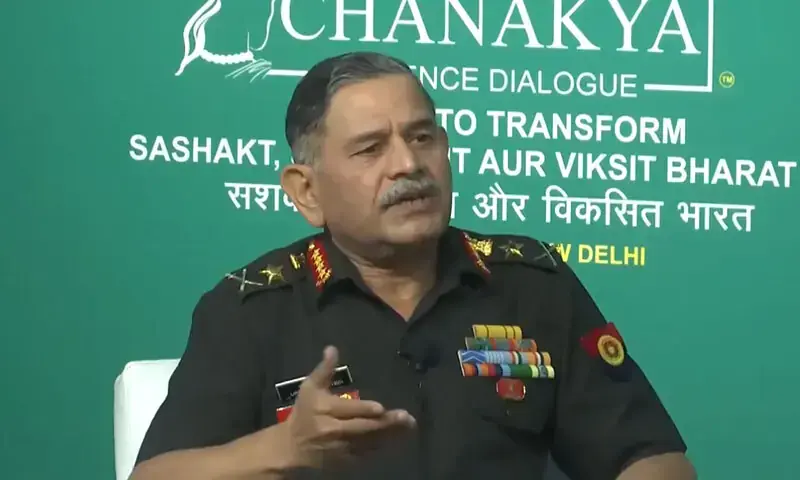


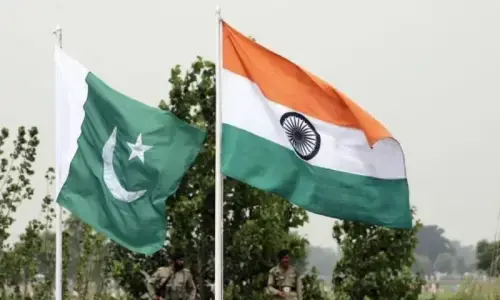
The Inter-Services Public Relations (ISPR) on Sunday took exception to the Indian army chief’s recent provocative remarks and cautioned New Delhi against pushing South Asia towards another conflict with “devastating” consequences for the region.
“Indian COAS gave a provocative statement during a recent interview that ‘Pakistan should decide if it desired to be part of geography and history’,” ISPR noted in a statement issued in response to Indian Army Chief Gen Upendra Dwivedi’s comments made a day earlier.
“Contrary to the delusional and hallucinational belief system and despite the omnipresent ill wishes that prevail in Hindutva-led India, Pakistan is already a country of consequence at global level, a declared nuclear power and an indelible part of South Asia’s geography and history,” the ISPR said.
It observed that the statement reflected that the “Indian leadership has neither been able to reconcile with the very idea of Pakistan nor it has learnt the right lessons, even after [the] passage of eight decades”.
“This hubristic, jingoistic and myopic mindset has repeatedly pushed South Asia towards wars and crises,” the military’s media affairs wing highlighted.
“Threatening a sovereign nuclear neighbour with elimination from ‘geography’ is not strategic signalling or brinkmanship; it is sheer bankruptcy of cognitive capacities, madness and warmongering despite knowing the reality that such geographic obliteration would certainly be mutual and comprehensive,” the ISPR warned.
It stressed that “responsible nuclear states reflect restraint, maturity, and strategic sobriety”, rather than speaking the “language of civilisational supremacy or national erasure”.
The ISPR advised the Indian leadership “not to attempt to push South Asia towards another crisis or war whose consequences would only be devastating for the complete region and beyond”.
“India needs to reconcile with Pakistan’s salience and learn to peacefully co-exist with it. Otherwise, any attempt to target Pakistan can trigger consequences that shall neither be geographically confined nor strategically or politically palatable for India,” the military further warned.
The ISPR highlighted that the “Indian narrative conveniently ignores India’s own historically documented record of being a harbinger of terrorism in the region, a state sponsor of terrorism, key source of regional instability, practitioner of transnational assassinations and a hotbed of disinformation campaign across the globe”.
“Delhi’s aggressive posturing stems less from confidence and more from frustration at its inability to harm Pakistan, that has been brutally exposed during Marka-i-Haq,” it added, referring to last year’s military escalation between the two neighbours.
At an interactive session in New Delhi on Saturday, Gen Dwivedi was asked about how the Indian army will respond if the “circumstances that led to Operation Sindoor last year” arose again, the Press Trust of India reported.
The Indian army chief reiterated New Delhi’s terrorism allegations against Pakistan, which the latter has vehemently rejected, and said that Pakistan had “to decide whether they want to be part of geography or history or not”.
Earlier this month, Pakistan marked the first anniversary of the May 2025 conflict between Pakistan and India, which included a four-day military escalation.
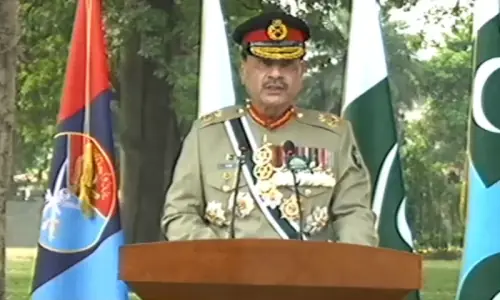
At a ceremony held on May 10 at General Headquarters (GHQ) in Rawalpindi to commemorate the victory, Chief of Defence Forces (CDF) and Chief of the Army Staff Field Marshal Asim Munir warned that any future “misadventure” against Pakistan will result in “extremely far-reaching and painful” consequences for the enemy.
A growing body of commentary from international analysts suggests that the next such crisis between the two nuclear-armed neighbours is not only more likely, but will prove dangerous, with fewer opportunities for outside powers to contain it.