
Cities hide their history in plain sight. Karachi is no different. The past of this city by the sea is not buried in books but is spoken every day by its people, and especially its bus conductors.
Indeed, the names given to Karachi’s areas and localities were not set at random; they have strong links to history. From a small fishing settlement called Kolachi, from which Karachi derives its name, to the various suffixes and affixes added to its areas during the pre-colonial and post-Partition eras, each name reflects an episode in the city’s evolution.
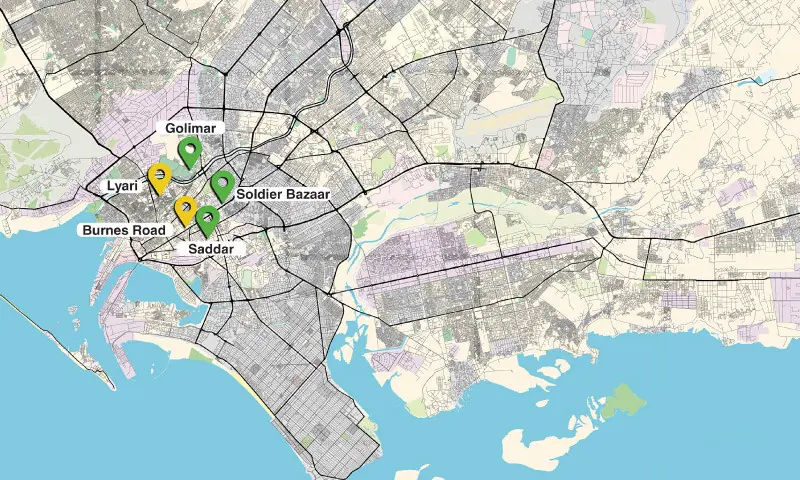
The famous neighbourhoods of Mithadar and Kharadar preserve this early history. In the 18th century, Karachi was surrounded by defensive walls, with two entry points or gates. The gate facing the sea was called Kharadar, derived from the Sindhi words khara [salty] and dar [gate], meaning “the gate of salt water.”
The other gate faced towards the Lyari River and was called Mithadar, from meetha meaning sweet, or “the gate of sweet water.” Although the walls of the old city no longer exist, the names of these gates survived and continue to identify prominent areas of the city today.
Saddar is another iconic area of Karachi. The name derives from the Persian and Urdu word sadr, meaning centre. During British rule, Saddar became the administrative and commercial hub of the city, with government buildings, markets and offices located there.
Karachi’s history is not only preserved in archives and museums. It lives in the names of its neighbourhoods, each reflecting an episode in the city’s long and layered past…
Some of the older parts of Karachi derive their names from the colonial era, which left a lasting mark on the city’s map. Burnes Road was named after Dr James Burnes, a British official who served in Sindh during the 19th century. Clifton was named after a seaside town in England, reflecting the British tendency to replicate familiar place names in their colonies.
When residential quarters were built for British civil officers, the locality became known as Civil Lines, another important district of Karachi. Similarly, the marketplace where British soldiers would occasionally shop became known as Soldier Bazaar.
Moving towards the sea, the popular picnic spot Hawke’s Bay was named after Bladen Wilmer Hawke, a British aristocrat who owned a beach house in the area during the 1930s.
Religious landmarks have also shaped the city’s geography. For instance, Guru Mandir takes its name from a historic temple dedicated to the Hindu deity Shiva. Although the temple building is no longer operational, the locality continues to be known by this landmark.
The period after Partition created another wave of names that continue to exist today. Named after Pakistan’s first prime minister, Liaquat Ali Khan, the area of Liaquatabad is a major residential and commercial locality of the city.
However, it is still widely known by its older name, Lalukhet. This name comes, reportedly, from a farmer named Lalu, who owned agricultural land in the area before Partition. When the government acquired the land to build housing for incoming migrants, the settlement informally became known as Lalukhet, or “Lalu’s field.”
Golimar is another place whose name originated during the colonial era. The name Golimar means “fire the bullet.” The area was once used as a shooting range by the British military, which is how the locality acquired its name. In the same way, Nazimabad, established in 1952, links its name with Khawaja Nazimuddin, Pakistan’s second governor-general.
During the early years after Pakistan’s creation, government planning produced several distinctive names for Karachi’s localities. Federal B Area, for instance, was developed when Karachi served as the country’s capital. The area was part of a housing scheme created for federal government employees working in the capital. Nearby lies the locality known as Buffer Zone, which was originally intended to separate government installations from nearby residential areas.
Paposh Nagar, another well-known area of Karachi, received its name because workshops there produced shoes and leather goods during the 1950s and 1960s. The name literally means “town of footwear.”
The area called Lyari, one of the oldest settlements in Karachi, takes its name from the Sindhi word lyar, referring to a type of tree that grows along riverbanks.
Similarly, the area of Malir derives its name from the Sindhi language, referring to greenery, fertile land or a valley, as the region was once known for orchards and agricultural settlements. Manghopir, another historic locality, takes its name from the Sufi saint Pir Mangho, whose shrine and traditions remain important to residents of the area.
Karachi’s localities were also named during the rise of industrial and administrative planning. SITE is an acronym for Sindh Industrial Trading Estate, a major industrial zone in the city, while Baldia Town takes its name from the Urdu word baldia, meaning municipality. Shah Faisal Colony was named after King Faisal of Saudi Arabia, reflecting the diplomatic and cultural ties between Pakistan and the Kingdom.
Some of Karachi’s important markets also retain names rooted in the colonial era. Lea Market and Bolton Market are two names familiar to almost every Karachiite.
Lea Market was named after Sir James Lea, a British commissioner of Sindh, while Bolton Market was named in honour of Charles Bolton, a municipal official during the colonial period. Though these names may appear ordinary today, they reflect the administrative structures that once governed the city.
For Karachi’s residents, the names of these areas are part of everyday life. Yet hidden within them is a rich history of culture, geography and memory. These names reveal the origins of the city and show how language and history continue to shape the identity of Karachi’s neighbourhoods.
The writer is a columnist and author. He can be contacted at omariftikhar82@gmail.com
Published in Dawn, EOS, March 19th, 2026