Iraqi Hezbollah’s commander killed in Baghdad strike
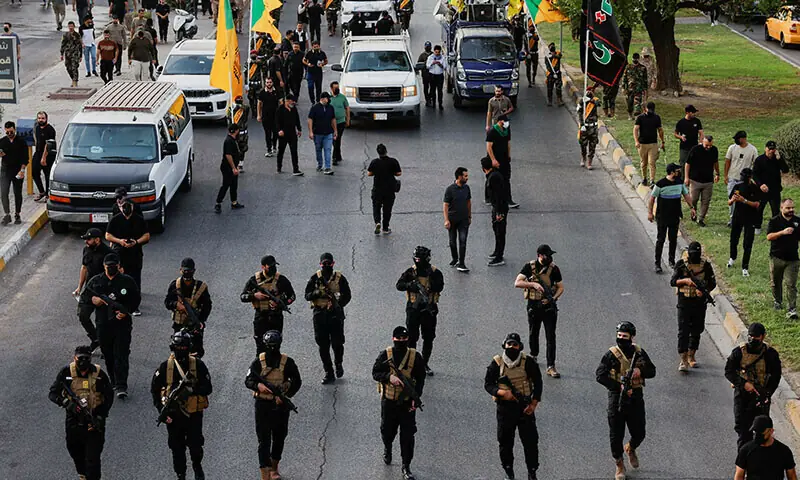
BAGHDAD: Iraq’s powerful Kataeb Hezbollah on Monday said its senior commander and security spokesperson Abu Ali al-Askari had been killed.
The group’s leader Ahmad al-Hamidawi, also known as Abu Hussein al-Hamidawi, said on Monday in a statement “we announce the martyrdom of Haj Abu Ali al-Askari”, without providing any details on how and when Askari was killed.
A security official said that “Abu Ali al-Askari is Abu Ali al-Amiri, the commander who was killed in a strike on Baghdad on Saturday”.
Hashed al-Shaabi fighters killed
A strike on Monday near Iraq’s western border with Syria killed six fighters from the former paramilitary coalition Hashed al-Shaabi, the alliance said.
The fighters from the alliance — also known as the Popular Mobilisation Forces (PMF), now part of Iraq’s regular army — were struck by a “Zionist bombing” that targeted “an official security position belonging to the Hashed al-Shaabi”.
Another four fighters were wounded, the group added in its statement. The Hashed al-Shaabi is an alliance of paramilitaries and factions created in 2014 to fight jihadists, and is now integrated into the Iraqi armed forces.
Iran-backed groups have brigades that operate within the alliance, but have a reputation for acting on their own.
Earlier, an official with the group said that the attack hit a checkpoint, blaming the United States.
He said the checkpoint, which also housed army and police personnel, was targeted again when ambulances arrived to help victims.
Since the start of the Middle East war on February 28, bases belonging to Hashed al-Shaabi have been hit several times, with strikes mostly targeting US-blacklisted Tehran-backed armed groups.
The Hashed al-Shaabi denounced the “repeated aggressions” against its forces.
Iraq has recently regained a sense of stability following years of conflict, and was unwillingly drawn into the current Middle East war after having long been a proxy battleground between the US and Iran.
These groups are also united under a loose alliance called the Islamic Resistance in Iraq, which has claimed attacks against US bases in Iraq.
Published in Dawn, March 17th, 2026