Govt hikes petrol, high-speed diesel prices by Rs55 per litre
The government announced a Rs55 per litre hike in the price of petrol and high-speed diesel each on Friday.
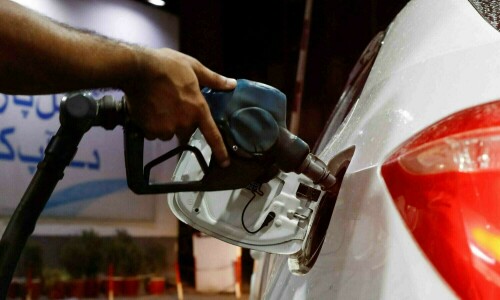
Consequently, the ex-depot high-speed diesel rate has been fixed at Rs335.86 per litre while the ex-depot petrol price has been revised to Rs321.17 per litre from Rs266.17 per litre, with an increase of 17pc.
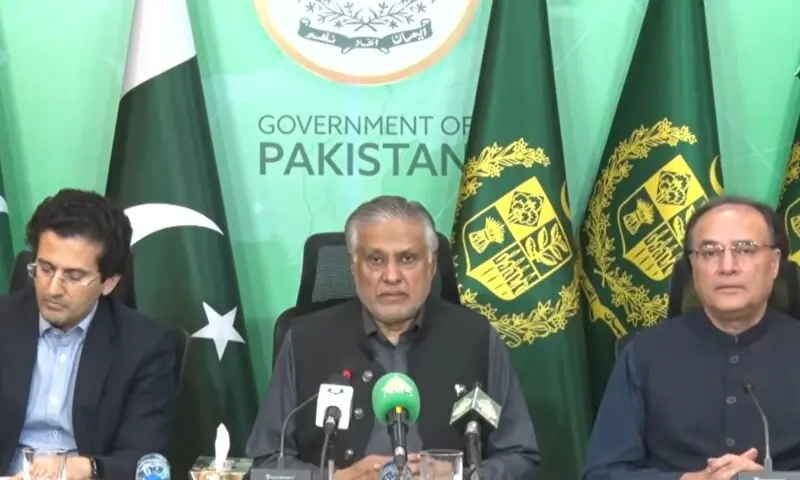
The announcement was made by Petroleum Minister Ali Pervaiz Malik during a press conference alongside Deputy Prime Minister and Foreign Minister Ishaq Dar and Finance Minister Muhammad Aurangzeb.
Dar said during the press conference that the new prices will come into effect from 12am on Saturday.
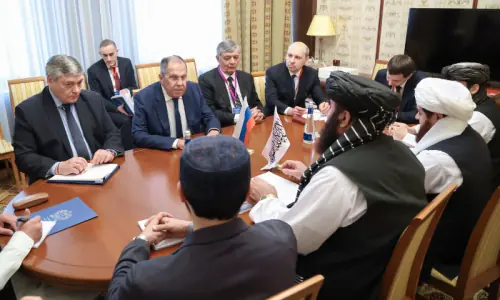
He began by talking about the ongoing war between Iran and the US and Israel, adding that the conflict had spilt over.
In this scenario, he said, the prices of petroleum products were soaring. “There has been an increase of 50 per cent to 70pc in various products’ prices,” he noted, adding that in other countries, the trickle-down effect was visible with an “automatic increase in [petroleum] prices”.
But in Pakistan, he said, Prime Minister Shehbaz Sharif had been “careful and deliberations have been going on for the past two to three weeks”.
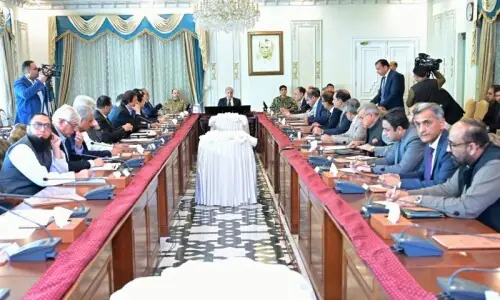
“There is a permanent committee that reviews [the situation] regularly under the leadership of Ali Pervaiz Malik and Aurangzeb,” he said, adding that the PM had also held meetings and reviewed the global situation.
“A committee led by me was then constituted,” he said, adding that it also included Malik and Aurangzeb. “We engaged the relevant stakeholders, and our objective was to pass the minimum effect [of the Middle East conflict on petroleum prices] to the end consumer.”
Dar said the government was making efforts to work with other countries to de-escalate the situation in the Middle East, “but God knows how long it will take”.
PM Shehbaz and Chief of Defence Forces and Chief of Army Staff Field Marshal Asim Munir had also been in contact with the civilian and military leadership of other countries in this regard, he mentioned.
He concluded that the new measures, taken in light of the ongoing situation, would take effect from 12am on Saturday.
Speaking after him, Aurangzeb said the committee constituted by the PM had been meeting daily for the past five days, where the stock of the situation was taken.
He said energy and Pakistan’s economy were joined at the hip. “So we are also looking at the wider implications for the economy,” he said, referring to the ongoing Middle East crisis and its effect on petroleum products’ supply and prices.
However, at present, “we are at a good place in terms of macro-stability … So there is no panic discussion. But having said that, hope is not a strategy. Therefore, we have to come together as whole-of-government. We have to do scenario planning and analysis, so that our approach as a whole-of-government remains proactive”, he explained.
He said demand or load management would turn out to be an important factor in terms of how the government took things forward.
“So in the next two days, we will meet the four chief ministers and their secretaries because the execution rests with the provinces … we will meet them to share our message with them and take their buy-in,” he added.
For his part, Malik said the country was facing “unusual circumstances”, and the “fire that ignited in our neighbourhood has engulfed the entire region”. More importantly, he added, “we do not know how long this crisis will persist”.
“As we don’t know when this will end, we have to act responsibly as a nation and a state,” he said, stressing the need to “stretch our resources”.
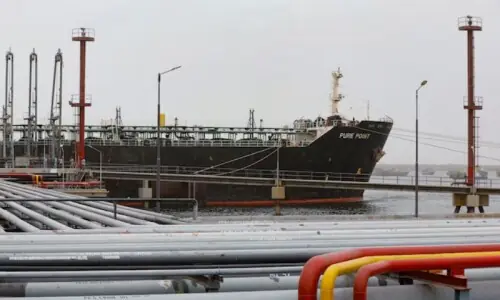
Price-setting had an important role in this regard, he said, further mentioning the stalling of activity at the Strait of Hormuz.
He also said that the PM had engaged with the Saudi government, and the foreign ministry had also provided assistance in arranging alternative sources of energy in the present scenario.
“Today, two PNSC ships are heading towards Yanbu and Fujairah ports to meet the energy needs of Pakistan,” he said, adding that Pakistan had also received an assurance from Aramco that if “we arrange a big vessel … they will load it from Yanbu and dock it in our waters so that there is a continuous supply of crude to our refineries through PNSC’s ships”.
Elaborating on the surge in petroleum prices in global markets, he said the government had taken the “difficult decision” to increase petroleum products’ prices so that there would be no disruption in the supply of petroleum products.
“After making some changes in the petroleum levy, we are increasing the prices of petrol and high-speed diesel each by Rs55,” he announced, assuring that after “the matter will settle, we will revise down the prices swiftly”.
He also announced that the prices would be reviewed on a weekly basis.