Finance minister stresses ‘more balanced’ system where capital markets complement banking sector
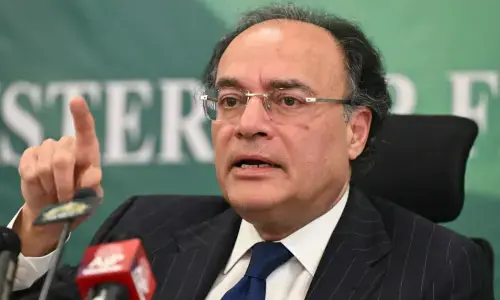
Finance Minister Muhammad Aurangzeb on Wednesday emphasised that Pakistan must gradually move toward a “more balanced financial system”, in which capital markets would complement the banking sector in meeting the economy’s financing needs.
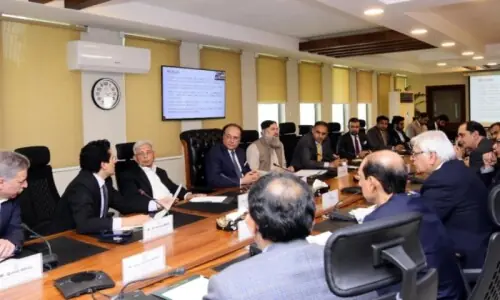
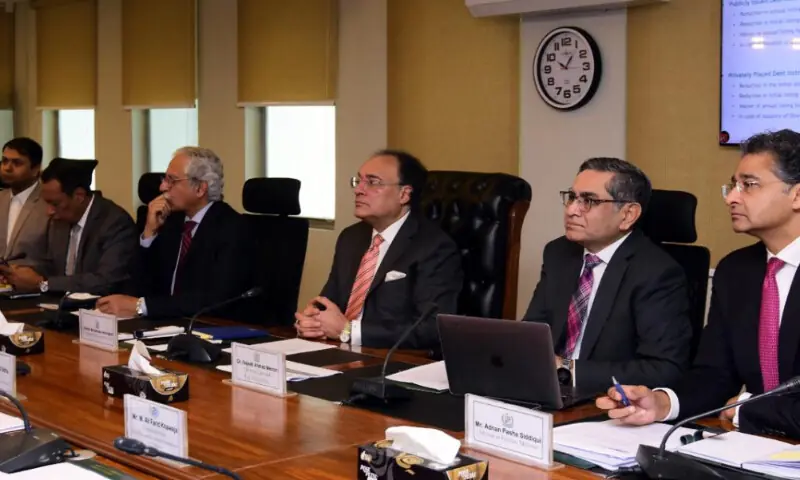
The finance czar expressed these views while chairing a meeting of the Capital Market Development Council (CMDC), according to a press release issued by the finance ministry.
The meeting was convened to review the “progress on reforms aimed at strengthening Pakistan’s capital markets, with particular focus on the development of the corporate debt market and expanding the role of capital markets in financing economic growth”, the press release said.
It added that in his opening remarks at the meeting, the finance minister underscored that a “strong and well-functioning capital market was vital for sustainable economic development” as it enabled corporations to access long-term financing while offering diversified investment opportunities to both institutional and retail investors.
“He emphasised that Pakistan must gradually move towards a more balanced financial system where capital markets complement the banking sector in meeting the financing needs of the economy,” the press release said.
The finance minister noted that the development of a vibrant corporate bond market would play a critical role in mobilising long-term domestic savings and supporting private sector investment, it added.
Aurangzeb also highlighted the need for “practical and time-bound reforms”, the press release said, adding that the finance minister stressed that stakeholders should address bottlenecks across the entire value chain of the capital market, including issuance processes, regulatory procedures, market infrastructure and secondary market liquidity.
“He emphasised that reforms should focus on creating an enabling environment where companies can efficiently raise capital through market-based instruments while investors benefit from greater transparency, liquidity and confidence in the system.”
Aurangzeb further emphasised the importance of strengthening awareness and communication regarding recent regulatory reforms introduced to facilitate corporate bond issuance and improve market access.
He directed the Securities and Exchange Commission of Pakistan (SECP) to enhance outreach efforts to ensure that corporates, financial institutions and market participants were fully informed about the simplified regulatory framework, reduced documentation requirements and other facilitation measures introduced in recent months, the press release stated.
It said that the finance minister highlighted the need to draw lessons from international and regional experiences in capital market development and asked relevant institutions to review “best practices in neighbouring markets that could be adapted to Pakistan’s context”.
“He stressed that improving market infrastructure and trading activity would be essential to strengthening investor confidence, particularly through the development of effective market-making mechanisms and improved liquidity in the secondary market for corporate debt instruments,” the press release read.
It said the meeting also discussed policy measures aimed at encouraging companies to utilise capital markets more actively for raising funds as an alternative to traditional bank borrowing.
“The finance minister noted that deepening the corporate bond market would help diversify financing sources for businesses while reducing excessive reliance on bank lending,” it said.
The press release said that the meeting also discussed the need to review the tax framework affecting capital market participants.
“The Tax Policy Office of the Ministry of Finance has initiated consultations to examine tax-related issues impacting both investors and issuers, to rationalise the tax structure and explore possible incentives that could promote greater participation in the capital market,” it said.
It added that the representatives of the Pakistan Stock Exchange, SECP, State Bank of Pakistan, Central Depository Company, National Clearing Company of Pakistan Limited, Pakistan Banks Association and Pakistan Business Council briefed the meeting on recent initiatives undertaken to facilitate the issuance of corporate bonds and improve market functioning.
Participants highlighted that several regulatory reforms had already been implemented, including simplified prospectus requirements, streamlined documentation procedures, reduced regulatory fees and digitisation of the issuance process to improve efficiency and transparency, it said.
It further stated that the stakeholders also discussed structural challenges affecting the growth of the corporate bond market, including delays related to approvals, the need for improved coordination among market participants and the importance of enhancing awareness among potential issuers.
“The discussion further focused on the need to improve secondary market liquidity, with participants emphasising that the absence of adequate market-making arrangements limits trading activity and price discovery in corporate debt instruments.
It was noted that stronger participation by banks and brokerage houses could play a significant role in enhancing market liquidity and facilitating broader investor participation,” the press release said.
Moreover, the meeting reviewed the broader reform agenda under CMDC, aimed at strengthening coordination among regulators, market infrastructure institutions and the private sector.
“In this regard, the CMDC is advancing a structured reform framework that includes initiatives to expand financial instruments, strengthen investor protection mechanisms, enhance corporate governance standards and promote greater participation by institutional and retail investors.
To support the implementation of these reforms, the CMDC will operationalise specialised working groups comprising representatives from regulators, financial institutions and industry stakeholders,” the press release said.
It further stated: “These working groups will focus on key reform areas including tax and fiscal policy, debt issuance frameworks, market infrastructure development and investor protection to accelerate policy implementation and strengthen coordination across institutions.”
The press release said Aurangzeb reiterated the government’s commitment to developing a “deeper and more efficient capital market as a key pillar for mobilising investment, strengthening financial stability and supporting private sector-led economic growth”.
“He emphasised that the council must continue to work closely with all stakeholders to ensure timely implementation of reforms that will help unlock the full potential of Pakistan’s capital markets,” it said.
The meeting was attended by senior officials of the finance ministry and representatives of key regulatory and market institutions, the press release said.