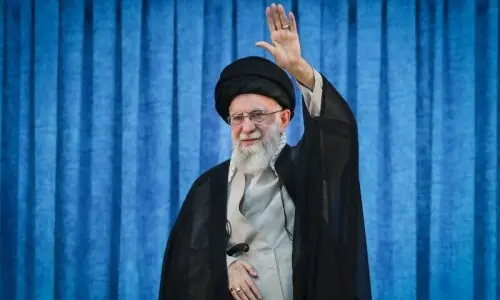
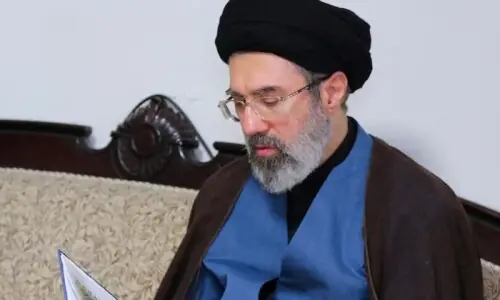
MOVING to fill a vacuum created by the brutal assassination of Ayatollah Ali Khamenei, Iran’s Assembly of Experts has chosen Seyyed Mojtaba Khamenei to fill his father’s position as Iranian supreme leader. The younger Khamenei will be the third holder of the office created after the Islamic Revolution of 1979, with Ruhollah Khomeini being the first.
The position is the most powerful in Iran, bringing together clerical authority and political and ideological leadership. Though Mojtaba Khamenei’s name had been doing the rounds for years as a potential successor to his father, many thought that a dynastic succession would be unlikely in the Islamic Republic, which had overthrown the Pahlavi monarchy. However, all major centres of power have declared their allegiance to the younger Khamenei, perhaps reflecting the need for unity at a time of great peril.
Mojtaba Khamenei, who has never held public office, saw action in the Iran-Iraq war and has attended courses at the Qom seminary. This means he maintains strong links with both the Sepah-i-Pasdaran and the clerical authorities in Iran — two of the most powerful pillars of the Iranian establishment.
He is considered close to the conservative camp of Iranian politics, and will likely continue his father’s policies. However, the biggest responsibility confronting him will be to lead and defend Iran in an existential battle, with the US-Israeli combine pounding his country relentlessly. The aggression against Iran has been ongoing for over a week with no end in sight, and militarily the war has expanded across the whole region, with its economic shockwaves shaking the global economy to the core.
Perhaps just as shocking as the wanton violence unleashed by Tel Aviv and Washington is the radio silence of other, relatively neutral actors. For example, the UN, EU and OIC have all expressed ‘concern’ over the escalating war, yet nothing concrete has been done to help bring about a lasting ceasefire.
The UN Security Council held a session just as the US-Israeli aggression began, but has done little of substance since. The UN secretary-general’s calls for cessation of hostilities have fallen on deaf ears. The EU, on the other hand, has issued sanctimonious criticism of Iran, as well as calls for ‘restraint’, and little more.
The OIC, on the other, has defended Iran’s right to self-defence, while also criticising Tehran for targeting the GCC states. Perhaps all this reflects the impotence of the current international order.
Two states — the US and Israel — are making a mockery of international law in true imperial fashion, while the comity of nation watches on. Perhaps Mojtaba Khamenei needs to reach out to the world community, starting with states that have not allied openly with the aggressors, so that the path towards a lasting ceasefire can be forged.
Published in Dawn, March 10th, 2026