0
0


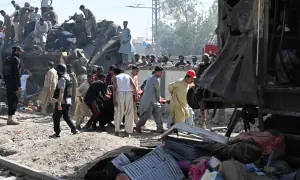
BALOCHISTAN has once again been pushed into grief and uncertainty by a series of terrorist attacks claimed mostly by the Balochistan Liberation Army (BLA). These acts of violence have claimed innocent lives, spread fear among ordinary citizens, and deepened the sense of instability in a province that has already endured decades of neglect, mistrust and conflict.
Terrorism, regardless of the cause it claims to serve, is an assault on humanity. At this critical moment, Pakistan must respond with unity, resolve and a strategy that combines firmness with justice.
First and foremost, there is an urgent need for national unity against terrorism. Terrorists do not distinguish between ethnicities, sects or political views; they kill indiscriminately. The victims in Balochistan are labourers, passengers, teachers and security personnel simply trying to live their lives.
Any attempt to justify such killings under the banner of ‘rights’ or ‘resistance’ must be rejected outright. As a nation, Pakistan must send a clear message to the terrorists that the murder of innocents is unacceptable and that terrorism will not be tolerated in any form. Political parties, civil society, media and religious leaders have a role in reinforcing this collective stance.
The state must take firm and decisive action against violent non-state actors who challenge the writ of the state through armed violence and intimidation. Dialogue cannot replace law-enforcement when weapons are used against civilians. A clear distinction must be made between peaceful political dissent, which is a democratic right, and terrorism, which is a crime. The state’s response should be lawful, intelligence-driven, and sustained, ensuring that perpetrators, facilitators and financiers of terrorism are identified and held accountable.
However, firmness alone is not enough. Lasting peace in Balochistan requires keen listening to voices from the local community and addressing all genuine grievances. Issues, such as lack of economic oppor-tunities, underdevelopment and political marginalisation have fuelled anger and alienation. Ignoring these concerns only strengthens the narrative exploited by terrorists. The government must engage directly with the people, ensuring trans-parency, justice and inclusion.
In this context, revisiting and revising the National Action Plan (NAP) is essential. While NAP provided a framework to counter extremism, its implementation has been uneven. There is a pressing need to empower local police and law-enforcement agencies with resources, training and legal authority. At the same time, a staunch and targeted operation against terrorists is unavoidable.
Such operations must be precise to avoid civilian harm, and must be followed by governance and development initiatives to prevent militant regrouping. Counter-terrorism cannot be episodic; it must be consistent and backed by a firm political will.
The role of traditional systems, like jirgas, needs serious reconsideration. While community engagement is vital, jirgas dominated by tribal lords sitting alongside high officials, often reinforce power imbalances and exclude ordinary citizens, especially women and youth. Either these forums must be reformed to ensure genuine representation and accountability, or the system should be phased out in favour of formal, democratic institutions that uphold the rule of law.
Peace will come neither through violence nor through denial. It will require unity against terrorism, firm state action, sincere listening, institutional reforms and justice. Only then can the province move towards stability, dignity and hope for its people.
Khateeb Khan
Kotli, AJK
Published in Dawn, February 23rd, 2026