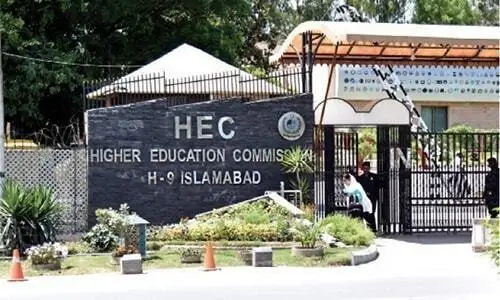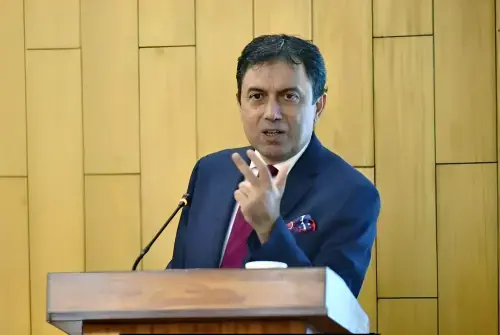


AFTER months of suspense, the Higher Education Commission has a new leader. Though the status of the HEC as a regulator of higher education affairs is reasonably well-grounded, the Commission’s future role, following the devolution of powers to the provinces, is not. True, compared to the erstwhile University Grants Commission, the HEC has made useful reforms such as regularly monitoring university programmes, promoting scholarship options for students and faculty, etc. But these past years have also been clouded by several issues that need the immediate attention of the HEC chief.
The HEC chair needs to take a strong position to justify the institution’s existence in the aftermath of the 18th Amendment. There are many roles and responsibilities that overlap between the federal and provincial tiers. For example, to launch a new academic programme, universities need statutory permission from both the federal and provincial higher education bodies.
Similarly, the HEC and provincial bodies conduct the performance review of programmes. In some cases, universities experience three evaluations as professional accreditation bodies, too, conduct their own review. It causes unnecessary fatigue. The HEC, the provincial commissions and professional bodies must formulate a unified mechanism for performance review.
Two, the HEC must initiate a consultative process to amend the laws governing it. Its focus must be on a regulatory role. Quality control mechanisms, continuous revision of baseline curricula, prospective grants and funding from international bodies, support to faculty in research, sustaining initiatives such as coordination with international higher education bodies, etc, are among the tasks it must retain.
The HEC must ensure that university autonomy is safeguarded. Recently, many arbitrary changes have been made to undergraduate, postgraduate and doctoral study schemes. Such moves, without consultation, are a blow to the independence of institutions of higher learning. Autonomy is crucial to a university’s functioning and is guaranteed by the law, rules and regulations.
The universities, especially those in the public sector, previously functioned well as truly autonomous bodies. While some universities might have relaxed the rules for reasons of their own, few misused this autonomy.
But lately, provincial governments, accreditation bodies and even the HEC have interfered in university matters without valid reason. Courses are centrally designed and imposed on universities, which are advised to include them as compulsory components in undergraduate and graduate programmes. Increased intervention in their management and academic process has seen vice-chancellors become subservient to bureaucratic controls.
The new HEC chair must safeguard university autonomy.
The HEC must review the research grants disbursed and the results achieved. University faculty blindly run after any and every study option with funding possibility. In many cases, such programmes are hardly relevant to our national context, while crucial courses that need research support are not attended to. For example, little research is available on how to build the capacity of our university graduates to enhance their performance and employability in the local and international job market.
The agenda for research must be drawn up through consultation. Pressing issues that have national implications must be prioritised. For instance, instead of blindly accepting the findings of donor-sponsored poverty alleviation programmes, local economists and social scientists should be asked to identify the root causes of poverty and their possible solutions, and be given an opportunity to test the solutions through pilot projects.
Intolerance and right-wing narratives have gripped our universities in recent times. Universities are traditionally places where dissent is respected and status quo academically and intellectually challenged. Conditions are ensured for free thinking and expression. It is only after such preconditions are met that original contributions to knowledge follow. Unfortunately, most of our institutions of higher learning show total disregard to characteristics that are required for true learning.
Public sector universities have an iron framework for the code of conduct of professors and scholars. Ideas and ideological references, political affinities, expression, discourse and even professional affiliations conform to state directives.
As a result, university professors are reduced to mere microphones that repeat undergraduate and postgraduate lessons in robotic performances. The new HEC chief may consider promoting debate to help carve out an enabling environment where intellectual freedom is ensured and the life and limb of both teachers and students are protected.
The writer is an academic and researcher based in Karachi.
Published in Dawn, February 23rd, 2026