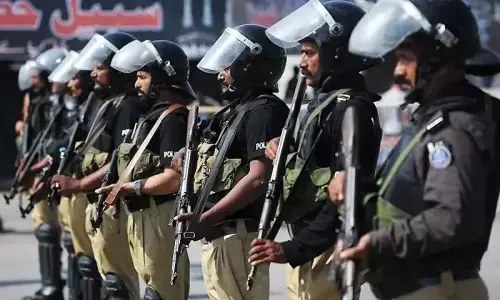
WITH a spate of terrorist attacks occurring in the country, a national-level response is required to address the issue. The latest atrocity has occurred in Bajaur, where a suicide bomber reportedly belonging to the banned TTP attacked a checkpost in Bajaur on Monday. At least 12 people were martyred in the incident — 11 security personnel and one minor girl. Meanwhile, on the same day, a motorcycle rigged with explosives was blown up outside a police station in Bannu, causing two fatalities. Furthermore, law enforcers said on Wednesday that terrorists attacked a police station and a customs office in Dera Ismail Khan, martyring a policeman and a customs officer. They added that the terrorists also fired at passenger buses in the area. Several acts of deadly violence have occurred in this area over the past few weeks.
Following the Bajaur attack, the prime minister commented that “under the vision of Azm-i-Istehkam, security forces are gaining major success in the fight against terrorism”. While that may be so, Pakistan continues to pay a high price as it loses security personnel and civilians in frequent terrorist attacks. For example, apart from the latest violence in KP, an imambargah in Islamabad was attacked earlier this month causing major casualties, while only days before the atrocity in the capital terrorists had launched coordinated attacks in Balochistan. Unless the state takes a fresh approach towards terrorism, we may see the same high levels of violence in the current year as we did in 2025. Last year was said to be the bloodiest in over a decade. The threats may be varied — separatist terrorists in Balochistan, religiously inspired elements in KP — but the response must ensure that all violent elements are neutralised, and the state is able to establish peace in the disturbed areas. There has been some welcome recent cooperation between the KP government — which remains the hardest hit province — and the centre in the field of counterterrorism; such efforts must be intensified. A whole-of-nation approach is needed, applying kinetic measures where required, conducting intel-based operations as well as sociopolitical interventions as needed, to defeat terrorism. The federal and provincial governments, lawmakers and the security apparatus, along with CT experts, must put their heads together to arrive at a solution that can bring lasting peace to Pakistan.
Published in Dawn, February 19th, 2026