National Assembly passes 59 bills in second parliamentary year: report
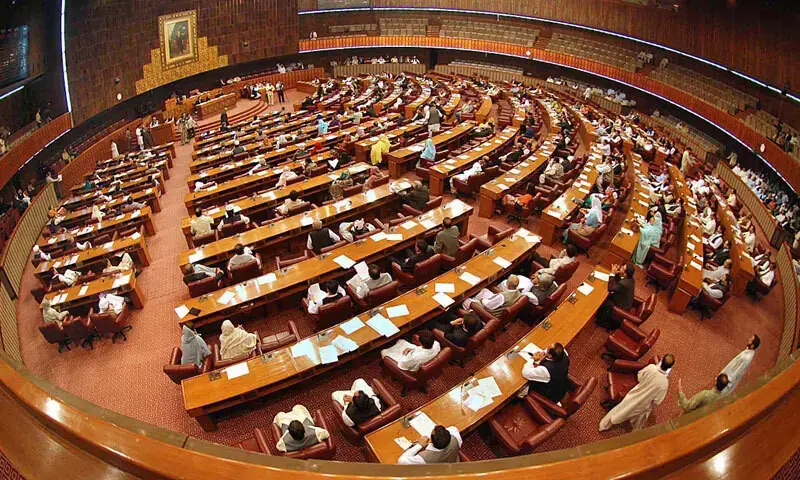

ISLAMABAD: Livestream curbs appeared to have become a new normal as the 16th National Assembly concluded its second parliamentary year.
During the parliamentary year, the House passed a total of 59 bills, including a number of controversial pieces of legislation.
According to a report released by the NA Secretariat, during the year, 59 government bills were introduced, 14 were transmitted from the Senate and 46 passed by the House. Additionally, 48 private members’ bills were introduced, 38 received from the Senate and 13 were passed.
As a result, 40 and six private members’ bills were enacted into law, bringing the total number of Acts passed during the year to 46. The House also adopted 27 resolutions addressing matters of national importance.
House achieved remarkable progress in lawmaking, oversight and institutional strengthening, says NA Secretariat report
The report lists as key legislative milestones the 27th Constitutional Amendment Bill, the Digital Nation Pakistan Act, 2025, aimed at regulating cybersecurity and strengthening digital infrastructure; amendments to the Prevention of Trafficking in Persons Act and the Prevention of Smuggling of Migrants Act, 2025, to enhance national security; the National Commission on the Status of Women (Amendment) Act, 2025; and the National Forensics Agency Act, 2024.
It says the completion of the second parliamentary year of the 16th National Assembly marked a significant milestone in Pakistan’s parliamentary and legislative history.
“Under the visionary leadership of Speaker National Assembly Sardar Ayaz Sadiq, the House achieved remarkable progress in lawmaking, oversight, and institutional strengthening, reflecting a renewed commitment to democratic governance and transparency.”
The National Assembly held 11 sessions, including three joint sittings, completing 130 working days and 87 actual sitting days, with a cumulative duration of 237 hours and 36 minutes. In the exercise of its constitutional oversight mandate, the assembly admitted 7,625 questions, of which 1,710 were answered by the concerned ministries.
A total of 329 calling attention notices were received, with 49 discussed on the floor of the House. Fifteen adjournment motions were submitted, of which 13 were disallowed. Furthermore, 33 questions of privilege were raised; six were referred to the relevant standing committees, 18 remain under process, six were disallowed and two were withdrawn.
In addition, 263 motions under Rule 259 were received, with four included in the orders of the day and three discussed. During the budget session for the financial year 2025-26, the annual budget was passed following comprehensive debate and incorporation of amendments proposed by members in the Finance Bill.
Notably, for the first time in parliamentary history, the Budget Bill 2025-26 was referred to the standing committee on finance and revenue, comprising members from both the National Assembly and the Senate, which actively reviewed it.
“Throughout the year, the speaker conducted the proceedings of the House with impartiality and played a pivotal role in fostering constructive engagement between the government and the opposition on matters of national significance.”
Special emphasis was placed on strengthening the question hour to ensure effective ministerial accountability.
In cases where important public-related questions remained unanswered, relevant secretaries were summoned and directed to provide timely and comprehensive responses. The speaker consistently reaffirmed his commitment to maintaining open and inclusive engagement with all members, particularly those from the opposition benches.
Key parliamentary forums, including the Women’s Parliamentary Caucus, the Parliamentary Caucus on Child Rights, the Young Parliamentarians Forum and the Parliamentary Task Force on Sustainable Development Goals, were revitalised to promote inclusive and participatory governance.
These forums organised policy dialogues, legislative workshops, public consultations and international engagements. The establishment of provincial caucuses further expanded grassroots participation and strengthened coordination between federal and provincial stakeholders. Speaker Sadiq also actively advanced parliamentary diplomacy during the second parliamentary year.
The Youth Internship Programme, initiated in 2014, continued to provide young individuals with hands-on exposure to parliamentary procedures and legislative work.
During the second parliamentary year, over 20,000 youth applied for 400 internship opportunities, demonstrating heightened youth interest and engagement in parliamentary affairs. The report claimed that the official social media platforms of the National Assembly were reactivated to enhance public access to parliamentary activities and information.
The introduction of live streaming of proceedings through NA TV further strengthened transparency, accessibility and public participation in parliamentary processes.
“The second parliamentary year of the 16th National Assembly thus stands as a testament to strengthened legislative performance, effective oversight, enhanced transparency, active parliamentary diplomacy and a renewed commitment to democratic values,” added the report.
Published in Dawn, February 18th, 2026