AS Islamabad seeks to deepen trade and transit linkages with the Central Asian region, a clear statistical bifurcation between Afghanistan and the five states of the region is essential for accurate policy assessment.
The five Central Asian republics distinct from Afghanistan are Kazakhstan, Kyrgyzstan, Tajikistan, Turkmenistan, and Uzbekistan. This grouping is recognised in international economic and geopolitical frameworks and forms the basis upon which Pakistan`s broader Central Asia strategy is measured.
Pakistan`s exports to Afghanistan plunged to $219.5 million in July December 2025 from $505.8m from the same period of 2024. Similarly, imports from Afghanistan that have long remained small, amounting to only $6.3m in July-December 2025 against $10m in July-December 2024, according to the State Bank of Pakistan.
This marked decline in bilateral trade is attributed largely to sustained border closures in the wake of the recently increased terrorist activity in May 2025 For FY25, total trade between Pakistan and the five Central Asian States was recorded at approximately $442.15m.
This aggregate comprises Pakistani exports of $197.06m down 31.63pc from the preceding year and imports of $245.09m, which surged more than four-fold.
Although the INSTC’s potential remains significant on paper, geopolitical strains have slowed cooperation, raised transit uncertainties, and underscored the need for renewed diplomatic engagement
Among the individual republics, Kazakhstan remained Pakistan`s foremost regional trading partner, with exports of $97.96m and imports of $129.63m. Uzbekistan followed with exports of $63.65m and imports of $79.23m. Tajikistan, Turkmenistan, and Kyrgyzstan registered comparatively smaller volumes, with exports to Kyrgyzstan contracting most sharply.
It is pertinent to note that the frequently cited figure of $2.41 billion in Pakistan Central Asia trade for FY25 includes Azerbaijan alongside Afghanistan and the five Central Asian republics. That broader regional aggregate, while accurate in its own context, is not suitable for a strict bifurcation between trade with Afghanistan and the standalone Central Asian states.
The dynamics of trade engagement with the Central Asian region, however, vary considerably across different partners, reflecting both opportunities and structural challenges. Kazakhstan, for instance, has emerged as one of Pakistan`s most rapidly expanding trade partners.
Bilateral trade with Kazakhstan remains much larger compared with the trade with other four Central Asian countries, largely fueled by massive increase in Kazakhstan’s exports to Pakistan. The surge in Pakistan imports from Kazakhstan remains concentrated into crude oil, wheat and legumes where Pakistan`s exports to Kazakhstan, which recorded a decline in the last fiscal year, are driven by food products and light industrial goods, with remarkable increases in potato exports and knitted garments.
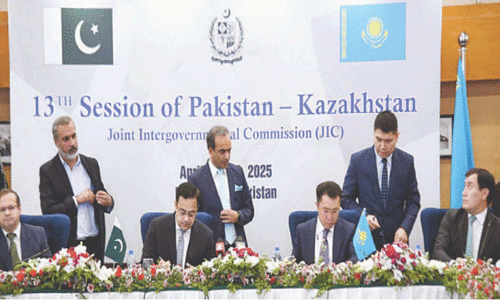
Pakistan is pursuing an ambitious medium-term goal of raising bilateral trade with Kazakhstan to $1bn. High level discussions have emphasised moving beyond fragmented initiatives to a structured implementation mechanism, with cooperation proposed in sectors including agro-industry, petrochemicals, metallurgy, and pharmaceuticals.
Pakistan’’s aspirations to become a pivotal Eurasian trade hub, however, are complicated by infrastructure and geopolitical competition. The International North-South Transport Corridor (INSTC) represents a significant alternative to Pakistans traditional routes, connecting India, Iran, Azerbaijan, Russia, and Central Asia via ship, rail, and road.
Studies suggest the INSTC is approximately 30 per cent cheaper and 40pc shorter than the Suez Canal route, reducing transit times from Mumbai to Moscow from 40-60 days to 25-30 days. Recent developments along the INSTC, including the Kazakhstan-Turkmenistan-Iran railway link and the expansion of Iran`s Chabahar Port, have created an efficient gateway for Central Asia that bypasses South Asian corridors.
Simultaneously, Afghanistan’s diversification efforts via Iran’’s Chabahar Port and other overland routes, China’s Belt and Road Initiative, and Russia’’s shifting focus due to the Ukraine conflict have reshaped the regional connectivity landscape, presenting both opportunities and formidable challenges for Pakistan.
Since the conflict between India and Pakistan in May 2025, which led to theclosure of Pakistani airspace and broad regional tensions, the operational environment for the INSTC has become more complex and uncertain. The escalation disrupted overland and air links in South Asia, creating political and logistical obstacles for multilateral connectivity initiatives, including the INSTC, which relies on broad cooperation among Iran, India, Pakistan, and Central Asian states.
Although the corridors potential remains significant on paper, the current geopolitical strains have slowed cooperation, raised transit uncertainties, and underscored the need for renewed diplomatic engagement and practical confidence-building measures among all corridor participants to unlock INSTC promise as a reliable trade route.
To translate geographic advantage into tangible economic benefit, Pakistan must address multiple structural and operational challenges. Growing trade deficits, exemplified by the massive increase in imports from Kazakhstan, underscore the need for export diversification beyond traditional sectors. The declining trade with Afghanistan further highlights the vulnerability of economic relations to political disputes.
Pakistan`s corridors must compete not only on geography but on reliability, efficiency, and value-added cooperation.
Implementation of existing transit agreements, customs harmonisation, and predictable cross-border protocols are essential for Pakistan to emerge as a credible transit hub rather than merely an aspirant.
Published in Dawn, The Business and Finance Weekly, February 16th, 2026