
Floods, storms, hurricanes, typhoons and blizzards are becoming more frequent and intense around the world. Every few days, we hear of some catastrophe in some part of the globe.
Elders say that even the weather is not what it used to be a couple of decades back; it is becoming hotter, with either more rain or rain at unusual times of the year, while some regions are experiencing drought due to very little rain. In addition to this, winters are milder, and ice covers and glaciers are shrinking around the globe.
Scientists and climate experts tell us that it is because of climate change and global warming.
What is climate change and global warming?
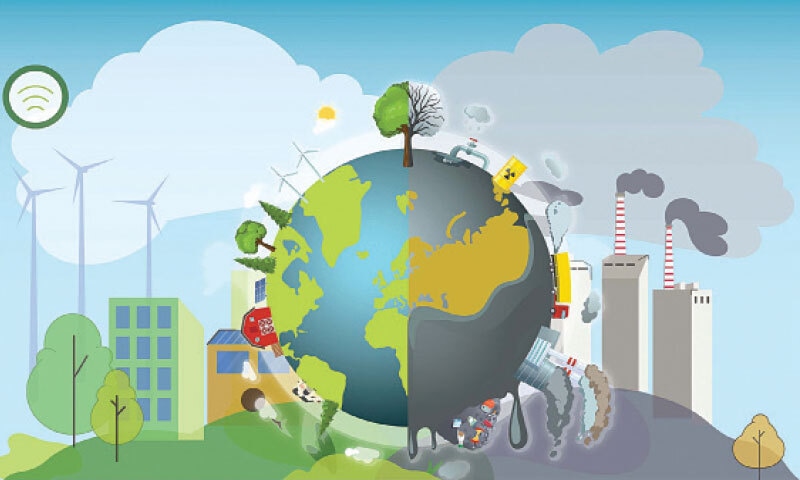
Global warming can simply be described as a gradual increase in Earth’s average temperature, primarily caused by the increase of greenhouse gasses as a result of human activities like burning fossil fuel, deforestation etc. Climate change is a term used for long-term shift in weather patterns, such as rising sea levels, melting glaciers and changes in precipitation.
What causes climate change?
Experts tell us that climate change is mainly the result of human activities, such as burning of fossil fuels in vehicles and industries, electricity generation and cutting down forests. All these activities release gasses, such as carbon dioxide, methane, etc. known as greenhouse gases, into the atmosphere, which slowly warm the planet, leading to climate change.
The overall impact
While global temperatures had been rising gradually over the centuries, this increase has accelerated and become more noticeable in recent decades. In fact, the 21st century has seen the weather getting hotter than ever.
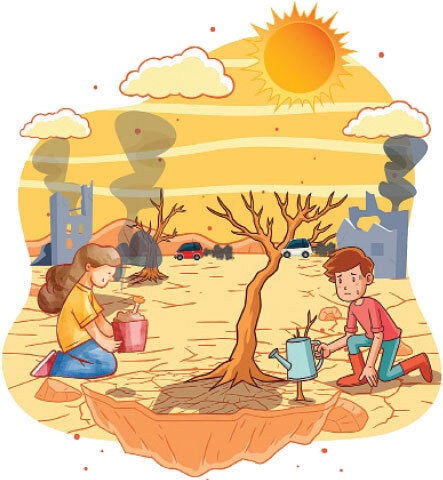
Rising global temperatures not only cause heat waves, changing rainfall patterns, change in frequency and timing of extreme events like floods, storms, sea level rise, wildfires, the intensity and duration of drought, threats to habitats and environment and ocean acidification (when extra carbon dioxide in the atmosphere is absorbed by the oceans, making them acidic) affecting marine life, but also affects human health, food supply and ecosystems.
Climate change is a global issue, irrespective of the amount of carbon emission by a particular country. Unfortunately, though Pakistan may not be contributing as much to global emissions of greenhouse gasses as the developed countries, it is one of the top countries of the world that are most affected by climate change.
We have faced severe heat waves during the last few years, while the occurrence of floods and droughts has increased; fresh water resources such as rivers, lakes, groundwater and the water stored in glaciers are being affected, thus decreasing the availability of water for human use in the country.
While the country is already facing challenges to food security, damages caused to crops and livestock due to severe weather conditions further lead to reduced food availability. As the summers get longer and severe, due to climate change, more electricity is required to keep our homes and workplaces cool, while decrease of water levels in dams also reduces electricity generation.
On the other hand, the milder winter leads to less snowfall, and this means less water in the rivers for irrigation, drinking and hydropower, potentially causing droughts, besides other effects on both flora and fauna.
Impact on children
While the whole world is affected, groups like the poor, elderly and children are especially vulnerable. Children, who form one-third of the world population, are disproportionately affected by climate change as they are more vulnerable to pollution, deadly diseases and extreme weather conditions; the effects on their development, health and education may have life-long and irreversible consequences.
For instance, due to displacement in case of floods their education is disrupted; food scarcity due to draughts impacts children’s growth; severe heat has harmful effects on their health, while children under the age of five are more affected by climate change-associated diseases, such as malaria, dengue, cholera and respiratory illnesses.
What needs to be done
In the fight against climate change, the first step is to reduce the emission of greenhouse gases which is responsible for climate change. This can be done by using renewable energy sources, such as solar, wind, hydro, geothermal, etc. that do not cause carbon emissions, for generating electricity in place of burning fossil fuel. Conserving energy and being less wasteful by employing the three ‘Rs’ (reduce, reuse, and recycle) method are some of the other measures that can be adopted.
Of course, the government, leaders and policy-makers have the greater responsibility, but you as the future generation, and future leaders and policy-makers, have to understand the problem and realise that even at this age you can play an important role in reducing/controlling carbon emissions, thus reducing global warming.
There are many direct actions that you can take either individually or collectively with friends in school and neighbourhood, and also encourage not just your peers but also your seniors at home and school to take appropriate action.
You can help reduce global warming by conserving energy and water, reducing waste through recycling and reusing, and making sustainable transportation choices like walking or using bikes. You can also make a positive impact by eating less meat and dairy, planting trees, and educating friends and family.
Conserve energy and water: The simplest thing you can do is to conserve energy by switching off extra lights and fans, and unplugging electronic gadgets when not in use, as well as using energy efficient appliances.
To conserve water, the best way is to take shorter showers, turn off taps when not using water, water the plants using a bucket and mug rather than hose, and employ any other way to use less water.
Reduce waste: Remember and practice the ‘3 Rs’: Reduce, Reuse and Recycle. Since production of most items cause carbon emission, it is important that we buy fewer things like clothes, toys and gadgets, and reuse whatever is possible. Rather than throwing away things, try to have them repaired, or if they are in working condition and you have out grown, them give them to someone else. Recycling is a great idea and not only helps the environment by reducing waste, but also saves you money.
Walk and cycle: Burning of petrol and diesel in vehicles produces carbon dioxide. For short distances, either walk or use a bike instead of using the car. It’s also a good exercise. Try using public transport or car pool for long distances when possible.
Adjust your diet: Do you know that production of meat and dairy items produce more greenhouse gasses than vegetables, fruits, whole grains, legumes, nuts and seeds, which also require less energy, land and water? Hence, if you are a meat lover, change your eating habits and eat less meat for the sake of the environment. Also, if you choose local produce, you can help reduce transportation emissions.
Refrain from wasting food by utilising leftovers. When you waste food, the resources and energy that were used to grow, produce, package and transport it, are also wasted. To add to that, when the food rots in a landfill, it produces methane, a powerful greenhouse gas.
Plant trees: Since trees absorb carbon dioxide, planting trees helps protect the environment. You can plant a few trees outside your home or in school with your friends. When the trees grow, they will also provide shade and make your surroundings cooler. It is important to choose native species of plants as non-native plants would not attract most birds and insects, who will lose a food source; non-availability of food may drive them away, even threatening their existence.
Gather information and speak up: Read and discuss about climate change with friends and family, and share information. You can ask your school to arrange special lectures and programmes where the students are given information about climate change and what can be done to mitigate it.
Advocate for green initiatives at school and in the neighbourhood, and together with your friends write letters to the government officials to adopt climate-friendly policies. Climate march with friends and school mates to draw attention to the climate issue is another idea.
Be Inspired: If you are still thinking that you are young and cannot do much, remember that each drop counts and first steps are taken early in life. You have the example of people like Greta Thunberg, a Swedish activist who in 2018 at the age of 15 gained global attention after staging a solo school strike outside the Swedish parliament; this inspired the worldwide ‘Fridays for Future’ movement (also known as the School Strike for Climate) — an international movement of school students who skip Friday classes to participate in demonstrations to demand action from political leaders to prevent climate change and take measures to reduce carbon emissions and transition to renewable energy.
Then there is Licypriya Kangujam, from Manipur, India, one of the youngest climate activists globally. She has campaigned for stricter anti-pollution laws since 2018 and addressed world leaders at the 2019 United Nations Climate Change Conference in Madrid, Spain, asking them to take immediate climate action. As a 14-year-old girl she stood before the world leaders at the 80th United Nations General Assembly in September 2025, and said: “The climate crisis is already devastating lives, especially those of children. We have no more time”. Her main mission is to make climate education mandatory schools. “There is no climate solution without climate education,” she repeats everywhere.
Lesein Mutunkei is a 16-year-old Kenyan environmental activist and footballer. In January 2018, he felt the need to do something and he came up with an innovative initiative called ‘Trees For Goals’. So he combined his love for football with his love for nature, and decided to plant a tree for every goal he scored.
Now that you have learnt about some young boys and girls who raised their voices and took action to make a difference, you can also shrug your inertia and start acting. Just remember that every drop counts and we all have to play our parts to make this world a better place for ourselves and for the generations to come.
In your efforts to harness climate change you would not be alone. Acknowledging that children are disproportionately affected by climate change, the recently concluded climate conference COP30 also included children in its agenda. The main theme regarding children was ‘ensuring their inclusion in climate decision-making’ with the slogan “Nothing About Us Without Us”, emphasising that children must be actively included in decisions regarding climate.
So what are you waiting for. Start acting.
Published in Dawn, Young World, January 17th, 2026