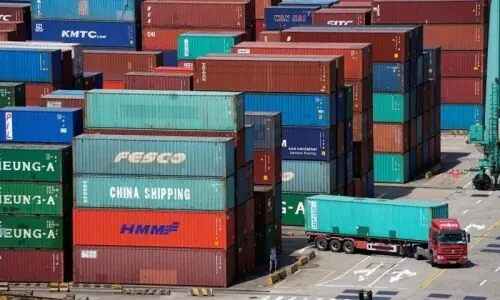
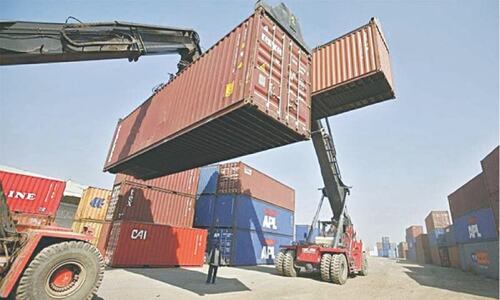
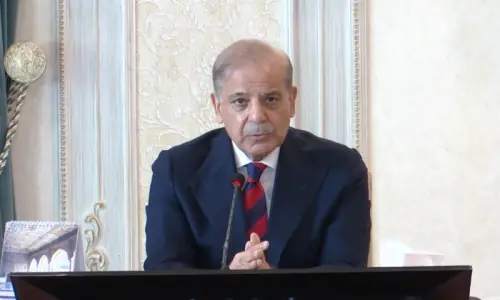
THE planning minister’s proposal to declare an ‘export emergency’ reflects a growing realisation that there can be no sustainable growth path without tackling deep-seated external-sector weaknesses rooted in low, stagnant exports. “We will have to … become an exporting nation on an emergency basis; otherwise, our dependence on the IMF and friendly nations for their financial support will continue,” he said while speaking on proposals formulated by a panel led by him.
This is true. Pakistan’s repeated balance-of-payment crises, resulting in long periods of low growth, and dependence on borrowing from global and bilateral lenders, stem from its inability to boost its export revenues.
That the government wants to raise exports by 40pc over four years and 200pc in 10 years signifies not just urgency but also political ambition. The announcement comes at a time when some reports claim that the state quarters backing the government are unhappy with the economy’s weak performance and are pushing for changes in the finance team and economic strategy to accelerate growth. As acknowledged by the minister himself, public impatience with subdued economic activity is mounting.
The panel’s proposals, including faster export refund payments and a dedicated PM Office unit with a hotline for facilitating exporters as part of the ‘export emergency’, seems to be focused on addressing the administrative bottlenecks that have eroded business confidence. While these are important measures to facilitate exports, they deal only with the symptoms, and not the underlying structural causes impeding export growth.
This is not the first time we are hearing such rhetoric. Yet the country’s export performance continues to lag despite frequent declarations of good intentions. In the first four months of the current fiscal, exports grew by barely 1pc. This underlines the growing gap between policy rhetoric and actual outcomes.
The nation’s economic history is littered with numerous export growth strategies that faltered at the execution stage due to political trade-offs and bureaucratic inertia. Whether this latest effort can avoid the fate that past attempts met will depend on the ability of the authorities to undertake reforms to resolve the underlying structural constraints: a distorted tax system, high energy prices, policy unpredictability, productivity improvements, export product and market diversification, etc. The success of any growth strategy depends on it.
Published in Dawn, January 14th, 2026