Opposition grows in US Congress to Iran action
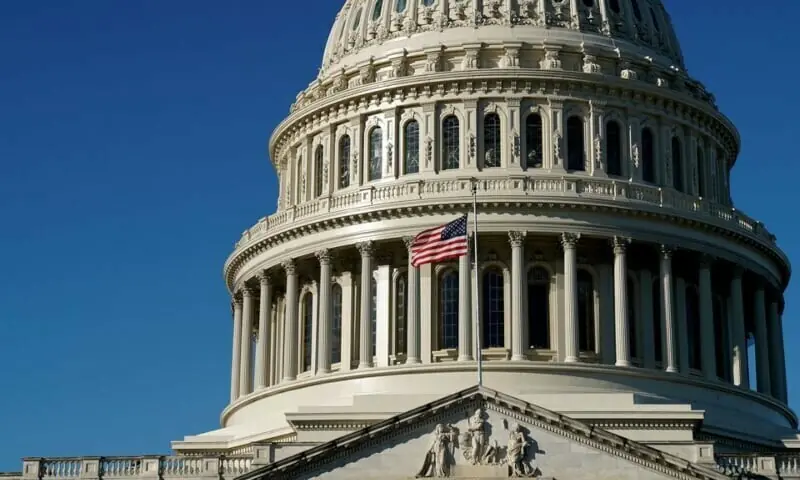
WASHINGTON: Opposition to any potential US military action against Iran is growing across party lines in Congress, with lawmakers warning that an attack could backfire and would also violate the US Constitution.
Senior Democrats and Republicans alike have questioned the Trump administration’s threats of military intervention as Iran faces widespread protests driven by economic hardship and calls for regime change. They argue that American involvement — particularly military action framed as support for protesters — could undermine the very movement it seeks to help.
Republican lawmakers such as Senator Rand Paul and Representatives Thomas Massie and Marjorie Taylor Greene have emphasised that the United States should prioritise domestic issues and avoid what they describe as “endless foreign wars”.
Senator Mark Warner of Virginia, the ranking Democrat on the Senate Intelligence Committee, cautioned that a military strike intended to assist protesters could have the opposite effect. Speaking to CNN, Warner recalled the consequences of earlier US intervention in Iran.
“The last time America intervened militarily in Iran was 1953, when a CIA-led coup overthrew the Iranian regime to protect oil,” Warner said. “And that, ultimately, most historians would say, was what led to the ayatollah’s rise in the 1970s.”
Warner said American intervention in Iran has historically produced “unintended consequences” and warned that military action now could strengthen, rather than weaken, the current leadership.
Republican Senator Rand Paul of Kentucky has also spoken out forcefully against military escalation. Appearing on ABC’s This Week, Paul said he was sceptical that bombing Iran would achieve its stated aims.
“I don’t think I have ever heard a president say they may take military action to protect protesters,” Paul said. “I’m not sure that striking Iran will have the effect that is intended.”
Senator Paul warned that US military action could end up unifying Iranians behind the government, even those currently protesting against the clerical leadership.
While expressing support for democratic aspirations, Paul argued that military force was not the answer.
“We wish freedom and liberation the best across the world,” he said. “But I don’t think it’s the job of the American government to be involved with every freedom movement around the world. … Bombing is not the answer.”
The senator also warned that any military action would lead to civilian casualties. “How do you drop a bomb in the middle of a crowd or a protest and protect the people there?” he asked.
The congressional pushback has also taken legislative form. Senators Bernie Sanders of Vermont and Tim Kaine of Virginia have introduced legislation that would bar the use of federal funds for military force in or against Iran unless Congress explicitly authorises it.
The measure has been co-sponsored by Senators Elizabeth Warren, Jeff Merkley and Chris Van Hollen. The proposed legislation points out that only Congress has the power to declare war under Article I, Section 8 of the United States Constitution.
It notes that “Congress has not declared war against Iran nor has Congress enacted a specific statutory authorisation for the use of force against Iran.”
Published in Dawn, January 13th, 2026