Trump concludes visit to China, says made 'fantastic trade deals' with Xi
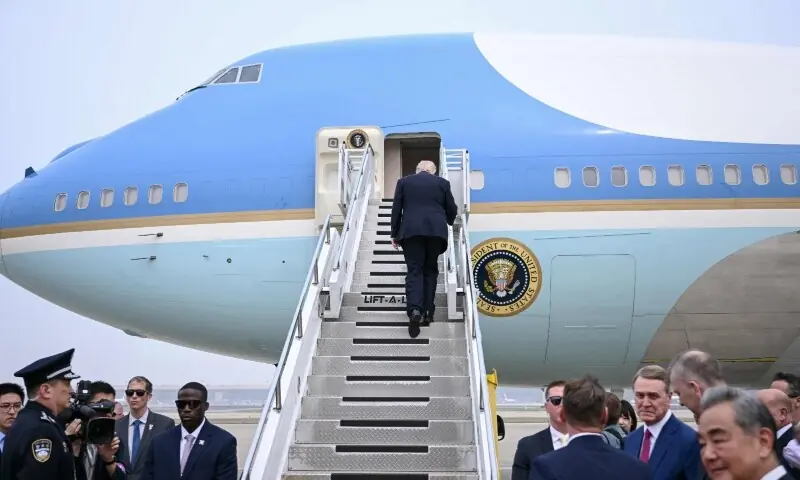
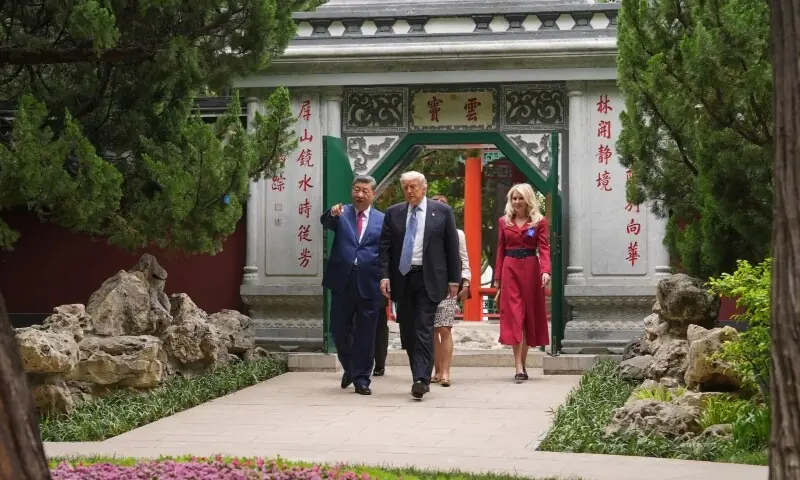


United States President Donald Trump on Friday concluded his visit China, where he said he made “fantastic trade deals” with Chinese President Xi Jinping.
Trump had arrived in Beijing seeking to seal deals in sectors including agriculture, aviation and artificial intelligence, as well as to contain differences between the two sides in a number of tense geostrategic areas — not least the Middle East war.
Trump’s overtures to Xi, whom he described as a “great leader” and “friend”, have so far been met with more muted tones by the Chinese leader.
But the US leader said “a lot of good” has come out of the visit.
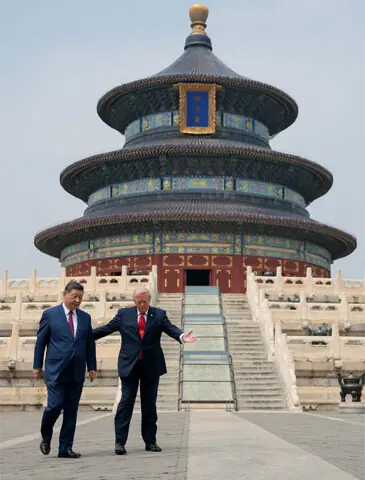
“We’ve made some fantastic trade deals, great for both countries,” he said, as Xi accompanied him through the gardens of Zhongnanhai, a central leadership compound next to Beijing’s Forbidden City.
“We’ve settled a lot of different problems that other people wouldn’t have been able to solve,” Trump added, without providing details.
Xi said it was a “milestone visit”, and that the two sides had to date established “a new bilateral relationship, which is a relationship of constructive strategic stability”.
He promised to send Trump seeds for the White House Rose Garden.
‘Help on Hormuz’
In an interview with Fox News after the first day of the summit wrapped, Trump said the talks in Beijing had gone well and that Xi had agreed to several US wishlist points.
On the topic of the war in Iran, the US president said Xi had effectively assured his counterpart that China was not preparing to militarily aid Tehran, which has essentially closed the Strait of Hormuz.
“He said he’s not going to give military equipment … he said that strongly,” Trump told Fox.
“He’d like to see the Hormuz Strait open, and said ‘if I can be of any help whatsoever, I would like to help,’” Trump added.
Asked whether the two leaders had discussed Iran, the Chinese foreign ministry on Friday released a statement calling for “a comprehensive and lasting ceasefire”.
“Shipping lanes should be reopened as soon as possible in response to the calls of the international community,” it added.
Taiwan policy ‘unchanged’
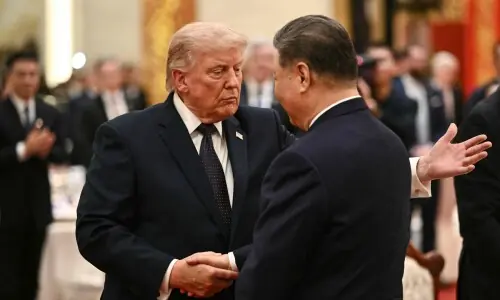
The warm handshakes and pomp on Thursday were somewhat overshadowed by a blunt warning from Xi on a much longer-standing geopolitical flashpoint, Taiwan.
Shortly after talks started, Chinese state media reported Xi had told Trump that missteps on the sensitive issue of Taiwan could push their two countries into “conflict”.
The Fox News interview did not touch upon Taiwan, and Trump did not comment to reporters when asked about the matter on Thursday.
However, US Treasury Secretary Scott Bessent told CNBC the president would say more “in the coming days”.
US Secretary of State Marco Rubio told NBC on Thursday though that “US policy on the issue of Taiwan is unchanged”.
Beijing had raised the topic, he said, but “we always make clear our position, and we move on to the other topics”.
Taipei responded on Friday thanking Washington “for repeatedly expressing its support”.
Boeing, oil, soybeans
Trump did not spell out on Friday the trade agreements that he said had been sealed with China.
However, in the Fox interview, Trump said one big business deal had already been struck, saying Xi had agreed to purchase “200 big” Boeing jets.
Shares of the US aviation giant fell after Trump’s comments, in a sign the market had expected a more robust purchase from China.
The US president said Beijing had also voiced interest in buying US oil and soybeans.
China, which is the key foreign customer of Iranian oil, bought small amounts of US oil before Trump imposed tariffs last year.
It has sharply slowed down purchases of US soybeans, turning instead to Brazil.
Asked about the business deals Trump had mentioned in the interview, China’s foreign ministry did not confirm or deny the information.
No announcements were made regarding the advanced Nvidia chips used in artificial intelligence, even though CEO Jensen Huang was among business leaders in Trump’s business delegation.
Chinese tech firms are barred from purchasing California-based Nvidia’s most cutting-edge AI chips, under US export rules that Washington says are to protect national security.
And Treasury Secretary Scott Bessent told CNBC that Trump and Xi were talking about setting up “guardrails” for the use of artificial intelligence.
Bessent said the world’s “two AI superpowers are going to start talking”, though US export controls on the advanced technology to China remain a sore point in relations.
Transcending the trap?
Trump’s visit to Beijing is the first by an American president in nearly a decade.
On Thursday, Xi referenced the “Thucydides Trap”, a political theory referring to an increased likelihood of war when a rising new power competes with an established great power.
Xi said, however, that he thought the United States and China could “transcend” this danger.
Responding to the comments in a social media post in the early hours of Friday, Trump said Xi “very elegantly referred to the United States as perhaps being a declining nation”.
He insisted Xi was not referring to the United States under his watch, which he claimed was experiencing an “incredible rise”, but rather the country under his predecessor Joe Biden.
“Two years ago, we were, in fact, a Nation in decline,” Trump posted on his Truth Social site.
“Now, the United States is the hottest Nation anywhere in the world, and hopefully our relationship with China will be stronger and better than ever before!”
He said that Xi “congratulated me on so many tremendous successes”.
On Friday, after the walk in the gardens of Zhongnanhai, Xi and Trump had lunch together, before the latter left for the airport.
As the US president entered Air Force One just before take-off, he pumped his fist in the air twice.