‘Visible’ action on Afghanistan-based terrorists sought
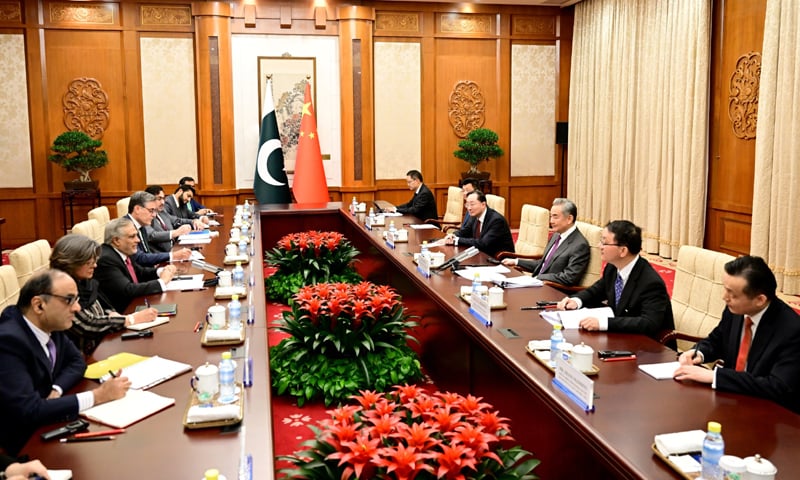

• Pakistan, China pledge to move forward on CPEC 2.0 in joint statement issued after foreign ministers’ strategic dialogue in Beijing; reaffirm commitment to security cooperation
• Agree Kashmir dispute should be resolved ‘peacefully in accordance with UN Charter’
ISLAMABAD: Pakistan and China on Monday issued a joint communique calling for more “visible and verifiable” actions to dismantle and eliminate all terrorist organisations based in Afghanistan, and to prevent them from using Afghan territory for militancy against any other country.
The joint statement came after the conclusion of the 7th round of the Pakistan-China Foreign Ministers’ Strategic Dialogue in Beijing, which was attended by Deputy Prime Minister and Foreign Minister Ishaq Dar, with both sides also agreeing to strengthen bilateral cooperation, including building an “upgraded version 2.0 of the China-Pakistan Economic Corridor (CPEC)”.
“The two sides called for more visible and verifiable actions to dismantle and eliminate all terrorist organisations based in Afghanistan which continue to pose serious threats to regional and global security, and prevent terrorist organisations from using the Afghan territory for terrorism against any other country and to endanger any other country,” the communique said.
The statement added that the two sides agreed to maintain close communication and coordination on the Afghan issue, and to work with the international community to “encourage the Afghan government to build an inclusive political framework, adopt moderate policies, focus on development, pursue good-neighbourliness, and play a constructive role in helping Afghanistan achieve stable development and integrate into the international community”.
China commended the measures taken by Pakistan to combat terrorism and for the safety of Chinese personnel, projects and institutions in the country.
“China fully recognised the significant contributions and huge sacrifices that Pakistan made in combating terrorism over the years,” the statement said.
Both sides “reiterated their commitment to combating terrorism in all its forms and manifestations with zero tolerance, and agreed to further deepen cooperation on counter-terrorism and security”, while making concerted efforts to ensure that “China-Pakistan Belt and Road cooperation advances in a secure and smooth manner”.
Calling on the international community to strengthen counter-terrorism cooperation, the two countries also expressed firm opposition to double standards on counterterrorism.
Both countries further “expressed readiness to continue leveraging the China-Afghanistan-Pakistan trilateral foreign ministers’ dialogue”, as well as the China Bangladesh-Pakistan cooperation mechanism to “deliver new outcomes”.
Enhance cooperation
The communique further read that the two sides agreed to build an upgraded version 2.0 of CPEC, align development plans and priorities, and deepen cooperation in key sectors, including industry, agriculture and mining, along with strategic and political coordination, trade, defence and security, investment, cybersecurity, science and technology, technical and vocational training education, financial and banking sectors, and people-to-people exchanges.
Pakistan and China marked the 75th anniversary of the establishment of diplomatic relations with the launch of commemorative activities which were an opportunity to consolidate bilateral friendship and expand new areas of cooperation.
Pakistan congratulated China on the “successful conclusion of the 14th Five-Year Plan and the upcoming 15th Five-Year Plan” under President Xi Jinping’s leadership.
China commended Pakistani leadership on “leading the country to achieve macroeconomic stability” and lay a solid foundation for national economic growth centred on Pakistan’s National Economic Transformation Plan (2024–2029), also called URAAN Pakistan.
Pakistan reiterated its firm commitment to the one-China principle, stating that Taiwan was an inalienable part of China’s territory. It opposed any form of “Taiwan independence” as well as any “attempt to create ’two Chinas’ or ’one China, one Taiwan”.
Islamabad reaffirmed support for Beijing on issues concerning Xinjiang, Xizang, Hong Kong and the South China Sea.
They also called for pushing for the “building and operation of the Gwadar Port, smooth passage of the Karakoram Highway, and enhancing Pakistan’s capacity for sustainable development”.
It was decided that the two countries will “take the year-round opening of the Khunjerab Pass as an opportunity to deepen two-way trade and people-to-people exchanges”.
They also agreed to “welcome third-party participation in CPEC cooperation that conforms with the modalities set by China and Pakistan”.
The two sides “expressed satisfaction at their expanding space cooperation and for the expected early entrance of Pakistani astronauts into the China Space Station”.
Kashmir dispute
The two sides also reaffirmed their commitment towards upholding UN principles and international law, vowing to “oppose the plotted resurgence of fascism and militarism”.
Pakistan informed China of the latest developments in India-occupied Kashmir, with the latter reiterating that the dispute should be resolved “properly and peacefully in accordance with the UN Charter, relevant UN Security Council resolutions and bilateral agreements”.
According to the communique, the two countries “expressed readiness to conduct trans-boundary water resources cooperation under the principle of equality and mutual benefit”.
Pakistan and China further reiterated their readiness to further enhance cooperation under the frameworks of the Global Development Initiative.
They reaffirmed their commitment towards making the “global governance system more just and equitable, and join hands to build a community with a shared future for humanity”.
Pakistan highly commended China’s efforts to “safeguard developing countries’ right to sustainable development”.
The two sides expressed satisfaction over their cooperation within multilateral mechanisms such as the UN and the Shanghai Cooperation Organisation (SCO).
China also voiced its “full support for Pakistan to work as the rotating president of the SCO from 2026 to 2027”.
Palestinian state
On the issue of Palestine, Pakistan and China called for an “unconditional, comprehensive and permanent ceasefire in Gaza” and stressed the significance of the Palestinian people’s right to self-determination.
The two countries called for the “implementation of the two-state solution with the establishment of an independent state of Palestine”.
“The two sides also expressed their concern at the situation in the occupied West Bank, and urged the need for urgently addressing it,” the communique said.
“The two sides agreed to hold the next round of Foreign Ministers’ Strategic Dialogue in Islamabad next year on mutually convenient dates,” it concluded.
Published in Dawn, January 6th, 2026