Balochistan police chief claims drop in terror attacks
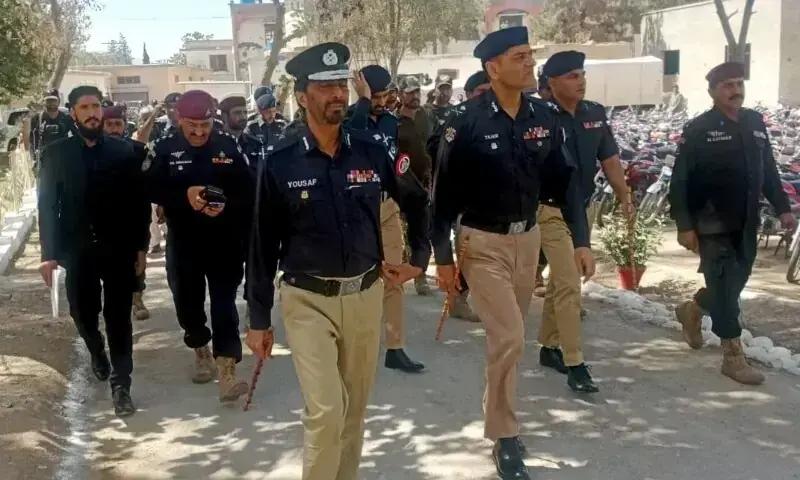

QUETTA: Coordinated action by police, security forces and other law enforcement agencies helped reduce terrorist attacks during the past year, Balochistan’s top police officer said on Wednesday and vowed to further strengthen the force in 2026 through improved planning, modern weapons and specialised training.
Addressing a press conference at the Central Police Office on the last day of 2025, Inspector General of Police Balochistan Muhammad Tahir said attacks were foiled in Gwadar, Quetta, Bagh, Jhal Magsi police station areas and Panjgur with support from other security agencies. DIG Headquarters Hassan Asad Alvi and AIG Operations Capt (retd) Naveed Alam were also present.
He said the police response would be further strengthened through training, provision of weapons and other requirements. The IGP said the force would enhance its operational capacity in the coming year, ensure merit-based recruitment across departments and improve mechanisms for policing.
“We have plans to develop police on modern lines,” he said, referring to the merger of the Levies into the police to create “one well-trained and effective force”. IGP Tahir said a stricter crackdown would be launched in the New Year against criminal elements across all districts, with a special focus on dangerous gangs, habitual offenders and organised criminal groups. “Anti-social elements will be dealt with under a zero-tolerance policy,” he said.
He said the scope of the Crime Branch would be expanded across Balochistan, with offices established to provide services “at people’s doorsteps”. He said a Security Division had been set up and around 1,000 police personnel had been redeployed after being withdrawn from VIP duties to areas facing staff shortages. He said the strength of the Anti-Terrorist Force (ATF) would be increased from 1,500 to 3,000 personnel.
Work had begun to improve the infrastructure of 81 police stations, while 30 database centres would be established by 2026, he said, adding that the IT sector would be strengthened. The Safe City project had been completed in Quetta and would be extended to Gwadar and other areas, he said. Bulletproof vehicles had been provided by the federal interior ministry and the provincial government, while the police would also procure vehicles through self-financing.
The IGP said training on modern lines to counter terrorism was under way with support from the Pakistan Army. Training of Levies personnel merged into the police had started at the Police Training College and the Regional Training Centre, Khuzdar, while newly recruited police personnel would also receive training from the army. He said training schools were being established for the CID, intelligence wing and other departments.
He said accountability mechanisms, checks and balances, and a system of rewards and punishments were being implemented, adding that the Crime Branch and the Special Crime Investigation Wing (SCIW) were resolving “blind cases”, prompting an expansion of their operations across the province.
Highlighting operational figures, IGP Tahir said police responded to attacks in Jhal Magsi, Tasp, Panjgur, Nag and Mashkeel. During 2025, police registered 1,438 weapons cases, arrested 1,447 suspects and seized 1,483 pistols, 118 Kalashnikovs, 187 rifles and shotguns, 39,786 rounds of ammunition, 21.98 kilograms of explosives and 1,175 magazines.
He said police registered 1,507 cases and arrested 1,589 suspects, seizing 3,903.991kg of hashish, 1,781.088kg of opium, 20.55kg of heroin, 252.448kg of ice (methamphetamine), 2.391kg of crystal, 570kg of sheesha, 4,564 bottles of liquor and 3,904 beer cans.
Published in Dawn, January 1st, 2026