FIFA faces World Cup broadcast crisis as India’s Reliance offers $20m
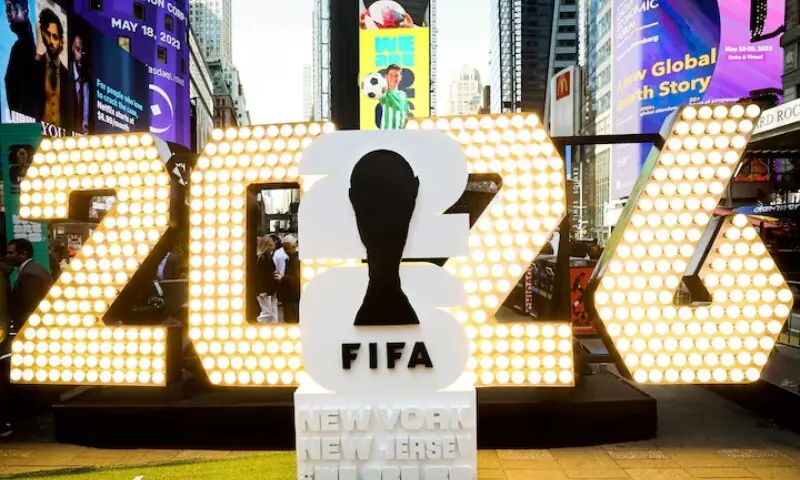


NEW DELHI: Millions of football fans in the world’s two most populous nations may not be able to watch the World Cup that starts next month, due to a deadlock over broadcast rights in India and no official decision in China.
In India, a Reliance-Disney joint venture has offered $20 million for 2026 World Cup broadcast rights, a fraction of FIFA’s ask, which was not acceptable to football’s global governing body, two sources told Reuters on Monday. Sony held talks but also decided not to make an offer for FIFA rights for India, a third source with direct knowledge said.
There has also been no deal announcement for China, which FIFA says accounted for 49.8pc of all hours of viewing on digital and social platforms globally during the 2022 World Cup.
FIFA has concluded agreements with broadcasters in over 175 territories globally, it said in a statement to Reuters.
“Discussions in China and India regarding the sale of media rights for the FIFA World Cup 2026 are ongoing and must remain confidential at this stage,” the statement said.
Reliance-Disney, a joint venture led by billionaire Mukesh Ambani’s Reliance, did not respond to requests for comment, and neither did Sony.
The lack of a confirmed broadcast agreement with India or China is unusual at this stage.
In past World Cups, including 2018 and 2022, Chinese state broadcaster CCTV secured the rights well in advance and began airing promotional content and sponsor-driven advertisements weeks before the tournament.
CCTV, which has extensive reach across television and digital platforms, did not immediately return a request for comment.
China accounted for 17.7pc and India 2.9pc of the global linear TV reach of the 2022 tournament. The two countries together accounted for 22.6pc of total global digital streaming reach for that World Cup.
The 2026 tournament kicks off on June 11, leaving barely five weeks for a deal to be finalised, broadcast infrastructure to be set up and advertising inventory to be sold.
For India, FIFA initially sought $100 million for broadcast rights for the 2026 and 2030 World Cups, the sources said, declining to be named because the talks are private.
When the World Cup last aired in India in 2022, Reliance’s then-standalone media arm secured the rights for about $60 million, which was announced around 14 months before the event in Qatar. “FIFA is looking for a similar amount for this edition of the tournament,” a FIFA source told Reuters.
Reliance and Disney have since formed a joint venture to emerge as a dominant force in India’s media and streaming landscape, and the $20 million FIFA offer underscores the negotiating power the Indian group commands.
FIFA had significantly lowered its ask from the $100 million earlier, but has not been keen on the $20 million figure Reliance offered, one source said.
Reliance-Disney, which has spent billions on cricket broadcast rights, believes the World Cup will have lower viewership in India as the tournament is being held in the United States, Canada and Mexico, and most matches will air past midnight in India, the sources said.
China has around 200 million soccer fans, more than any other country, but has failed to build world-class teams, partly due to a top-down approach where clubs pick players from a very small pool of pre-screened candidates.
The second source added that football does not command the commercial premium in India like its most popular sport cricket, and an advertising slowdown linked to the Iranian war has further eroded revenue expectations.
“Football is a niche segment in India,” said the source.
Sony, which has TV channels and a streaming app in India, also decided not to purchase broadcast rights from FIFA as it did not make economic sense for the group, said the third industry source.
“Not much time is left but I won’t call it a stalemate. It’s more like we are at the end of a chess game with a couple of moves left,” said Rohit Potphode, managing partner for sports at advertising agency Dentsu India.
Published in Dawn, May 5th, 2026