The introduction of the subject Artificial Intelligence was new at Hannah’s school. It was a subject that interested almost all the children, and everyone wanted to learn more about it.
Her teacher had told them in class that in the coming years, robots would take over many human roles. From that lesson until she reached home, Hannah kept thinking about everything related to AI — robots, gadgets and technology. That night, after brushing her teeth, she slipped into bed and soon dozed off.
After a while, there was loud banging on her door. She was startled. How could someone knock like that? She slowly walked towards it and found a robot standing there. It grabbed her hand and dragged her out of her room. She was dumbfounded to see a female robot sitting in the lounge. Hannah was then pushed out of the house and the main door slammed shut behind her. Hanna found herself homeless, forced out of her own house.
Trying to understand what had happened, she gathered herself and rang the bell. This time, the door slid open. Standing puzzled and confused, she peeked inside. It was the same house, but it no longer felt like her home. She couldn’t see her family members anywhere. There wasn’t a single human being. She wondered, “Why are robots roaming freely everywhere? Where have my parents and siblings gone?”
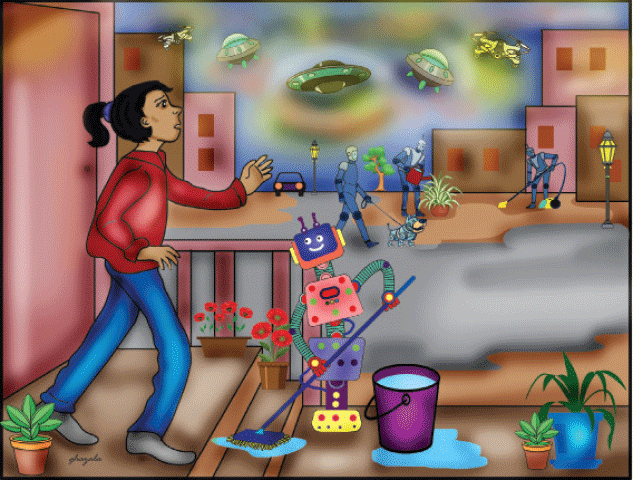
She quietly slipped inside and hid behind a curtain to observe what was going on. She looked at the wall where their LED TV once hung; instead, there was a huge screen, and two robots were moving around, performing household tasks. Hannah noticed that the robots were functioning like a family.
She then looked out of the window and saw robots walking on the road. Strange flying objects hovered in the air, and there was not a single human in sight. It was terrifying. There was no sign of human life — only machines everywhere. A growing sense of dread made Hannah breathless, and she began to cry. But she quickly realised this was not the time to panic; it was time to act.
She needed a practical way to disrupt the robots without being noticed. Crawling quietly, she reached the small control panel near the kitchen, where the fire alarm switch was located for emergencies. Taking a deep breath, she triggered the system. Within seconds, the ceiling sprinklers burst open, spraying water all over the room. The robots began to spark and malfunction as the water hit their circuits.
For the first time since it all began, Hannah felt she might actually have a chance to understand what was happening.
Her plan worked and she watched the robots malfunction one by one. But when she looked into the garden, the robots outside were still busy with their tasks, unaffected. She was about to trigger the system again when she heard her brother yelling her name.
Hannah opened her eyes and found herself lying in her bed. She realised she had entered a city of machines in her dream. It was nothing more than a haunting nightmare. Unreal, yet vivid. Still shaken, she lay awake, wondering whether the robots were simply a product of her subconscious or whether things could truly turn sinister in the coming years, with human roles taken over by robots and AI.
Once, we believed digitisation and robots were meant only to help us. But for Hannah, they turned into a frightening vision. Her dream is something each of us should reflect upon. Our growing dependence on Meta AI and other AI tools may leave us lagging behind in important ways. School children, in particular, are becoming heavy users, which may affect their creativity and critical thinking over time.
Now is the time to think deeply about this before it is too late. Think. Reflect.
Published in Dawn, Young World, December 20th, 2025