India’s ‘new normal’ doctrine destabilises nuclear South Asia: CISS
• Think tank says the narrative attempts to justify unilateral strikes
• Terms Western belief in India as a counter to China flawed
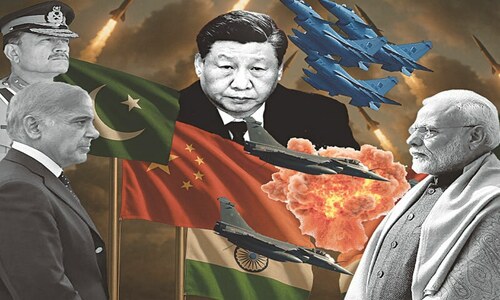
ISLAMABAD: An Islamabad-based think tank on Sunday warned that India’s “new normal” military doctrine is a destabilising force in nuclear-armed South Asia, saying New Delhi’s posture risks triggering a serious escalation in any future crisis.
The assessment from the Centre for International Strategic Studies (CISS) came during a dialogue with Australian scholars and officials, the research institute said in a media statement.
Delegates from CISS argued that India’s narrative of a “New Normal” aims to normalise escalatory actions and justify unilateral military strikes under the guise of counterterrorism.
The security doctrine, central to India’s policy since 2019 and reasserted this year, signals a shift toward conventional military responses such as Operation Sindoor to alleged cross-border attacks, the think tank said.
The approach indicates India will not be constrained by Pakistan’s nuclear deterrent, a stance that directly challenges the region’s long-standing nuclear balance, according to the CISS assessment.
Risk of miscalculation
“Institutionalising assured military retaliation in a nuclearised region is inherently destabilising,” the CISS mentioned. The think tank argued that by leveraging its conventional military advantage for limited war strategies, New Delhi raises the risk of miscalculation.
Pakistani scholars at the dialogue questioned India’s logic of blaming Pakistan for every violent incident while facing more than two dozen separatist and insurgent movements on its own territory. Using such claims as a pretext for military strikes undermines crisis stability, they maintained.
The delegation said Pakistan’s true new normal “Full Spectrum Deterrence” continues to restrain India. They noted that Pakistan would be prepared to deliver a “Quid Pro Quo Plus” response to any future Indian military action, as it did during a confrontation in May 2025.
CISS also contended that Western support for India’s military modernisation is based on a flawed assumption that New Delhi will serve mainly as a counterweight to China. The think tank argued India’s enhanced capabilities remain largely directed toward Pakistan.
Australian experts, in turn, outlined their country’s rationale for joining alliances like AUKUS and the Quad.
The Australian delegation stressed that AUKUS is a trilateral partnership and there are no plans for expansion. While policy debates occasionally reference possible future members such as Norway, South Korea, Canada or India, they said such prospects remain limited. They also emphasised that the alliance adheres to nonproliferation standards fully aligned with IAEA safeguards.
Participants included Justin Burke of the Australian National University’s National Security College; Mike Hughes of the Australian Strategic Policy Institute; officials from the Australian High Commission in Islamabad; and CISS Executive Director Ali Sarwar Naqvi.
Published in Dawn, December 8th, 2025