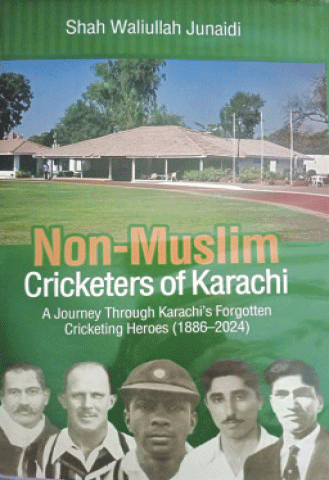
Non-Muslim Cricketers of Karachi
By Shah Waliullah Junaidi
Published by Shah Muhammad Hamza
ISBN: 978-969-23431-3-8
103pp.
Books on the non-contemporary history of Pakistan cricket are notoriously hard to find — especially ones rich in history and detail. Shah Waliullah Junaidi’s Non-Muslim Cricketers of Karachi stands out as a rare, carefully researched chronicle and a genuine treat for anyone interested in Karachi, its cricketing heartbeat, and the sport’s evolution in the region.
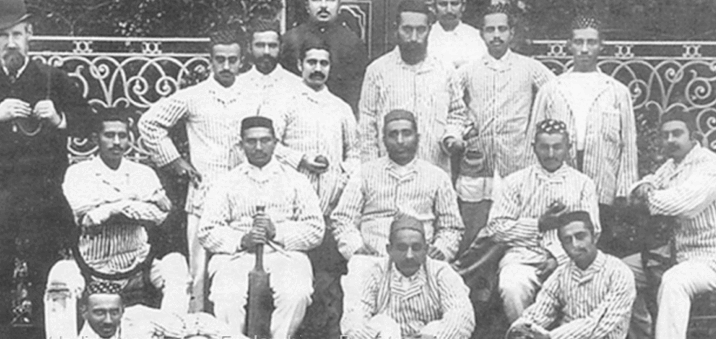
Karachi may not dominate Pakistan’s national squads the way it once did, but its influence on the country’s cricketing identity remains unmistakable. Junaidi notes that the city’s first cricket club — the Oriental Cricket Club — was formed in 1848. Yet he begins his main narrative in 1886, when an all-Parsi Indian team, including several Karachi players, toured England. From there, he traces cricket’s journey through to 2024, reviving the memory of the administrators, coaches and cross-community players who helped Karachi’s cricket culture take root.
The book is organised into sections such as ‘Parsi Pioneers’, ‘Karachi’s Christian Cricketers’, ‘British Officers and the Europeans Team’ and ‘Karachi’s Hindu Cricketers’, followed by chapters on Jewish, Sikh and Ahmadi players. Together, these stories show how cricketers from different communities helped shape Pakistan into an emerging Test nation.
Junaidi also documents the historical grounds that opened the game to all, while paying tribute to the individuals who nurtured it. His research preserves a diverse sporting heritage that might otherwise have faded away.
A recent book is a long-overdue celebration of Karachi’s Non-Muslim cricketers and their enduring imprint on Pakistan’s cricketing story
The narrative recalls Karachi’s first inter-communal tournament in 1916, featuring Parsis, Hindus, Muslims and Christians — a format expanded in 1922 with the addition of Europeans. It also reminds readers that United India’s first Test opener, Naoomal Jeoomal, was from Karachi, as were Gulabrai Ramchand — the 12th Indian Test captain — and Anthony DeMello, regarded as one of the founding fathers of Indian cricket.
The book offers plenty of archival surprises. English Test cricketer Reg Simpson made his first-class debut in post-war Karachi and later scored a century against Pakistan in 1954. Similar gems appear throughout: Karachi-born cricketers, club players and visiting professionals who contributed, in one way or another, to Pakistan’s rise as a respected Test nation.
The Parsi community emerges as a particularly influential force. The first Indian team to tour England in 1886 was an all-Parsi team that included Karachi players Pestonji Dinshaw Dastur, Dinshaw D. Khambatta and Burorji P. Balla. The book also notes that Rusi Dinshaw was an integral part of Pakistan’s unofficial tests before it got Test status, and even toured India with the inaugural Test squad but did not receive a cap. He is the only Parsi to have ever been selected for a Pakistan Test squad, which is no small achievement.
The anecdotes continue: Jimmy Irani — father of England’s Ronnie Irani — played for the Karachi Parsi Institute; Hockey Olympian Peter Paul Fernandes represented Sindh in cricket’s Ranji Trophy before winning a hockey gold for India in 1936; and both the wicketkeeper behind Sir Don Bradman and the bowler who delivered the ball that brought up his 100th hundred were Karachiites. All-rounder Jack Britto left cricket for Olympic hockey, while Karachi-born Test pacer Antao D’Souza famously dismissed Geoff Boycott in both innings of his first-class debut.
Still, the book isn’t without flaws. At times, the tone slips into a casual, magazine-like style rather than the steadier voice expected of a cricket historian. A few omissions stand out — such as mentioning Indian first-class cricketer Pravin Hansraj without naming his son, actor-director Jugal Hansraj, or referencing British naval officer Phillip Herman Bonham-Carter without explaining his relevance, which is that he was born in Karachi. These are the kinds of gaps a thorough editorial pass or even basic proofreading could have fixed.
Junaidi, however, gives thoughtful attention to Pakistan’s own non-Muslim Test players, including Anil Dalpat, Danish Kaneria, Antao D’Souza and Wallis Mathias — one of the finest fielders of his generation. He revisits the careers of Pananmal Punjabi and Gulabrai Ramchand, the former ending his Test journey in Karachi and the latter taking six wickets in an innings there before eventually captaining India. He also honours Naoomal Jeoomal who, despite representing India, remained in Pakistan until the 1970s and quietly mentored the next generation of players. Pakistan’s only Jewish first-class cricketer, Isaac Solomon, moved to Israel after its creation.
Adding birth-and-death years for each player would have streamlined the book further and created space for more context. Thankfully, rare passport-sized black-and-white photographs and memorable side-stories — such as Maneck P. Dastur’s tragic death hours after playing against the MCC, and the resilience of Bras Agapito Lucas D’Cunha, who overcame both polio and a snake bite — help keep the narrative lively.
The book also pays tribute to Dawn’s legendary sports correspondent Ian Fyfe and statistician Ben Lawrence — Pakistan’s answer to Bill Frindall — both central to Karachi’s cricketing structure until they died in 2005 and 2020, respectively. Even I, having shared the press box with Ian Fyfe, did not know he had been one of Karachi’s leading left-arm spinners and a playing coach for the Karachi Goan Association. Junaidi also highlights the work of Claude Blake Rubie, whose Rubie Shield tournament produced countless young talents, including Hanif Mohammad.
One structural issue remains: the chapters on Jewish, Sikh, and Ahmadi cricketers could have been combined, thereby saving space for more recent or colour photographs of players who are still alive or recently departed. Similarly, statistics for each player at the end could have benefitted readers, since it’s a norm in sports books.
Ultimately, Non-Muslim Cricketers of Karachi is a timely reminder of the city’s pluralistic sporting heritage — vibrant, complex, and deeply woven into Pakistan’s cricketing story. It preserves, with clarity and care, a chapter of history that has long deserved the spotlight.
The reviewer is a broadcast journalist who also writes on sports, film, television and popular culture
Published in Dawn, Books & Authors, December 7th, 2025