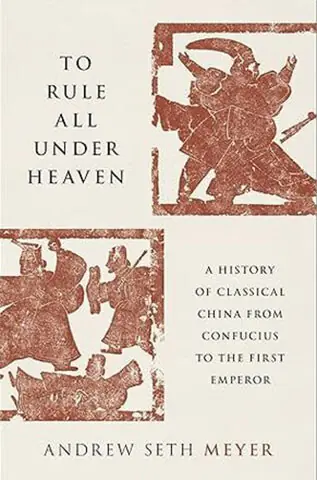
To Rule all Under Heaven: A History of Classical China from Confucius to the First Emperor By Andrew Seth Meyer
Oxford University Press
ISBN: 978-0-19-766748-4
555 + XXVpp.
Andrew Seth Meyer’s To Rule All Under Heaven: A History of Classical China from Confucius to the First Emperor brilliantly tells the story of the four revolutions that transformed the chaotic aristocratic polity of the Zhou Dynasty (1045 BCE–256 BCE) into the centralised, bureaucratic, dirigiste regime that became synonymous with how we think about China.
These revolutions were political, intellectual, social and administrative, and operated concurrently during the long decline and fall of the Zhou Dynasty, which reached its climax during the Warring States period (475 BCE–221 BCE). Amidst these upheavals, a civilisation was reforged.
The political revolution is the easiest to grasp. At the founding of the Zhou Dynasty, the ruling house appointed its relatives to rule different regions. This imperial nepotism was grounded in the belief that regional overlords, being related to the ruling house, would create a natural concordance. Instead, the opposite happened, as the ruling family lost most of its authority and became a figurehead, used by powerful satraps in their machinations.
It was clear to many of the ducal houses within the Zhou confederation that they, not the king, called the shots. As the tenuous bonds of ritual, devotion and familial loyalty came under increasing pressure and regional lords jockeyed for position, a centuries-long conflict was ignited that would ultimately end with the state of Qin conquering everyone else and creating a unified state.
The real transformation of China began more than two millennia ago. Now a remarkable, deeply researched work of extraordinary insight brings this early history to life and offers powerful lessons that the world today ought to heed
The intellectual revolution was, arguably, more important than the political. The Zhou domain could have permanently fragmented into petty states and remained mired in withering anarchy and warlordism. That this didn’t happen, Meyer explains, was because of the role of ideas and the way in which different great humanistic thinkers — such as Confucius (551 BCE–479 BCE), Mo Di (470 BCE–391 BCE), Hui Shi (380 BCE–310 BCE), Mencius (372 BCE–289 BCE) and hundreds of lesser-known figures — reimagined how the state and society ought to reconstitute themselves.
In this transformation, three key practices emerged that shaped intellectual and cultural life. A substantial proportion of the aristocratic class and wealthy commoners embraced the new learning, which often emphasised loyalty to the state and legitimacy gained through competence.
This brings us to the social revolution that unfolded during this time. As competition between regional states became more prolonged and attritional, aristocratic norms of warfare were abandoned in favour of armies recruited on a massive scale from the peasantry. Richly adorned aristocrats, with their displays of individual brilliance, gave way to a peasant-soldier class, officered and provisioned along professional lines.
The violence and dislocation wrought by endless warfare led to many elite clans falling into relative poverty and becoming warriors for hire (knights) willing to serve anyone who would employ them. States steadily seized the lands and ancestral holdings of lesser aristocrats to make room for more farms and peasants to produce more soldiers and larger retinues for their ruling families. Many scions of decaying aristocratic clans turned towards seeking prestige through learning and becoming serious disciples of notable thinkers.
The birth of an intelligentsia organised into competitive schools of thought, where rigorous scholarship was prized, set the stage for the fourth, and arguably the greatest, revolution. This was the birth of meritocracy and the emergence of good bureaucracy as a civilisational ideal.
As military and political competition intensified, intellectual ferment pervaded the realm and social upheaval rewrote the rules of engagement amongst classes. Several leaders hit upon the same idea within a few decades of each other. This idea was that government should be entrusted to those most capable and that merit was a function of academic learning and scholarship, not birth or wealth.
These officials, or civil servants, would be more loyal to the ruler than entitled aristocrats or even the ruler’s own relatives and, being highly educated, would be able to solve problems of governance.
Meyer takes us through how this process played out in different Warring States, but the remarkable conclusion that many of them embraced was that the quality of the state was primarily the function of the quality of its bureaucracy. A good bureaucracy was the foundation of a great state. A wise ruler was one who exercised general superintendence and cultivated a good bureaucracy that could govern the state efficiently and justly, with minimal intrusion by courtiers and the dynasty.
Meyer shows that, during this struggle, many states had embraced the meritocratic revolution and reformed themselves. Consequently, when the Qin Dynasty unified the realm, their systematisation of language, administration, measurements and laws was built upon a rich heritage of reform. And, while the Qin Dynasty proved short-lived, being overthrown by the Han Dynasty (202 BCE – 220 CE), the changes made gave the Chinese civilisation its defining characteristics.
Meyer’s work is extraordinarily rich in its narrative detail and serves as an effective introduction to a host of Chinese thinkers and leaders who aren’t familiar to non-specialists. This is a great service because it helps excavate the diversity of perspectives that went into China’s transformation.
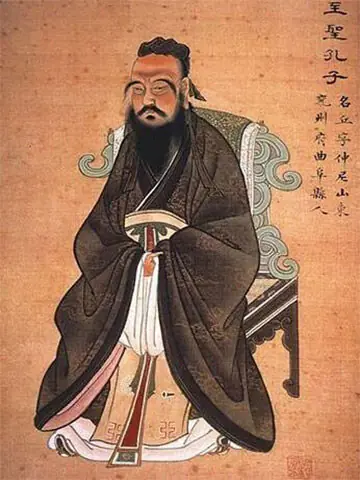
To Rule All Under Heaven also offers powerful lessons that the world today ought to heed. One of these is that learning and expertise matter and that a wise ruler is one who seeks out those who are knowledgeable. Meyer uses Confucius’ life as an example of this. Confucius wandered from one place to another with his small group of disciples, offering to educate courtiers and rulers in his philosophy of humaneness, reason, compassion and respect for learning. Everywhere he went, he was laughed out of the room.
On one occasion, Confucius became seriously ill, fell unconscious and had to be carried in a litter by his disciples. One of his disciples, Zilu (540 BCE–480 BCE), organised the others into a retinue, and they collectively pretended to be carrying a great aristocrat. When Confucius recovered and regained consciousness, he remarked, “It has been a while that Zilu has been shamming, has it not? In acting as if I have retainers when I have none, whom have we fooled?”
But Confucius had set out to change how people think about the world and, today, an entire civilisation bears his stamp. In the short run, power trumps wisdom. In the long run, wisdom trumps power. A wise ruling class understands this and cultivates learning; a foolish one does not.
Another lesson is that societies that can draw upon a heritage characterised by idealisation of public service, respect for learning and meritocracy are more likely to build successful states. The divergent trajectories of modern India and China are a case in point. China has deep traditions of meritocracy and strong state-centric public service ethos and thus, while being autocratic, has far more responsive governance than India.
In India, meritocracy is a colonial intervention and Indian social norms and expectations seek to subvert merit at nearly every turn. Consequently, the democratically elected leaders of India do less good for their own people than China’s one-party state does for its people. To build a good democracy or a good autocracy, you need administrative meritocracy and a public service ethos. Otherwise, you just end up with bad government.
Meyer’s To Rule All Under Heaven is a remarkable work that brings the centuries before China’s unification to life. It is deeply researched and written with extraordinary insight and a profound empathy for its subject. It is also accessible to a general readership, while the maps, timeline and notes offer solid additional guidance to anyone looking to understand the mainspring of Chinese civilisation.
The reviewer is Professor of History at Quaid-i-Azam University, Islamabad and, most recently, the author of New World Empires: Cultures of Power and Governance in the Americas. X: @IlhanNiaz
Published in Dawn, Books & Authors, July 26th, 2026