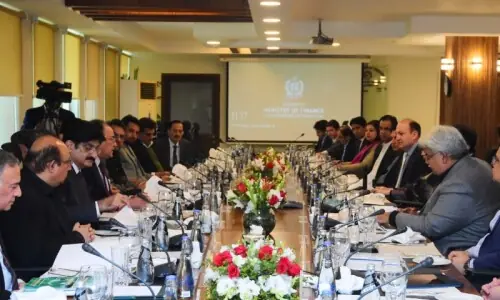
THREE key takeaways have emerged from the inaugural NFC discussions on the 11th Award. First, the federal government has pitched an ambitious revenue mobilisation plan, proposing to raise consolidated revenues by over 5pc of GDP over the next three years.
The FBR will boost its tax collection by 3-3.5 percentage points to increase the tax-to-GDP ratio to 13pc, while the provinces are expected to enhance their share from the existing 0.28pc to 3pc of GDP through effective taxation on services, property and farm income.
Secondly, the provinces declined to share their expenditure details on legal and technical grounds. Sindh rightly pointed out that the commission is a forum to discuss and decide formulae for dividing tax resources vertically between the centre and provinces, and horizontally among the provinces, and not to dictate how the federating units should spend their money.
By implication, they have indicated their opposition to the centre’s reported proposal that the provinces should share expenses on BISP and HEC.
Third, the meeting took up KP’s demand for an additional share from the federal divisible pool in view of increased fiscal needs after the Fata merger. A working group was formed to study the impact of the merger on the provincial budget and address additional fiscal needs under the NFC Award.
Though there was no talk of reducing provincial shares from the divisible pool, the government took the opportunity to highlight the fiscal squeeze it has been facing since the finalisation of the seventh NFC Award that significantly reduced its own share some 15 years ago. It was pointed out that the average annual federal fiscal deficit had risen from the previous 4pc to nearly 7pc since 2011 due to the fiscal squeeze.
That said, the talks on the 11th Award have opened at a politically charged moment amid attempts by the centre to undo the constitutional protection given to the existing provincial share under the NFC Award, and reclaim federal control over population and education through the 27th Amendment. In fact, the government has long been trying to, unsuccessfully, reclaim what it ceded to the provinces under the seventh Award.
Meanwhile, it resorted to indirect taxation, including various levies such as on petroleum products and gas outside the divisible pool to avoid sharing these revenues with the federating units. The numbers, however, show that these additional revenues are insufficient for the centre to meet its growing expenditures and now it wants to boost revenues through the divisible pool itself by increasing the federal share or transferring major expenditures to the provinces.
Although the maiden NFC meeting took place in a cordial atmosphere, there is no guarantee that the centre will refrain from attempting to slash the provincial share or, alternatively, impose new expenditures on the provinces as talks move forward.
Published in Dawn, December 6th, 2025