France to increase nuclear warheads, work with allies to protect Europe
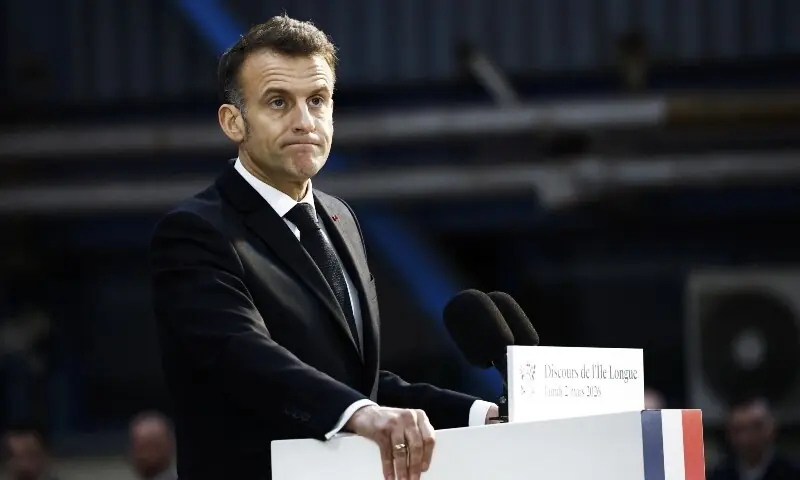


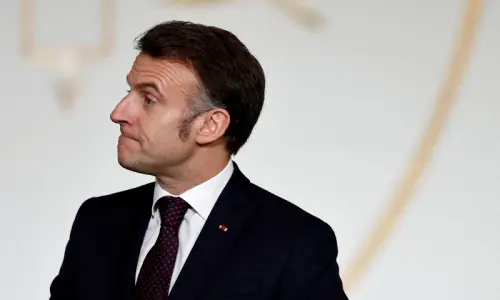
President Emmanuel Macron said on Monday that France would increase the number of its nuclear warheads and cooperate with eight European countries to help protect the continent as the clock ticks on his presidency.
His speech at France’s Ile Longue nuclear submarine base came after US and Israeli attacks against Iran in a campaign that risks destabilising the Middle East.
Macron updated France’s nuclear doctrine as Russia’s war against Ukraine grinds into a fifth year and Nato allies worry about Washington’s wavering commitment to Europe.
“We must strengthen our nuclear deterrent in the face of multiple threats, and we must consider our deterrence strategy deep within the European continent, with full respect for our sovereignty,” Macron said.
He announced “the gradual implementation of what I would call advanced deterrence”.
Macron announced a series of concrete measures in a bid to bolster Europe’s security as France’s allies are concerned that a possible win by the eurosceptic far-right National Rally party of Marine Le Pen in next year’s presidential election could undermine cooperation in Europe.
“An upgrade of our arsenal is essential,” Macron said. “That’s why I ordered an increase in the number of nuclear warheads in our arsenal.”
Macron added, however, France would no longer be disclosing details on its nuclear stockpile.
France maintains the world’s fourth-largest nuclear arsenal, estimated at around 290 warheads. Britain, which is no longer a member of the European Union, is the only other European nuclear power.
By contrast, the United States and Russia, the world’s two main atomic powers, have thousands of nuclear warheads each.
Eight countries
Since Macron’s last speech on nuclear deterrence in 2020, Paris has been in talks with countries including Germany and Poland over how France could use its atomic arsenal to bolster security.
On Monday, Macron said eight European countries had agreed to participate in the “advanced” nuclear deterrence scheme proposed by France, including Germany, Britain and Poland.
The countries — also including the Netherlands, Belgium, Greece, Sweden and Denmark — will be able to host French “strategic air forces”, which will be able to “spread out across the European continent” to “complicate the calculations of our adversaries,” he said.
The scheme could also involve “the conventional participation of allied forces in our nuclear activities,” such as recent military exercises in which British forces have been involved, Macron added.
Macron also warned that a widening war between the United States, Israel, and Iran risked spilling over to Europe’s borders.
The conflict, which began on Saturday, “brings and will continue to bring instability and a possible conflagration to our borders, with Iran’s nuclear and ballistic capabilities still intact”, he said.
Heloise Fayet of the French Institute of International Relations and Claudia Major of the German Marshall Fund of the United States warned that a common European deterrent would require a level of political integration that seems unrealistic in the near future.
Writing in Le Monde, they said Europe should develop a nuclear strategy “that is truly European and not a copy of the American model”.
“The first step is to stop delegating thinking on nuclear strategy to the United States,” said Fayet and Major. “The era of strategic complacency is over.”
The Ile Longue base is home to France’s four ballistic missile submarines — Le Triomphant, Le Temeraire, Le Vigilant and Le Terrible. At least one is permanently at sea to ensure nuclear deterrence.