Women powering Pakistan’s growth push: SBP chief
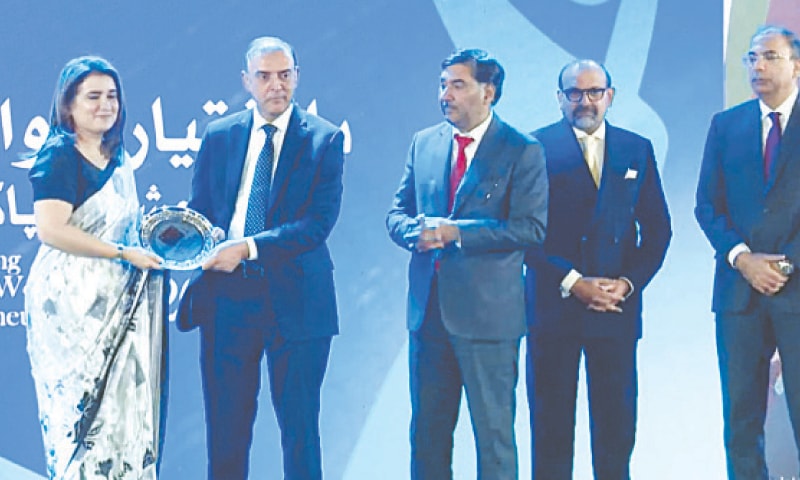

KARACHI: Including women is not a matter of fairness but a powerful driver of growth, State Bank of Pakistan (SBP) Governor Jameel Ahmad said at Pakistan Women Entrepreneurship Day 2025.
Women’s financial inclusion, he noted, has risen to 52 per cent. “We have succeeded in narrowing the gender gap from 47pc in 2018 to 30pc in 2025,” he added, with more than 17.6 million new women-owned bank accounts opened since 2021.
Between November 2024 and October 2025 alone, over 974,000 loans amounting to Rs230.3 billion were disbursed under the government’s push to expand women’s access to finance. Yet 93pc of these loans fall under microfinance, showing that most women remain concentrated in micro- and entry-level segments.
This gap between access and advancement is starkly visible in the entrepreneurial landscape as well. Only 1pc of enterprises are led by women, said Dr Zeelaf Munir, chairperson of the Pakistan Business Council. “And 92pc of women-owned enterprises remain informal, unseen, under-recognised, carrying the load, yet locked out of value,” she said.
“A bank account does not guarantee a market. A loan is not a promise of growth. True scale emerges when women step from working alone to becoming part of value chains that recognise their worth,” Dr Munir added.
She pointed to Artistic Milliners as an example: the company worked with women cotton farmers and introduced training, inputs and sustainable farming practices not as an add-on but as a strategic part of its sourcing model. The results were tangible: cotton yield rose by 4pc, fertiliser use dropped by 32pc, pesticide use fell by 22pc, irrigation hours declined by 13pc and overall farming costs fell by a third.
This is the kind of structural shift that underpins long-term competitiveness. Bangladesh didn’t transform its garment exports through factories alone; it transformed them by integrating women into the value chain at scale.
“When women earn, their families flourish, their children attend school regularly and their communities benefit,” Dr Munir highlighted.
TCS President Saira Awan Malik supported this point, noting that caregiving and childbearing responsibilities disproportionately fall on women, especially in more conservative societies like ours, where social expectations are heavier. Beyond these cultural norms, she said, women also face significant structural barriers, such as mobility constraints.
“Female participation should not be seen as a cultural threat or a challenge to social cohesion. Instead, it is a powerful force for both social good and economic progress,” Ms Malik said. Looking ahead, as part of the third edition of the National Financial Inclusion Strategy 2024-28, the government aims to raise overall financial inclusion to 75pc by 2028 and reduce the gender gap to 25pc, the SBP governor added.
Published in Dawn, December 4th, 2025