3
3

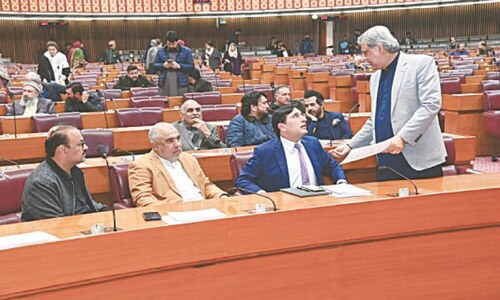
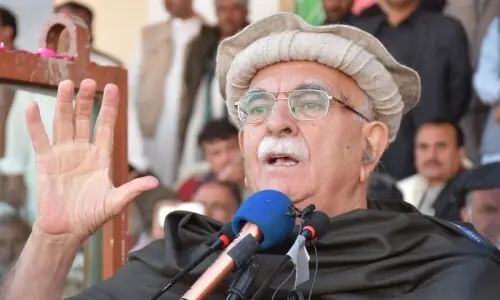
NATIONAL Assembly Speaker Ayaz Sadiq seems to have taken serious affront to combative remarks made by Pakhtunkhwa Milli Awami Party chief Mehmood Khan Achakzai, which the former criticised on Monday as “irresponsible and provocative”. To recap, Mr Achakzai is said to have made a statement challenging the proceedings of the House and suggesting they could be disrupted by public pressure.
As custodian of the House, Mr Sadiq responded sharply, asserting that “It is my responsibility to protect parliament”, and stating that “such thinking and statements must be collectively discouraged to ensure parliament’s supremacy, preservation of the constitutional system and protection of democratic traditions”, according to remarks paraphrased in a recent news report. Thankfully, the matter did not go beyond verbal sparring, and Mr Sadiq prudently blocked voting on a proposed resolution condemning Mr Achakzai’s statement and seeking his disqualification, though he allowed it to be read out.
Yet a broader question arises: is the sanctity of parliament something to be invoked only rhetorically, or is it ever to be upheld in practice as well? Consider, for example, the way the National Assembly is being run. After losing their erstwhile leader in August to a May 9 case, the opposition had collectively nominated Mr Achakzai as its representative leader in the House. Instead of honouring the nomination, however, Mr Sadiq has refused to notify Mr Achakzai as opposition leader, and on Monday quickly interrupted when Mr Achakzai was described as such, saying he, as Speaker of the House, did not recognise him in that capacity.
It does not behove the Speaker or his office to thwart the opposition in this manner. It has been widely speculated that certain quarters view Mr Achakzai as ‘undesirable’ for his political stance. The Speaker’s apparent acquiescence in this view does little to enhance the credibility of his office or the standing of parliament.
Consider also the manner in which parliament has legislated sweeping and far-reaching changes to Pakistan’s laws in recent years. Many would agree that there was very little that was dignified about the manner in which the 26th Amendment was passed. The same can be said for the 27th. When an institution repeatedly described as ‘supreme’ is perceived as playing more of a validating role, it can hardly expect the genuine respect its office-bearers demand for it.
The opposition, too, must reflect on its conduct. The main opposition party seems preoccupied with its jailed leader: its representatives show very little care for their responsibilities as public representatives and remain fixated on a single-point agenda. A parliament distracted by personal battles and narrow agendas cannot hope to command public respect. The people deserve a legislature that takes itself seriously. If our elected representatives expect dignity for parliament, they must first demonstrate it through their own actions.
Published in Dawn, December 3rd, 2025