Balochistan, AJK and GB challenge NFC based on population

• Maleeha Lodhi deplores drop in Pakistan’s HDI ranking
• Raza Rabbani highlights youth’s alienation from policymaking
• Sindh health minister claims provinces did not receive promised Rs10bn from federal government for population welfare services after devolution
ISLAMABAD: Differences of opinion surfaced among the federating units over the issue of high population growth in the country, as Balochistan, AJK and GB demanded an end to heavy allocations in the NFC award on the basis of population.
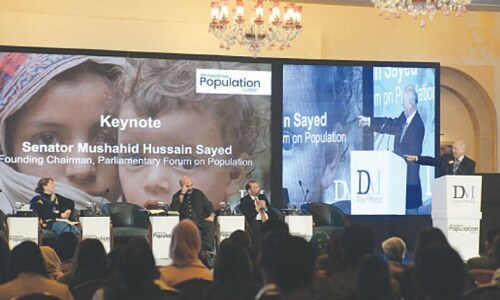
Continuing with the overall narrative of various speakers at the ‘Pakistan Population Summit 2025’ held here on Monday by DawnMedia that Pakistan needed a stronger political will to counter the overgrowing population, the session focused on the performances of provinces, as well as AJK and GB.
Speaking at their session, Dr Maleeha Lodhi and former Senator Raza Rabbani talked about the human development crisis in the wake of growing population in the country. They depicted a bleak picture of the future of the youth population in the country due to limited opportunities.
Dr Lodhi said that the deficit in human development rarely comes up in parliamentary debate, and the broader picture remains grim. She also referred to the latest Human Development Report of the UN Development Programme showing Pakistan’s ranking drop to 168 out of 198 countries.
Mr Rabbani highlighted that while youth are a significant part of the population, they are excluded from decision-making. “It was like a pressure cooker environment for them.”
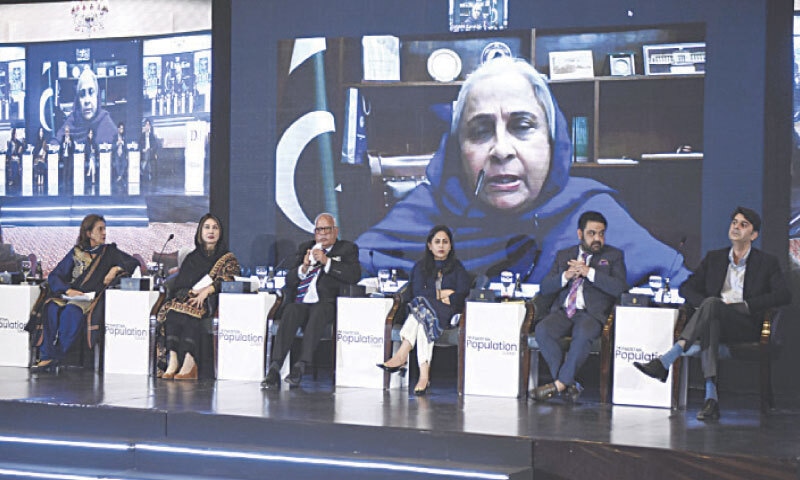
Meanwhile, speaking at the session titled ‘Centre-Province Coordination on Population’, Dr Malik Mukhtar Ahmed Bharath, minister of state for National Health Services, expressed dismay that the situation in Punjab has not changed since the time he was Punjab’s population minister and Shehbaz Sharif was the chief minister.
He criticised certain outcomes of the 18th Amendment, adding that segregation of the lady health workers programme and the population ministry was the “worst thing” that happened to the population management programme.
He added, “We are only addressing 60pc of the population of Punjab, while 40pc of the urban population is still being neglected because of the absence of the Lady Health Workers programme in the towns and cities.”
Former Gilgit-Baltistan lawmaker Javaid Ali Manwa noted that the population segment contributed 82.5 per cent to the National Finance Commission (NFC) award, while inverse population density made up 2.5 per cent.
“This was actually encouraging population growth and GB was a sufferer due to low population. These imbalances needed to be addressed in order for a national framework on tackling the population crisis,” Mr Manwa said.
He pointed out the “contradiction” that, on the one hand, there was a need to manage population growth, but on the other hand, the same factor was a contributor to how many resources a region gets.
Similar views were expressed by Raja Muhammad Razzaque, former secretary of Azad Jammu and Kashmir’s Population and Welfare Department, and Shakeel Qadir, chief secretary Balochistan.
“We have a scarce population spread over a very large area, but population welfare policies are formulated keeping in view the mainstream areas of the country,” Mr Qadir said.
Mr Qadir as well as Dr Aneela Mehfooz Durrani, secretary Population Welfare Department, Khyber Pakhtunkhwa, noted their provinces had traditional societies and acknowledged there were situations where population management was considered taboo, and women were not empowered enough to make decisions regarding it.
Both Balochistan and KP faced terrorism restricting the movement of officials and experts related to service delivery.
Contrary to this narrative, Sindh Minister for Health and Population Welfare Dr Azra Fazal Pechuho, addressing the summit via video link, noted that population management programmes have suffered after devolution, because the federal government had togiveRs10billion to the provinces for population welfare services, but that money did not come through.
She highlighted the achievements of Sindh in this regard and added that the province has ample stocks of contraceptives for one year, but sourcing stocks from India, specifically long-acting contraceptives, has been difficult due to worsening relations between the two countries.
She suggested that all commodities should be manufactured locally, as it will save foreign exchange as well as ensure availability of stocks.
Nadia Saquib, secretary of Health and Population Department, Punjab, underscored the importance of increasing the coverage of primary healthcare services, but there were various problems, such as absenteeism, healthcare professionals’ non-availability and disgruntled workers.
She detailed that the Punjab government had outsourced district hospitals and small clinics to doctors to address these issues.-
Published in Dawn, December 2nd, 2025