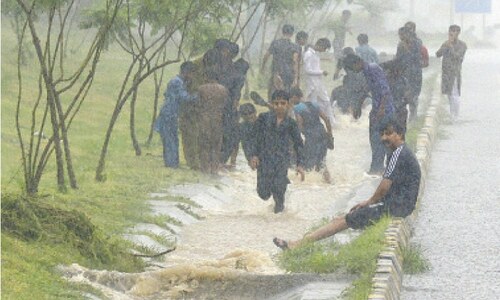
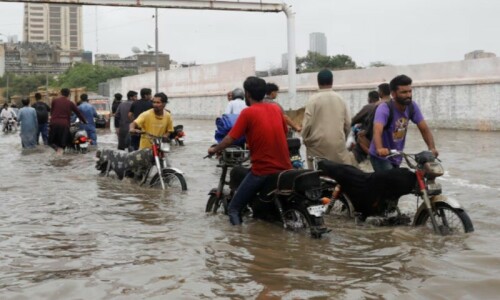
ALARM bells are ringing, and it is really hoped the government is listening. The NDMA has issued an earlier-than-usual monsoon warning, saying that Pakistan could face 22-26pc above-normal rainfall next year. The advisory reminds us how the country faces escalating climate extremes, where each year brings a new ‘record’ of loss and disruption.
After the devastation of 2022, caused by glacial melt and record monsoon rains, and the deadly 2024 floods, driven by stalled monsoon systems that unleashed days of downpour, the prospect of an even harsher season should trigger an immediate shift from reaction to readiness. The NDMA’s disclosure that 3.1m people had to be relocated to safety this year alone speaks to both the scale of the threat and the fragility of Pakistan’s disaster-management architecture.
Early warnings issued six to eight months in advance will hold little meaning if riverine encroachments still stand, drains stay clogged, and provincial administrations lack the capacity or will to enforce evacuation plans. Tourism restrictions in June and July signal prudence but they are by no means a substitute for resilient infrastructure, local-level preparedness, and coordination across the federation.
The prime minister’s directive to begin early preparations and immediately implement the Ministry of Climate Change’s short-term plan is welcome, but political urgency must be matched by administrative discipline. Pakistan has long suffered from a pattern in which plans are drafted, alerts are issued, meetings are convened and yet the same communities drown each year because enforcement collapses at the provincial and district levels. That pattern must break.
The proposed meeting of the National Water Council must be more than symbolic. It needs to address the questions of land use, river management, water governance, and resource allocation that successive governments have avoided. With climate-driven hazards intensifying, the margin for complacency has evaporated. We must act now to strengthen embankments before the rivers swell, pre-position relief supplies before roads wash out, and empower local disaster committees before the first cloudburst.
Urban centres too must prepare. Cities like Karachi, Lahore and Peshawar can no longer afford dysfunctional drainage, unchecked construction, and seasonal firefighting. The early warnings for 2026 offer the country an unusual gift: time. Squandering this opportunity would be unforgivable.
Published in Dawn, November 24th, 2025