3 key judicial bodies reconstituted in light of 27th Constitutional Amendment


As the dust settles after the passage of the 27th Amendment Constitutional Amendment, changes have been made to key constitutional and statutory judicial bodies.
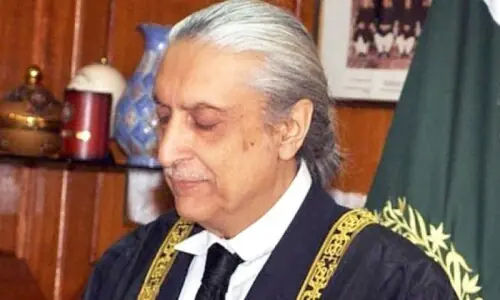
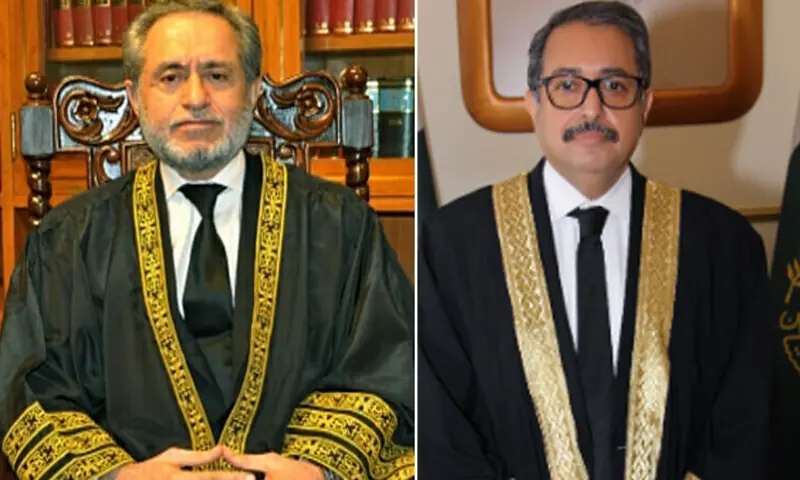
Following these changes, Supreme Court’s Justice Jamal Khan Mandokhail has been included in the Supreme Judicial Council (SJC) and the Practice and Procedure Committee while Federal Constitutional Court’s (FCC) Justice Aamer Farooq has been made a member of the Judicial Commission of Pakistan (JCP).
Among the three statutory bodies, the SJC is the the top forum for judicial accountability that probes allegations of misconduct against judges, the Practice and Procedure Committee forms benches and fixes cases, and the JCP is responsible for appointing judges to the superior judiciary.
Changes in their composition were required to synchronise them with the latest constitutional amendment.
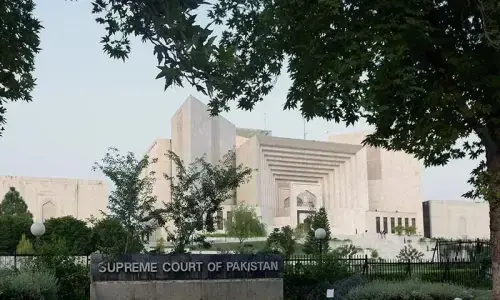
A Supreme Court (SC) press release issued on Tuesday said: “Pursuant to the 27th Constitutional Amendment, [these] key constitutional and statutory judicial bodies […] have been reconstituted in accordance with the revised constitutional framework.”
Elaborating on the changes in the bodies’ composition, the press release said that Justice Mandokahail, being the second-most senior judge of the SC, had been jointly nominated by Chief Justice of Pakistan (CJP) Yahya Afridi and FCC Chief Justice Aminuddin Khan as a member of the SJC.
Now, apart from Justice Mandokhail, the SJC will comprise the CJP, FCC CJ Aminuddin, Justice Munib Akhtar of the SC, Justice Syed Hassan Azhar Rizvi of the FCC, Lahore High Court (LHC) CJ Aalia Neelum and Islamabad High Court (IHC) CJ Sardar Muhammad Sarfraz Dogar.
According to the 27th Amendment, the SJC will be headed by the senior most judge between the CJP and FCC chief justice. The inter-se seniority in this case will be determined by the dates of their appointment as the chief justices of the SC and FCC. This means that CJP Yahya will continue to head the body.
The SC press release also added that the two judges had nominated Justice Mandokhail as a member of Practice and Procedure Committee.
Under the Supreme Court (Practice and Procedure), Act 2023, the three-judge committee will now comprise the CJP, Justice Akhtar and Justice Mandokhail, who has become the second-most senior judge following the resignation of Syed Mansoor Ali Shah.
According to the SC press release, Justice Farooq, the second most senior judge of the FCC, was jointly nominated by the chief justices of the SC and FCC as a member of the JCP.
Following this, the JCP will now comprise the CJP, FCC chief justice, Justice Akhtar, FCC’s Justice Syed Hassan Azhar Rizvi, Justice Aamer Farooq, Attorney General for Pakistan (AGP) Mansoor Usman Awan, Law Minister Azam Nazir Tarar, Pakistan Bar Council (PBC) representative Ahsan Bhoon, two members from the National Assembly, two members from the Senate and a woman or non-Muslim nominated by the National Assembly speaker.
“The reconstituted bodies will continue to play a central role in matters of accountability, judicial appointments, and procedural governance under the amended constitutional scheme,” the press release read.
The changes in the bodies’ composition come amid a restructuring of the judiciary following the enactment of the 27th Amendment.
The contentious amendment, which resulted in the establishment of the FCC, was passed by Parliament amid the opposition’s outcry. It has also been criticised by some legal experts as a means to dethroning the SS as the country’s highest judicial forum, ceding that position to the FCC.
Former and sitting judges, as well as lawyers, have also voiced opposition to the proposed amendment, particularly citing its implications for the Supreme Court.
Hours after the Amendment was enacted on November 13, two judges of the SC had resigned, citing their reservations against it. These two judges were Athar Minallah and Mansoor Ali Shah, who was the senior puisne judge of the SC at the time.
ICJ’s reservations
The International Commission of Jurists (ICJ) has also expressed concern over several main points of the Amendment, namely the formation of the FCC, the appointment of judges and chief justices to the SC and the FCC, the composition of the JCP, the transfer of high court judges and the immunities granted to the president and the military leadership.
“Before the amendment, the Supreme Court of Pakistan exercised the functions that have now been given to the FCC,” the (ICJ) statement issued on Nov 13 read. “Following the amendment, the Supreme Court will now effectively be an appellate court only in matters that do not involve the interpretation of the Constitution of Pakistan.”
The ICJ further noted that the first batch of FCC judges would be appointed by the president on the prime minister’s advice, with future judges being appointed on the recommendation of the JCP, while the chief justice would be appointed by a “special parliamentary committee”.
“The amendment does not provide any criteria on which the appointments will be made and does not require reasons to [be] given for the appointments, apart from general qualifications necessary to be considered a judge of the FCC,” the statement read.
“The appointments are also of concern as the [chief justice] of the FCC and the senior-most judge of the FCC will also be members of the Judicial Commission of Pakistan … and the Supreme Judicial Council,” it highlighted.