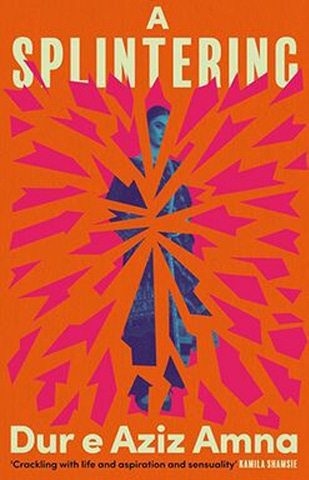
A Splintering
By Dur-e-Aziz Amna
Duckworth Books Ltd
ISBN: 978-071-5655894
275pp.
What’s incredible about Dur e Aziz Amna as a writer is her ability to keep the reader with her through the story.
Her debut novel, American Fever, which was about a sharp-witted Pakistani girl making sense of her school experience in America, is wildly different from her second novel, A Splintering, which is about an ambitious girl from Mazinagar who will go to any lengths to achieve her dream, no matter how big they are. I finished both books in a day, which shows her capacity to tell a captivating story.
Amna’s prose is crisp and clinically observed, sometimes to a fault. Some of her observations, while brilliant, feel like they could be her’s rather than the character’s and Tara, the protagonist, is such a powerful character that sometimes I wanted to stay with her in the text and feel her rage rather than being told about it or about concepts such as tradition and modernity.
Tara, the cleverest girl with the worst teeth, is trying to find her way out of a deeply difficult life with confusing values. There are elements of luck that help her carve her way out of poverty, and when luck isn’t with her, she forces its hand. She has no sympathy for those who suffer, yet she suffers with those she sees in pain. It’s a difficult place to be a woman in Pakistan and to live life on your own terms, and yet, as it is so delicately portrayed in the novel, even life lived on a woman’s terms is done with a man’s permission.
A sophomore novel about an ambitious and ruthless young woman trying to rise above poverty and confusing values captures womanhood perfectly
There are glimpses of the pseudonymous Italian novelist Elena Ferrante’s writing in the characters and their relationships, and I think the author may have benefitted with this story being expanded across a few novels. The story is compelling, but there are many threads, interesting threads, that could be expanded further to build Tara’s suffocating world.
There are certain interesting choices in terms of language as well, where the whole novel is written entirely in English, to the point that chanaas are referred to as “chickpeas and parathas” and the parents are referred to as Mother and Father, which is almost unexpected in South Asian literature, where Ami and Abu or, at the very least, some italicisation is part and parcel of the way we tell our stories.
The choice seems deliberate, even though we learn that Tara doesn’t speak much English. So the modern, clipped vernacular is an interesting choice for someone who probably would not be exposed to that language. Amna is a skilled writer, and this seems to be a deliberate choice, given what we know about Tara.
Amna also deftly gets across a very important reality of life in Pakistan: no matter how wealthy you are, there is always another layer of wealth to aspire to that secures you safety in a world rife with instability, whether it’s political or environmental. There are places where those elements could also have been drawn out, especially the environment, so that it was a part of the fabric of the story rather than a plot device that at certain points felt like deus ex machina. Had it been built into the beginning, it could have emerged more naturally from the text.
There’s also the question of confused values. Given Tara’s choices (especially in the second half of the novel, it begins to feel a little like Yorgos Lanthimos’ film Poor Things, but in a good way), one would think she had clarity about where she stood about God and life. But her ideas of love and belief in God are skewed, along with those of her family. This can be confusing at times, especially given the kind of decisions they make but, perhaps, that’s the beauty of it, that there are no easy answers. When you are faced with that kind of poverty, being sanctimonious and abiding by man-made rules will only get you so far.
At times, there are characters that seem more self-aware than I would expect, especially in terms of their own cruelty towards others, but I like the parallels Amna draws and the relationships that exist with each of the characters. It is a complicated web, especially since the person Tara tries to escape to get a better life, her brother Lateef, the person she faults for his scummy ways, is also someone she fears, hates and, in some ways, is like.
There’s unpredictability to her, a restlessness in the character as well as to the text, in the way we flit from one level of Tara’s social mobility to the next, and with each there are complications that open up while Tara’s dissatisfaction remains intact.
There were parts where I yearned to see more of her emotions or learn more about certain characters. Her father seemed almost non-existent in the story, to the point where I couldn’t believe that he must have once been an angry, violent man like his son, and there were characters who we didn’t see in any real interactions until much later in the text. But what I did appreciate was that all the men were shown in different shades as well; along with violence, there was love in the way they understood it, apathy and changing emotions.
Given that the whole narrative is from Tara’s perspective, I would have loved to have felt her feelings as well, especially since we are told about her love for her children and, at times, can feel it in her descriptions or can read her rage in the words she uses for people when she is sick of them or finds them weak. But given that we are in her character throughout, she feels almost disassociated from her body in a way that she herself does not realise. For that reason, at times, it was hard to believe that she was feeling the things she was feeling when she was saying them.
But what I do appreciate, more than anything, is the unflinching detail with which she presents her life. What’s most interesting about her is that, while she speaks about her aversion to the weak and rages at being treated badly by different people at different instances, or does things which would make you think that she either thinks she’s above any reprehension or is cold, she begins the novel by telling you that while she does not feel any nostalgia for the past and understands why she did the things she did, she also asks the reader not to judge her too harshly.
This is where Amna captures womanhood perfectly — our desire to live as we want, our belief that we are unaffected by those around us, but this is only possible through a certain level of disassociation or dissonance. Because, ultimately, how you show up, and who you are in the world, especially if you come from that kind of poverty, is determined by the people in power. And you need them to not judge you harshly, so you have a chance to survive.
This is a powerful book with a powerhouse of a character, by a wonderful writer with many more books inside her. Well worth a read.
The reviewer is a writer and editor based in Amsterdam. She is currently working on a collection of short stories and a novel
Published in Dawn, Books & Authors, November 16th, 2025