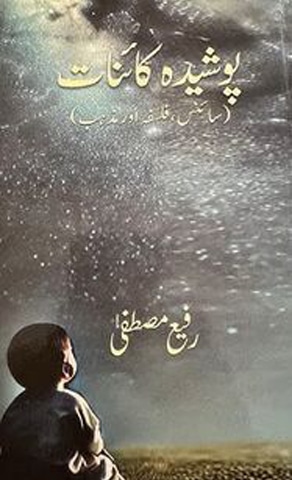
Posheeda Kainaat
(Science, Falsafa Aur Mazhab)
By Rafi Mustafa
Kohi Goth Publications
ISBN 9789692273329
376pp.
Who created the universe? Or is all this a random result of an accident? Where did the universe begin? Where will it end? Is there a God?
Definitive answers to such questions have haunted and eluded mankind forever. Religion became the comforting offshoot of this perplexing human quest to reconcile with the unknown. It provided solace and liberation from the complex oblivion.
Rafi Mustafa, the author of Posheeda Kainaat [The Hidden Universe], delves deep into the three distinct areas of knowledge that man employed to spearhead the search to address the above questions and determine the elusive ultimate truth.
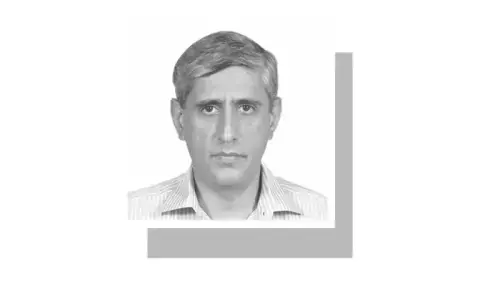
Mustafa holds a PhD in chemistry, studied at the University of British Columbia, and has taught at universities in Canada, Sudan and Pakistan. He is also a novelist. His novels include Tales from Birehra, Ae Tahayyur-i-Ishq and Ik Rasta Hai Zindagi.
In his introduction to the book, Mustafa says, “I have written this book for my dear friend Dr Khalid Sohail [a psychiatrist and prolific author] but you may also read it.” He adds, “He calls me a saint and himself a sinner. In retaliation, I call him the saint and myself a sinner… His journey is from Islam to atheism, while my journey is from atheism to Islam.”
A knowledgeable treatise written in chaste Urdu attempts to explore scientific, philosophical and religious ideas about the place of humans in the universe
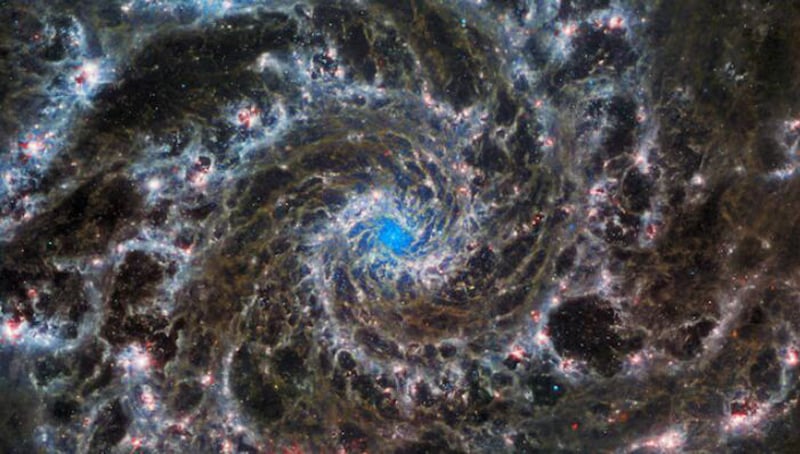
The first section of the book is an in-depth introduction to the entire range of natural sciences. It also probes into the mysteries of outer space and galaxies. To begin with, consider that the universe comprises billions of galaxies, and each galaxy contains billions of solar systems, including ours. Mustafa explains the mindboggling mathematics, physics and the light-years that keep the ever-expanding universe intact, among other dynamics.
He describes the history of science in the last 3,000 years, as well as the latest discoveries, for instance in the field of genetics. He illustrates the tools man invented to explore outer space and the darkest depths of the oceans, as well as the inner universe of cells and microbes, through the ever-evolving telescope and microscope.
You find ‘infinity’, ‘zero’ and the magic of numericals (including the inescapable mysterious figure of 1.618… called the Golden Ratio!), time and space, and the baffling light-years, defined and calculated with fascinating clarity. This section is a rich all-you-wanted-to-know about science in exceptionally eloquent Urdu.
Similarly, in the second section of the book, Mustafa offers the history of philosophy, theories and conclusions about man, his beginnings and his destiny, as perceived by the likes of Socrates, Plato, Aristotle and Al-Biruni, down to contemporary thinkers such as Einstein, Stephen Hawking and others, with diligence and lucidity.
In the third section of the book, Mustafa explores religion through the ages and its different manifestations — the primitive forms of religion, their history and evolution and the ambiguities, differences and similarities between various faiths over the millennia.
Then he compares the thought process of the religious approach of thinking with that of the scientific one, and how these two paths of exploration both sought to find the ultimate truth. The former provides answers first, while the latter begins with questions to find answers. He also discusses the question of whether science and religion are adversaries or allies. He explains how, beyond a point, they begin to converge.
How far has man’s quest for existential and spiritual answers been fulfilled? Surely, we have come a long way from believing that the earth is not round but rather a flat, straight surface. The component of supernatural and mythological explanations has shrunk, though the odyssey continues.
A school of thought holds that man has not been able to accept the reality that he is absolutely insignificant in the overall scheme of things. He goes through an extreme, multifaceted struggle to acquire some significance for himself, through science, philosophy, magic, spirituality and, above all, religion. He created omnipotent great deities and started restoring his own worth by association. Another school of thought believes that religion is a feeling we spend all our life in justifying, knowing very well that man has nothing to do with his own birth or existence.
Mustafa reminisces about his school days during the 1950s, when literary, cultural and ideological movements were at their peak. “It was a period of open-mindedness, when social values were undergoing profound changes. People, and particularly the youth, did not hesitate to talk with ideological and intellectual freedom. Terms like revolution, religion, atheism and communism were part of general discourse.” Things changed afterwards, according to him.
So, how much of the Posheeda Kainaat is revealed in this book? Plenty. Even though the reader may not find a wholesome closure, or conclusion of some kind for the elusive eternal questions mentioned above, as he might have hoped, Posheeda Kainaat is a treasure about the human knowledge attained thus far.
In addition to diagrams, five valuable annexures further add to the book’s value and make it a 101 of all human knowledge. It stands out as an uncommon objective treatise written in chaste Urdu, through three streams of knowledge: science, philosophy, and religion.
Perhaps, a fourth dimension, briefly referred to in the book, might offer some impetus to the struggle of finding the answers in the meantime — a poet’s perception! As Ghalib wrote:
Hai kahaa’n tamanna ka doosra qadam ya Rab
Hum ne dasht-i-imka’n ko aik naqsh-i-pa paya
[Where is the second step of longing, oh God?/ I found the expanse of possibilities, a mere single footprint to be].
The reviewer is a freelance writer and translator.
He can be reached at mehwer@yahoo.com
Published in Dawn, Books & Authors, November 16th, 2025